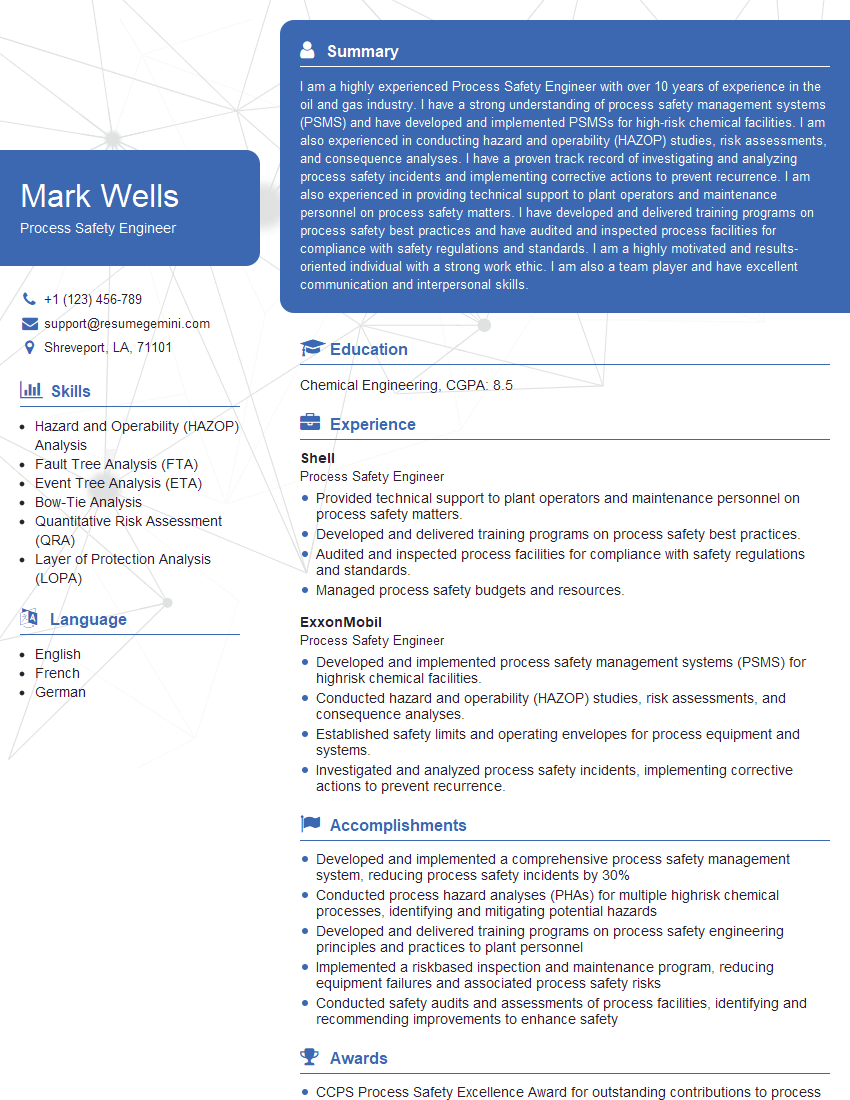
Are you gearing up for a career shift or aiming to ace your next interview? Look no further! We’ve curated a comprehensive guide to help you crack the interview for the coveted Process Safety Engineer position. From understanding the key responsibilities to mastering the most commonly asked questions, this blog has you covered. So, buckle up and let’s embark on this journey together
Acing the interview is crucial, but landing one requires a compelling resume that gets you noticed. Crafting a professional document that highlights your skills and experience is the first step toward interview success. ResumeGemini can help you build a standout resume that gets you called in for that dream job.






Essential Interview Questions For Process Safety Engineer
1. Describe the key principles of process safety management (PSM) and how they are applied in your work?
Process Safety Management (PSM) is a systematic approach to managing the risks associated with hazardous chemicals and processes. The key principles of PSM include:
- Management of change
- Process safety information
- Pre-startup safety review
- Mechanical integrity
- Hot work permit
- Training
- Audits and inspections
I apply these principles in my work by:
- Developing and implementing PSM programs
- Conducting process hazard analyses and risk assessments
- Recommending and implementing safety measures
- Auditing and inspecting processes and equipment
- Training employees on PSM
2. Explain the role of a process safety engineer in the design of a new chemical plant?
Project Initiation and Planning
- Participate in the project planning process
- Identify process hazards and develop mitigation measures
- Develop process safety management (PSM) program
Design and Construction
- Review process designs and equipment specifications
- Ensure compliance with relevant codes and standards
- Conduct safety audits and inspections
Commissioning and Start-up
- Participate in pre-startup safety review
- Monitor process start-up and operation
- Identify and address any safety issues
Operation and Maintenance
- Provide ongoing process safety support
- Respond to process upsets and emergencies
- Update PSM program as needed
3. What are the different types of process hazards, and how can they be mitigated?
The different types of process hazards include:
- Fire and explosion
- Toxic release
- Overpressure
- Mechanical failure
These hazards can be mitigated by using a variety of measures, including:
- Engineering controls (e.g., process interlocks, pressure relief valves)
- Administrative controls (e.g., operating procedures, training)
- Personal protective equipment (e.g., respirators, gloves)
4. What is a process hazard analysis (PHA), and what are the different types of PHAs?
A process hazard analysis (PHA) is a systematic review of a process to identify potential hazards and develop mitigation measures. The different types of PHAs include:
- Hazard and operability study (HAZOP)
- What-if analysis
- Failure mode and effects analysis (FMEA)
- Fault tree analysis (FTA)
- Event tree analysis (ETA)
5. What are the main elements of a safety instrumented system (SIS)?
The main elements of a safety instrumented system (SIS) include:
- Sensors
- Logic solver
- Final elements
SISs are designed to automatically take action to prevent or mitigate the consequences of a process hazard.
6. What are the key elements of a layered protection system (LPS)?
The key elements of a layered protection system (LPS) include:
- Inherent safety
- Passive protection
- Active protection
- Emergency response
LPSs are designed to provide multiple layers of protection to prevent or mitigate the consequences of a process hazard.
7. What are the different types of risk assessments, and how can they be used in process safety management?
The different types of risk assessments include:
- Quantitative risk assessment (QRA)
- Qualitative risk assessment (QRA)
- Bow-tie analysis
Risk assessments can be used in process safety management to:
- Identify hazards
- Estimate the likelihood and consequences of hazards
- Develop mitigation measures
- Make decisions about risk acceptance
8. What are the key elements of a process safety culture?
The key elements of a process safety culture include:
- Leadership commitment
- Employee involvement
- Communication and training
- Hazard identification and risk assessment
- Incident investigation and learning
- Continuous improvement
A strong process safety culture is essential for preventing process accidents and protecting workers, the public, and the environment.
9. What are the challenges associated with managing process safety in a complex and evolving industry?
The challenges associated with managing process safety in a complex and evolving industry include:
- The increasing use of new and complex technologies
- The globalization of the industry
- The changing regulatory landscape
- The need to balance safety with productivity
To meet these challenges, process safety engineers must be adaptable, innovative, and committed to continuous learning.
10. What are your strengths and weaknesses as a process safety engineer?
Strengths:
- Strong technical knowledge of process safety principles
- Experience in conducting process hazard analyses and risk assessments
- Ability to develop and implement safety measures
- Excellent communication and interpersonal skills
Weaknesses:
I am always looking for ways to improve my knowledge and skills. However, I am confident that my strengths far outweigh my weaknesses, and that I am well-qualified for this position.
Interviewers often ask about specific skills and experiences. With ResumeGemini‘s customizable templates, you can tailor your resume to showcase the skills most relevant to the position, making a powerful first impression. Also check out Resume Template specially tailored for Process Safety Engineer.
Career Expert Tips:
- Ace those interviews! Prepare effectively by reviewing the Top 50 Most Common Interview Questions on ResumeGemini.
- Navigate your job search with confidence! Explore a wide range of Career Tips on ResumeGemini. Learn about common challenges and recommendations to overcome them.
- Craft the perfect resume! Master the Art of Resume Writing with ResumeGemini’s guide. Showcase your unique qualifications and achievements effectively.
- Great Savings With New Year Deals and Discounts! In 2025, boost your job search and build your dream resume with ResumeGemini’s ATS optimized templates.
Researching the company and tailoring your answers is essential. Once you have a clear understanding of the Process Safety Engineer‘s requirements, you can use ResumeGemini to adjust your resume to perfectly match the job description.
Key Job Responsibilities
Process Safety Engineers play a critical role in ensuring the safety and reliability of industrial processes involving hazardous materials.
1. Risk Assessment and Management
Conduct comprehensive risk assessments to identify potential hazards and evaluate their likelihood and consequences.
- Develop risk mitigation strategies and safety protocols to minimize risks.
- Monitor and review safety systems and procedures for effectiveness.
2. Process Design and Review
Participate in the design and review of process systems, equipment, and facilities to ensure compliance with safety standards.
- Provide technical guidance on safety-related aspects of process design.
- Review and approve process safety documents, such as HAZOPs and safety analysis reports.
3. Safety Audits and Inspections
Conduct regular safety audits and inspections to identify hazards and assess compliance with safety regulations.
- Recommend corrective actions to address identified safety deficiencies.
- Participate in incident investigations and provide expert guidance on root cause analysis.
4. Training and Awareness
Develop and deliver training programs on process safety for employees and contractors.
- Promote a culture of safety awareness and responsibility.
- Stay abreast of industry best practices and advancements in process safety.
Interview Tips
Preparing thoroughly for your interview can significantly enhance your chances of success. Here are some helpful tips:
1. Research the Role and Company
Take the time to thoroughly research the specific Process Safety Engineer role and the company you are applying to.
- Review the job description carefully and identify the key responsibilities and qualifications.
- Visit the company’s website to learn about their business, values, and safety culture.
2. Quantify Your Experience
When describing your past experiences, it is essential to provide specific examples and quantify your accomplishments whenever possible.
- Use numbers and metrics to demonstrate the impact of your work on process safety.
- For example, instead of saying “I conducted risk assessments,” you could say “I conducted 50 comprehensive risk assessments, identifying over 100 potential hazards and developing mitigation strategies that reduced risks by 30%.”
3. Showcase Your Technical Knowledge
Process Safety Engineers must have a strong technical foundation. Be prepared to discuss your knowledge of:
- Hazard identification and risk assessment techniques.
- Process safety regulations and standards.
- Chemical process engineering principles.
- Safety system design and evaluation.
4. Emphasize Your Communication Skills
Process Safety Engineers must be able to effectively communicate with a variety of stakeholders, including engineers, managers, and regulators.
- Highlight your experience in presenting technical information to non-technical audiences.
- Provide examples of how you have successfully collaborated with cross-functional teams to achieve safety goals.
5. Be Enthusiastic and Professional
Your enthusiasm for process safety and your commitment to professionalism will make a positive impression on the interviewers.
- Be confident in your abilities and demonstrate a genuine passion for safety.
- Dress professionally and arrive on time for your interview.
Next Step:
Now that you’re armed with interview-winning answers and a deeper understanding of the Process Safety Engineer role, it’s time to take action! Does your resume accurately reflect your skills and experience for this position? If not, head over to ResumeGemini. Here, you’ll find all the tools and tips to craft a resume that gets noticed. Don’t let a weak resume hold you back from landing your dream job. Polish your resume, hit the “Build Your Resume” button, and watch your career take off! Remember, preparation is key, and ResumeGemini is your partner in interview success.