Are you gearing up for a career shift or aiming to ace your next interview? Look no further! We’ve curated a comprehensive guide to help you crack the interview for the coveted Property and Casualty Insurance Claims Examiner position. From understanding the key responsibilities to mastering the most commonly asked questions, this blog has you covered. So, buckle up and let’s embark on this journey together.
Acing the interview is crucial, but landing one requires a compelling resume that gets you noticed. Crafting a professional document that highlights your skills and experience is the first step toward interview success. ResumeGemini can help you build a standout resume that gets you called in for that dream job.






Essential Interview Questions For Property and Casualty Insurance Claims Examiner
1. Describe the process you would follow to investigate a homeowners insurance claim for a fire loss.
– Begin by gathering all necessary information, including the policy number, date of loss, and details of the damage. – Interview the policyholder, witnesses, and relevant parties to obtain a clear understanding of the incident. – Inspect the property to assess the damage, take photographs, and document the condition. – Determine the cause of loss and identify any factors that may affect the claim. – Review the policy to determine coverage and any limitations or exclusions that apply. – Calculate the amount of the loss based on the coverage and damages. – Prepare a claim report summarizing the investigation findings, damages, and recommended settlement amount.
2. How do you determine the value of damaged property for an insurance claim?
Replacement Cost Value (RCV)
- Estimate the cost to replace the property with new materials of similar quality.
- Consider factors such as labor costs, material prices, and local market conditions.
Actual Cash Value (ACV)
- Calculate the current market value of the property before the loss.
- Deduct depreciation for wear and tear and obsolescence.
3. Explain how you handle subrogation in property and casualty insurance claims.
– Investigate the claim to determine if a third party is liable for the loss. – Identify the responsible party and gather evidence to support the subrogation claim. – File a formal subrogation demand and negotiate with the third party’s insurer to recover the amount paid by the primary insurer. – Keep the policyholder informed throughout the process and ensure their interests are protected.
4. What are some common challenges you have encountered as a Property and Casualty Insurance Claims Examiner?
– Dealing with complex or catastrophic losses that involve extensive damage and multiple parties. – Determining liability in cases where multiple factors contribute to the loss. – Investigating fraudulent claims or exaggerated damage estimates. – Managing high caseloads and meeting deadlines while maintaining accuracy. – Negotiating settlements with policyholders, contractors, and other parties.
5. How do you stay up-to-date on changes in insurance regulations and industry best practices?
– Attend industry conferences and workshops. – Read insurance publications and online resources. – Stay connected with other professionals in the field through networking events. – Pursue continuing education courses or certifications. – Consult with legal counsel to ensure compliance with legal requirements.
6. Describe a situation where you had to handle a difficult or irate policyholder. How did you resolve the issue?
– Listen attentively to the policyholder’s concerns and try to understand their perspective. – Maintain a calm and professional demeanor. – Explain the claim process and any limitations or exclusions that apply. – Provide clear and detailed information about the claim investigation and settlement offer. – Be empathetic and show that you are genuinely concerned about their well-being.
7. How do you prioritize and manage your workload when handling multiple claims simultaneously?
– Establish clear deadlines and prioritize claims based on urgency. – Delegate tasks to team members when necessary. – Utilize technology and automation tools to streamline the claim process. – Communicate regularly with policyholders to keep them updated on the status of their claims. – Seek support from colleagues and supervisors when needed.
8. What is your understanding of the role of an insurance adjuster in the claims process?
– Investigate, evaluate, and settle claims. – Determine liability and coverage. – Estimate damages and recommend settlement amounts. – Negotiate with policyholders and third parties. – Provide customer service and support to policyholders. – Ensure compliance with insurance regulations and company policies.
9. How do you handle claims that involve specialized or complex issues?
– Consult with experts, such as engineers, contractors, or appraisers. – Review relevant case law and industry guidelines. – Seek guidance from supervisors or more experienced team members. – Utilize online resources and databases to gather information. – Document all decisions and actions taken throughout the claim investigation.
10. Describe your experience in using insurance claims software and technology.
– Proficient in using claims management systems, such as Guidewire or CCC. – Familiar with various software applications for claims investigation, damage assessment, and communication. – Utilize technology to automate workflows, streamline processes, and improve efficiency. – Stay informed about emerging technologies and their potential impact on the claims process.
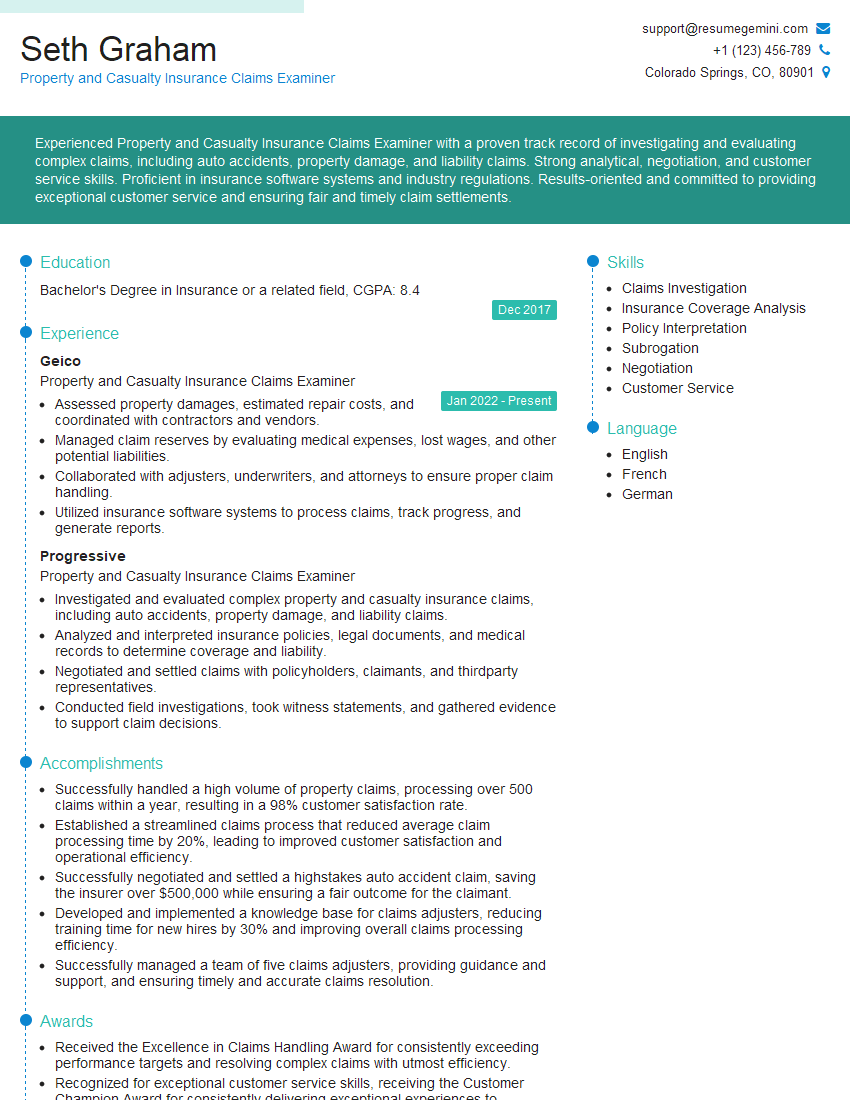
Interviewers often ask about specific skills and experiences. With ResumeGemini‘s customizable templates, you can tailor your resume to showcase the skills most relevant to the position, making a powerful first impression. Also check out Resume Template specially tailored for Property and Casualty Insurance Claims Examiner.
Career Expert Tips:
- Ace those interviews! Prepare effectively by reviewing the Top 50 Most Common Interview Questions on ResumeGemini.
- Navigate your job search with confidence! Explore a wide range of Career Tips on ResumeGemini. Learn about common challenges and recommendations to overcome them.
- Craft the perfect resume! Master the Art of Resume Writing with ResumeGemini’s guide. Showcase your unique qualifications and achievements effectively.
- Great Savings With New Year Deals and Discounts! In 2025, boost your job search and build your dream resume with ResumeGemini’s ATS optimized templates.
Researching the company and tailoring your answers is essential. Once you have a clear understanding of the Property and Casualty Insurance Claims Examiner‘s requirements, you can use ResumeGemini to adjust your resume to perfectly match the job description.
Key Job Responsibilities
Property and Casualty Insurance Claims Examiners are responsible for evaluating, investigating, and processing claims for property and casualty insurance policies. They ensure that claims are valid, calculate settlement amounts, and maintain documentation related to the claims process. Key responsibilities include:
1. Claim Evaluation and Investigation
Evaluating claims to determine if they fall within the coverage of the policy, including reviewing policy details and applicable laws.
- Obtaining and reviewing policy documents, witness statements, and any other relevant information.
- Investigating claims through various methods such as interviewing claimants, inspecting damaged property, and obtaining expert opinions.
2. Claim Settlement
Calculating settlement amounts for approved claims, considering factors such as the extent of damage, policy limits, and applicable deductibles.
- Negotiating settlements with claimants or their representatives, aiming to resolve claims fairly and promptly.
- Authorizing payments to claimants or repair shops upon settlement.
3. Documentation and Communication
Maintaining detailed documentation of all claim-related activities, including investigation reports, correspondence, and settlement agreements.
- Communicating with policyholders, claimants, attorneys, and other relevant parties throughout the claims process.
- Providing updates on claim status and answering inquiries promptly.
4. Compliance and Reporting
Ensuring compliance with applicable laws, regulations, and company policies related to claims handling.
- Preparing and submitting required reports, such as claim summaries and statistical data.
- Monitoring claim trends and identifying areas for improvement in the claims handling process.
Interview Tips
To ace the interview, candidates should prepare thoroughly and demonstrate the following:
1. Technical Knowledge
Proficiency in insurance principles, underwriting guidelines, and claims handling procedures. A strong understanding of relevant laws and regulations is essential.
- Highlight specific training, certifications, or experience that demonstrate your knowledge and expertise.
- Quantify your accomplishments in previous claims examiner roles, showcasing your ability to handle a high volume of claims efficiently and effectively.
2. Investigative Skills
The ability to gather facts, analyze data, and draw logical conclusions. Strong interviewing, research, and analytical skills are highly valued.
- Provide examples of how you have successfully investigated complex claims, including any challenges you faced and how you overcame them.
- Emphasize your attention to detail, objectivity, and ability to remain impartial throughout the investigation process.
3. Negotiation and Communication Skills
Excellent negotiation and interpersonal skills to effectively communicate with claimants, policyholders, and other stakeholders. The ability to build rapport and resolve conflicts is crucial.
- Share examples of how you have successfully negotiated claim settlements, focusing on your ability to find mutually acceptable solutions.
- Highlight your strong communication skills, both verbal and written, and your ability to convey complex information clearly and persuasively.
4. Analytical and Problem-Solving Abilities
The ability to analyze large amounts of data, identify patterns, and develop innovative solutions. Strong problem-solving and decision-making skills are essential.
- Describe situations where you have used analytical thinking to identify risks or opportunities and develop creative solutions.
- Emphasize your ability to prioritize tasks, manage multiple projects, and meet deadlines effectively.
5. Commitment to Ethical Practices
A strong commitment to ethical behavior and maintaining confidentiality. The ability to act with integrity and professionalism is highly valued in the insurance industry.
- Discuss your understanding of ethical guidelines and your commitment to protecting the interests of both policyholders and claimants.
- Provide examples of situations where you have demonstrated honesty, trustworthiness, and objectivity in your professional interactions.
Next Step:
Now that you’re armed with interview-winning answers and a deeper understanding of the Property and Casualty Insurance Claims Examiner role, it’s time to take action! Does your resume accurately reflect your skills and experience for this position? If not, head over to ResumeGemini. Here, you’ll find all the tools and tips to craft a resume that gets noticed. Don’t let a weak resume hold you back from landing your dream job. Polish your resume, hit the “Build Your Resume” button, and watch your career take off! Remember, preparation is key, and ResumeGemini is your partner in interview success.