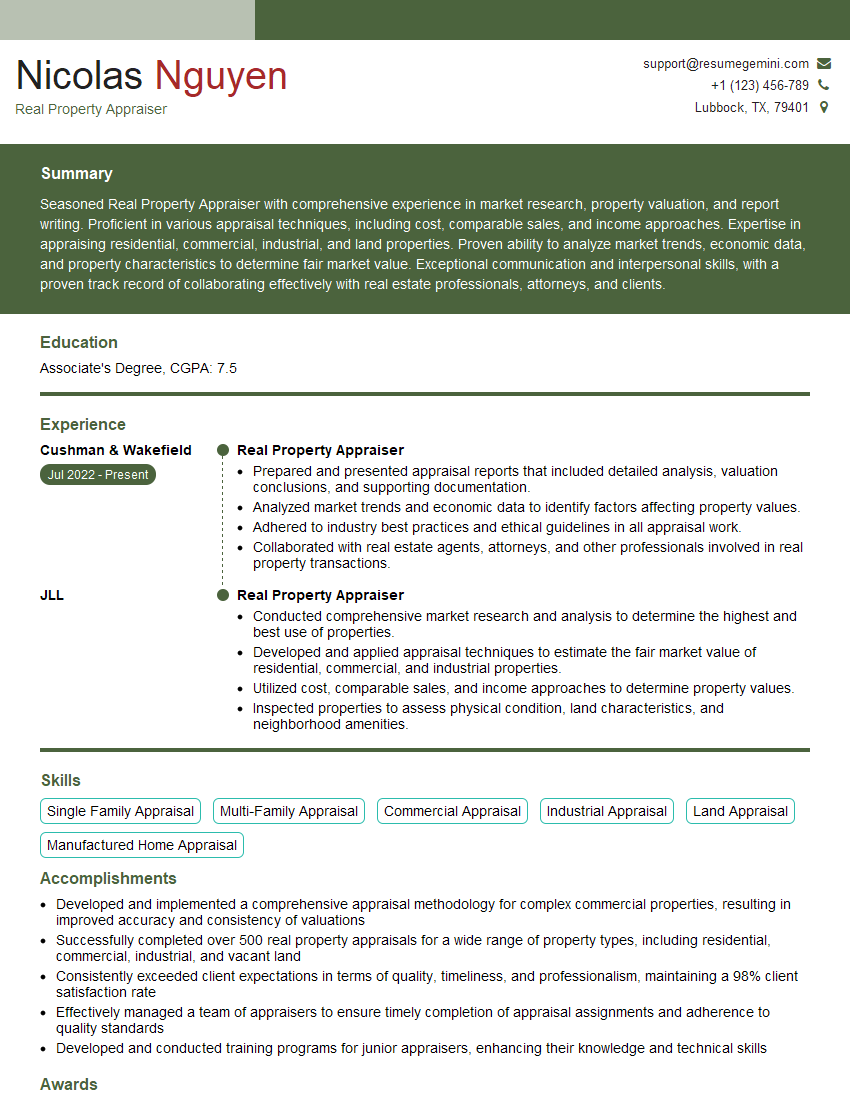
Feeling lost in a sea of interview questions? Landed that dream interview for Real Property Appraiser but worried you might not have the answers? You’re not alone! This blog is your guide for interview success. We’ll break down the most common Real Property Appraiser interview questions, providing insightful answers and tips to leave a lasting impression. Plus, we’ll delve into the key responsibilities of this exciting role, so you can walk into your interview feeling confident and prepared.
Acing the interview is crucial, but landing one requires a compelling resume that gets you noticed. Crafting a professional document that highlights your skills and experience is the first step toward interview success. ResumeGemini can help you build a standout resume that gets you called in for that dream job.






Essential Interview Questions For Real Property Appraiser
1. What are the three approaches to real property appraisal?
The three approaches to real property appraisal are the sales comparison approach, the income capitalization approach, and the cost approach.
- Sales comparison approach: This approach compares the subject property to similar properties that have recently sold in the same market. The appraiser makes adjustments for differences in the properties, such as size, location, and condition, to estimate the value of the subject property.
- Income capitalization approach: This approach estimates the value of the subject property based on its income-producing potential. The appraiser considers the property’s rental income, operating expenses, and capitalization rate to determine its value.
- Cost approach: This approach estimates the value of the subject property based on the cost to replace or reproduce it. The appraiser considers the cost of the land, the cost of construction, and any other relevant factors to determine the value of the property.
2. What are the different types of real property appraisals?
The two types of real property appraisals are market value appraisals and tax assessments.
Market value appraisals
- Are used to determine the value of a property for a variety of purposes, such as buying, selling, or refinancing.
- Are based on the sales comparison approach, the income capitalization approach, and the cost approach.
Tax assessments
- Are used to determine the value of a property for property tax purposes.
- Are typically based on a simplified version of the sales comparison approach.
3. What are the ethical responsibilities of a real property appraiser?
The ethical responsibilities of a real property appraiser include:
- Maintaining independence and impartiality
- Disclosing any conflicts of interest
- Using sound appraisal practices
- Protecting the confidentiality of client information
- Maintaining continuing education
4. What are the challenges of real property appraisal?
The challenges of real property appraisal include:
- Data availability: Appraisers may not always have access to all of the data they need to make an accurate appraisal.
- Market volatility: Real estate markets can be volatile, which can make it difficult to estimate the value of a property.
- Appraisal bias: Appraisers may be biased by their personal opinions or by the interests of their clients.
- Legal liability: Appraisers can be held liable for their appraisals if they are inaccurate or negligent.
5. What are the trends in real property appraisal?
The trends in real property appraisal include:
- Increased use of technology: Appraisers are increasingly using technology to collect data and perform analysis.
- Greater emphasis on sustainability: Appraisers are increasingly considering the sustainability of properties when making appraisals.
- Increased regulation: The government is increasingly regulating the real property appraisal industry.
6. What is your experience with real property appraisal?
I have been working as a real property appraiser for the past 5 years. During that time, I have appraised a wide variety of properties, including residential, commercial, and industrial properties.
- In my previous role, I was responsible for appraising properties for a variety of purposes, such as buying, selling, refinancing, and estate planning.
- I have a strong understanding of the three approaches to real property appraisal, and I am proficient in using a variety of appraisal software and techniques.
- I am also a member of the Appraisal Institute, and I am committed to maintaining my professional development.
7. What are your strengths as a real property appraiser?
My strengths as a real property appraiser include:
- Attention to detail: I am very detail-oriented, and I take pride in producing accurate and well-documented appraisals.
- Objectivity: I am able to remain objective and unbiased when appraising properties, even when there are conflicting interests.
- Communication skills: I am able to communicate complex appraisal concepts in a clear and concise manner.
8. What are your weaknesses as a real property appraiser?
My weaknesses as a real property appraiser include:
- Limited experience with certain types of properties: I have not had much experience appraising certain types of properties, such as farms and ranches.
- Time management: I sometimes have difficulty managing my time effectively, which can lead to delays in completing appraisals.
9. Why do you want to work for our company?
I am interested in working for your company because I am impressed with your reputation as a leading provider of real property appraisal services. I am also impressed with your commitment to customer service and your emphasis on professional development.
- I believe that my skills and experience would be a valuable asset to your team, and I am confident that I can make a significant contribution to your company.
- I am also eager to learn from your experienced appraisers and to contribute to the success of your company.
10. What are your career goals?
My career goals are to become a certified real property appraiser and to eventually open my own appraisal firm. I am also interested in teaching appraisal courses and writing articles on appraisal topics.
- I believe that working for your company would provide me with the opportunity to develop my skills and knowledge, and to achieve my career goals.
- I am confident that I can make a significant contribution to your company, and I am eager to learn and grow with your team.
Interviewers often ask about specific skills and experiences. With ResumeGemini‘s customizable templates, you can tailor your resume to showcase the skills most relevant to the position, making a powerful first impression. Also check out Resume Template specially tailored for Real Property Appraiser.
Career Expert Tips:
- Ace those interviews! Prepare effectively by reviewing the Top 50 Most Common Interview Questions on ResumeGemini.
- Navigate your job search with confidence! Explore a wide range of Career Tips on ResumeGemini. Learn about common challenges and recommendations to overcome them.
- Craft the perfect resume! Master the Art of Resume Writing with ResumeGemini’s guide. Showcase your unique qualifications and achievements effectively.
- Great Savings With New Year Deals and Discounts! In 2025, boost your job search and build your dream resume with ResumeGemini’s ATS optimized templates.
Researching the company and tailoring your answers is essential. Once you have a clear understanding of the Real Property Appraiser‘s requirements, you can use ResumeGemini to adjust your resume to perfectly match the job description.
Key Job Responsibilities
A Real Property Appraiser is a professional who determines the value of real estate properties for various purposes such as taxation, lending, insurance, and legal proceedings. Their key job responsibilities include:
1. Property Evaluation
Conduct thorough inspections and analysis of real estate properties including land, buildings, and improvements to determine their physical condition, size, features, and amenities.
- Evaluate market trends, comparable sales, and economic factors to assess the property’s market value.
- Use various appraisal techniques such as cost approach, income approach, and sales comparison approach to estimate the property’s worth.
2. Report Preparation
Prepare detailed appraisal reports that provide a comprehensive analysis of the property’s value, supporting evidence, and justification for the estimated value.
- Ensure that appraisal reports meet industry standards and comply with regulatory requirements.
- Clearly communicate the property’s value and the methodology used to determine it.
3. Client Consultation
Meet with clients to discuss appraisal findings, explain the valuation process, and answer their questions.
- Provide guidance and advice to clients on real estate-related matters.
- Maintain confidentiality and ethical standards in all client interactions.
4. Continuing Education
Stay abreast of industry best practices, appraisal techniques, and regulatory changes through ongoing professional development.
- Attend industry conferences, workshops, and seminars.
- Obtain certifications and designations to enhance credibility and expertise.
Interview Tips
To ace an interview for a Real Property Appraiser position, consider the following tips and hacks:
1. Preparation
Thoroughly research the company, industry, and the specific role you are applying for. Familiarize yourself with the job requirements and responsibilities.
- Review recent market trends and appraisal techniques.
- Practice answering common interview questions related to property valuation, report writing, and ethical considerations.
2. Industry Knowledge
Demonstrate a strong understanding of real estate appraisal principles, methodologies, and industry regulations. Highlight your experience with different property types and valuation scenarios.
- Discuss specific appraisal projects you have worked on and the challenges you encountered.
- Share examples of how you have applied industry best practices to ensure accurate and reliable property valuations.
3. Communication Skills
Appraisers need to effectively communicate their findings, both verbally and in writing. Emphasize your ability to write clear and concise appraisal reports, present complex information, and engage with clients.
- Highlight your experience in presenting appraisals to stakeholders, such as lenders, attorneys, and property owners.
- Prepare examples of how you have successfully resolved client queries and addressed concerns.
4. Ethics and Professionalism
Real Property Appraisers must adhere to strict ethical standards and maintain the confidentiality of client information. Emphasize your commitment to integrity, objectivity, and independence.
- Explain how you have navigated potential conflicts of interest and maintained impartiality in your appraisals.
- Discuss your understanding of the Uniform Standards of Professional Appraisal Practice (USPAP) and other relevant ethical guidelines.
Next Step:
Now that you’re armed with interview-winning answers and a deeper understanding of the Real Property Appraiser role, it’s time to take action! Does your resume accurately reflect your skills and experience for this position? If not, head over to ResumeGemini. Here, you’ll find all the tools and tips to craft a resume that gets noticed. Don’t let a weak resume hold you back from landing your dream job. Polish your resume, hit the “Build Your Resume” button, and watch your career take off! Remember, preparation is key, and ResumeGemini is your partner in interview success.