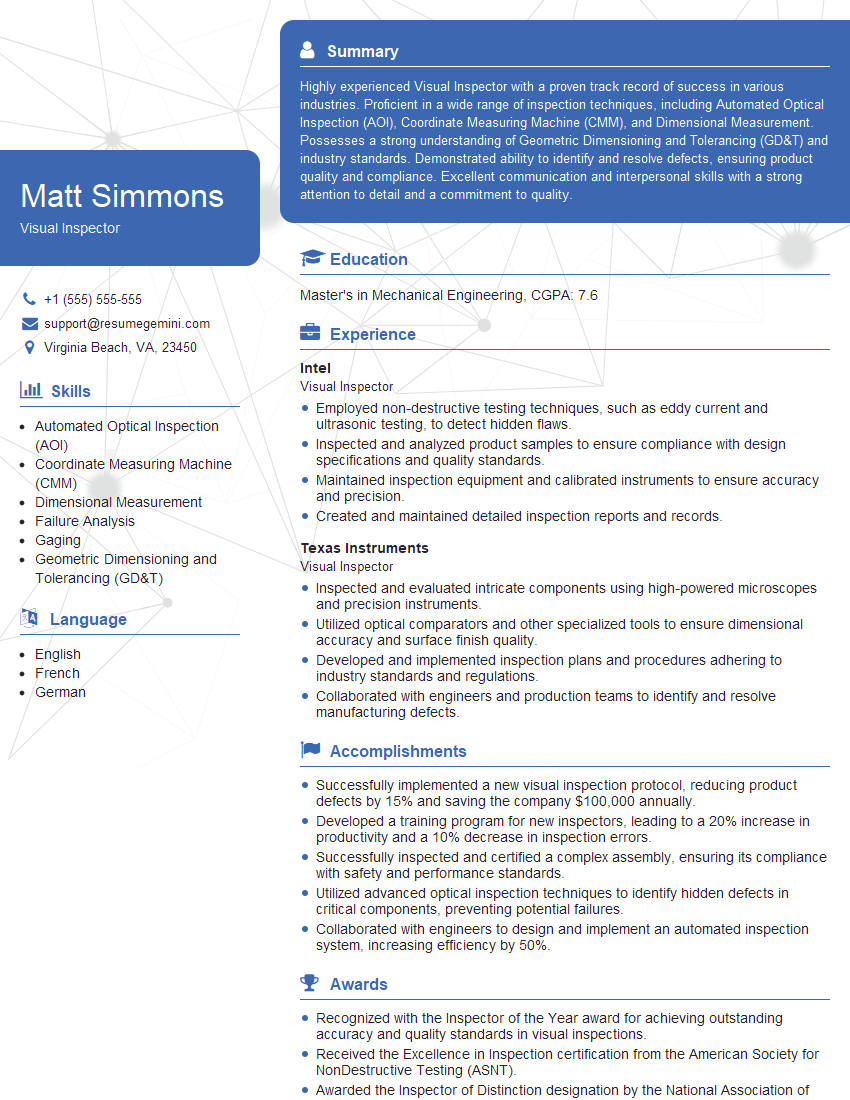
Are you gearing up for a career in Visual Inspector? Feeling nervous about the interview questions that might come your way? Don’t worry, you’re in the right place. In this blog post, we’ll dive deep into the most common interview questions for Visual Inspector and provide you with expert-backed answers. We’ll also explore the key responsibilities of this role so you can tailor your responses to showcase your perfect fit.
Acing the interview is crucial, but landing one requires a compelling resume that gets you noticed. Crafting a professional document that highlights your skills and experience is the first step toward interview success. ResumeGemini can help you build a standout resume that gets you called in for that dream job.






Essential Interview Questions For Visual Inspector
1. What are the different types of visual inspection techniques?
- Manual Inspection: Conducted by the human eye, assessing the quality of products by examining their physical appearance.
- Automated Optical Inspection (AOI): Involves using cameras to capture images of products and analyzing them using computer algorithms.
- Machine Vision Inspection (MVI): Utilizes advanced algorithms and high-speed cameras to perform complex visual inspections.
2. Describe the key responsibilities of a Visual Inspector.
- Inspect products visually to identify defects or non-conformances.
- Document inspection findings accurately and efficiently.
- Monitor and maintain inspection equipment.
- Provide feedback to improve production processes.
3. What are the common defects you look for during visual inspection?
- Scratches, dents, and other surface imperfections
- Dimensional inaccuracies and variations
- Color variations and inconsistencies
- Contamination and foreign objects
4. How do you ensure accuracy and consistency in your visual inspections?
- Follow standardized inspection procedures
- Use proper lighting and magnification tools
- Calibrate inspection equipment regularly
- Receive ongoing training
5. What are the challenges you have faced as a Visual Inspector? How did you overcome them?
- Repetitive and monotonous tasks: Stay focused and motivated by setting performance goals.
- Eye strain and fatigue: Take regular breaks and use ergonomic equipment.
- Identifying subtle defects: Enhance visual acuity through training and practice.
- Working in fast-paced environments: Prioritize inspections, delegate tasks when possible, and optimize workflows.
6. How do you stay up-to-date with advancements in visual inspection technology?
- Attend industry conferences and seminars
- Read technical publications and articles
- Network with other inspectors and professionals
- Participate in training programs offered by manufacturers
7. How do you prioritize tasks when multiple inspections need to be completed simultaneously?
- Assess the criticality of defects: Focus on identifying and reporting major defects first.
- Consider the production schedule: Prioritize inspections for products that are time-sensitive.
- Delegate tasks effectively: Train other inspectors or operators to handle less critical inspections.
- Utilize technology: Implement inspection software or automation to streamline the process.
8. What is your experience in using inspection software and equipment?
- List specific software and equipment you have used: Highlight your proficiency in industry-specific tools.
- Describe how you have used technology to enhance your inspections: Explain how it has improved efficiency, accuracy, or reporting.
- Express eagerness to learn new technologies: Show that you are adaptable and willing to embrace advancements.
9. How do you handle situations where you identify a potential defect but are unsure of its significance?
- Consult with a supervisor or colleague: Seek guidance from experienced professionals.
- Refer to product specifications and drawings: Verify the acceptability of the defect based on established standards.
- Escalate the issue to the appropriate personnel: Notify quality control or engineering if the defect is significant.
10. What motivates you to perform visual inspections to the best of your ability?
- Ensuring product quality and safety: Express your commitment to protecting consumers and maintaining brand reputation.
- Attention to detail and precision: Highlight your keen eye for identifying defects and your dedication to accuracy.
- Contribution to the production process: Emphasize how your inspections help improve efficiency and reduce waste.
- Continuous improvement: Explain your desire to constantly learn and refine your inspection skills.
Interviewers often ask about specific skills and experiences. With ResumeGemini‘s customizable templates, you can tailor your resume to showcase the skills most relevant to the position, making a powerful first impression. Also check out Resume Template specially tailored for Visual Inspector.
Career Expert Tips:
- Ace those interviews! Prepare effectively by reviewing the Top 50 Most Common Interview Questions on ResumeGemini.
- Navigate your job search with confidence! Explore a wide range of Career Tips on ResumeGemini. Learn about common challenges and recommendations to overcome them.
- Craft the perfect resume! Master the Art of Resume Writing with ResumeGemini’s guide. Showcase your unique qualifications and achievements effectively.
- Great Savings With New Year Deals and Discounts! In 2025, boost your job search and build your dream resume with ResumeGemini’s ATS optimized templates.
Researching the company and tailoring your answers is essential. Once you have a clear understanding of the Visual Inspector‘s requirements, you can use ResumeGemini to adjust your resume to perfectly match the job description.
Key Job Responsibilities
Visual Inspectors are responsible for examining products visually to identify defects and ensure product quality. Their key job responsibilities include:
1. Inspection and Evaluation
Inspecting products thoroughly for defects, deviations, or non-conformities with established standards and specifications.
- Identifying and documenting defects, such as scratches, dents, cracks, or misalignments.
- Using a variety of inspection techniques, such as visual inspection, microscopy, or automated optical inspection.
2. Quality Control
Ensuring that products meet quality standards and specifications.
- Verifying that products are free from defects and comply with design specifications.
- Monitoring production processes to identify potential quality issues and implementing corrective actions.
3. Data Collection and Analysis
Collecting and analyzing data related to inspection results.
- Recording inspection data, including defect types, quantities, and locations.
- Analyzing data to identify trends, patterns, and potential quality issues.
4. Reporting and Communication
Communicating inspection results and providing feedback to relevant stakeholders.
- Preparing and submitting inspection reports to supervisors, engineers, or quality managers.
- Collaborating with other departments, such as production, engineering, or quality assurance, to resolve quality issues.
Interview Tips
1. Research the Company and Industry
Familiarize yourself with the company’s products, services, and industry. This will help you understand the role and how your skills align with the company’s needs.
- Visit the company’s website and social media pages.
- Read industry-related articles and news to stay up-to-date on advancements and best practices.
2. Prepare for Technical Questions
Visual Inspectors need a strong understanding of inspection techniques, quality standards, and data analysis. Be prepared to answer questions about your experience and knowledge in these areas.
- Review common inspection techniques, such as visual inspection, microscopy, and automated optical inspection.
- Familiarize yourself with quality standards and specifications relevant to the industry.
3. Highlight Your Attention to Detail
Visual Inspectors must have a keen eye for detail and the ability to identify even the smallest defects. Emphasize your attention to detail and ability to focus on accuracy.
- Provide examples of your experience in identifying and resolving quality issues.
- Highlight your ability to work independently and maintain focus for extended periods.
4. Prepare for Behavioral Questions
Interviewers may ask behavioral questions to assess your teamwork skills, problem-solving abilities, and communication style.
- Use the STAR method (Situation, Task, Action, Result) to answer behavioral questions.
- Provide specific examples of times you worked effectively in a team, solved problems, or communicated effectively.
Next Step:
Now that you’re armed with the knowledge of Visual Inspector interview questions and responsibilities, it’s time to take the next step. Build or refine your resume to highlight your skills and experiences that align with this role. Don’t be afraid to tailor your resume to each specific job application. Finally, start applying for Visual Inspector positions with confidence. Remember, preparation is key, and with the right approach, you’ll be well on your way to landing your dream job. Build an amazing resume with ResumeGemini