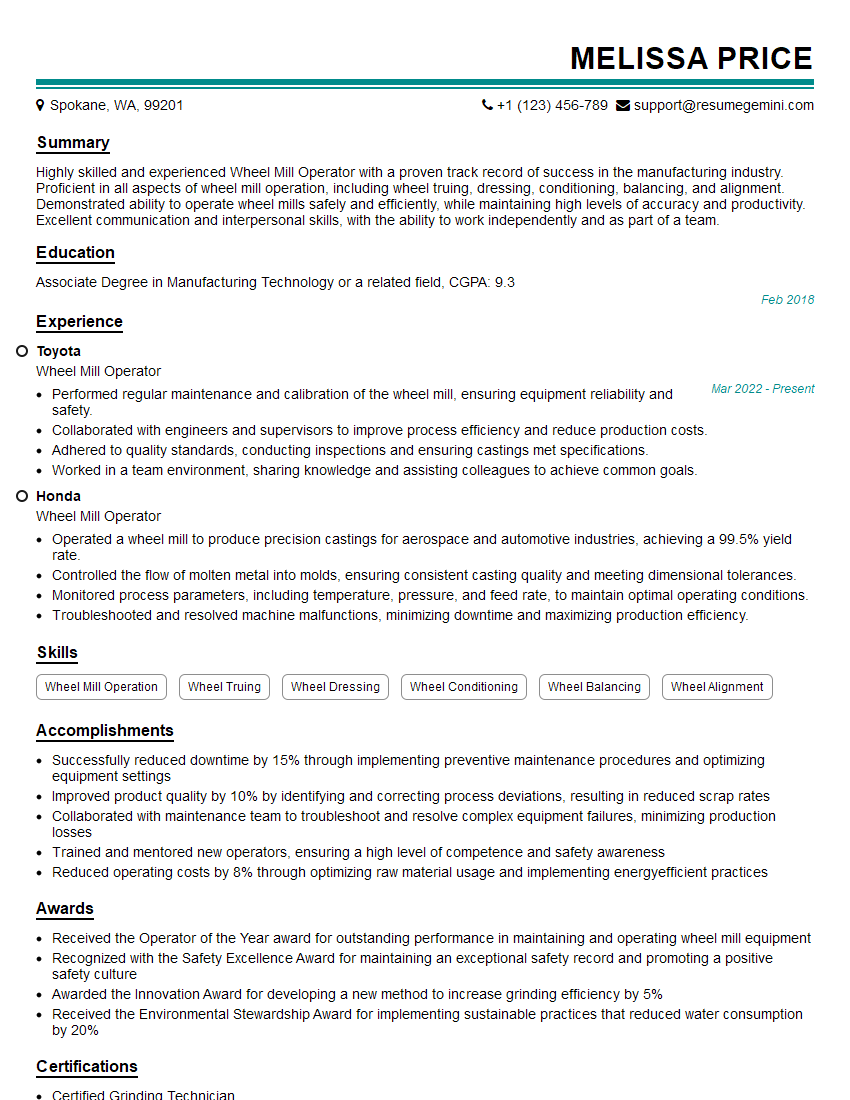
Are you gearing up for a career shift or aiming to ace your next interview? Look no further! We’ve curated a comprehensive guide to help you crack the interview for the coveted Wheel Mill Operator position. From understanding the key responsibilities to mastering the most commonly asked questions, this blog has you covered. So, buckle up and let’s embark on this journey together.
Acing the interview is crucial, but landing one requires a compelling resume that gets you noticed. Crafting a professional document that highlights your skills and experience is the first step toward interview success. ResumeGemini can help you build a standout resume that gets you called in for that dream job.






Essential Interview Questions For Wheel Mill Operator
1. Explain the process of grinding wheels?
Grinding wheels are rotating abrasive tools used to shape and finish metal workpieces. The process of grinding involves the controlled contact of the abrasive wheel with the workpiece, which removes material through a combination of cutting and rubbing. The abrasive particles on the wheel cut into the workpiece, removing small chips of material. The rubbing action helps to smooth the surface of the workpiece and remove any burrs or imperfections.
2. What are the different types of grinding wheels?
Ceramic
- Made of ceramic materials such as aluminum oxide or silicon carbide.
- Hard and durable, suitable for grinding hard materials like steel and cast iron.
Vitrified
- Bonded with glass or ceramic materials.
- Strong and heat-resistant, used for grinding various materials.
Resinoid
- Bonded with resin materials.
- Flexible and easy to shape, ideal for grinding soft materials like wood and plastic.
Metal
- Made of metal, usually steel.
- Very hard and durable, used for heavy-duty grinding applications.
3. What are the safety precautions when operating a wheel mill?
Operating a wheel mill requires strict adherence to safety protocols to prevent accidents and injuries. These precautions include:
- Wearing appropriate personal protective equipment (PPE), including gloves, safety glasses, and earplugs.
- Inspecting the grinding wheel for any cracks or damage before use.
- Ensuring the grinding wheel is properly mounted and balanced.
- Using the correct wheel speed and feed rate for the specific grinding application.
- Avoiding excessive pressure on the workpiece to prevent wheel breakage.
- Never touching the grinding wheel while it is in motion.
- Keeping the work area clean and free of debris.
4. How do you dress a grinding wheel?
Dressing a grinding wheel involves shaping and sharpening the abrasive surface to maintain its cutting efficiency and prevent glazing. This process can be done using a dressing tool, such as a diamond dresser or a silicon carbide stick. By applying the dressing tool to the rotating wheel, the abrasive particles are removed, exposing fresh cutting edges. Proper dressing ensures the wheel continues to perform optimally and reduces the risk of workpiece damage.
5. What are the different coolants used in wheel milling?
- Water-based coolants: Commonly used, inexpensive, and effective in reducing heat and preventing workpiece distortion.
- Oil-based coolants: Provide better lubrication and cooling than water-based coolants, but can be more expensive and require special disposal methods.
- Synthetic coolants: Offer improved performance over traditional coolants, providing better cooling, lubrication, and corrosion protection.
6. How do you troubleshoot common problems with wheel mills?
Troubleshooting common problems with wheel mills is crucial for maintaining optimal performance and ensuring safety. Some common issues and their potential solutions include:
- Excessive vibration: May indicate an unbalanced wheel, loose bearings, or improper mounting.
- Glazing of the grinding wheel: Occurs when the abrasive particles become dull, reducing cutting efficiency. Dressing the wheel can resolve this issue.
- Chattering: Caused by workpiece deflection or resonance. Adjusting the cutting parameters, such as speed and feed rate, can help eliminate chattering.
- Burn marks on the workpiece: Excessive heat generation due to high grinding pressure, dull wheel, or insufficient coolant. Adjusting parameters and ensuring proper cooling can prevent burn marks.
7. How do you calibrate a wheel mill?
Calibrating a wheel mill involves adjusting its settings to ensure accurate and precise grinding operations. The calibration process typically includes:
- Setting the wheel speed: Using a tachometer to match the wheel’s speed to the recommended value for the specific grinding application.
- Adjusting the table travel: Ensuring the table moves smoothly and accurately along the X and Y axes using a precision measuring instrument.
- Setting the depth of cut: Determining the desired depth of cut and adjusting the machine accordingly using a depth gauge or dial indicator.
- Checking the wheel alignment: Using a dial indicator or other precision measuring tool to ensure the grinding wheel is aligned perpendicular to the workpiece surface.
8. What are the different types of workpiece materials that can be ground on a wheel mill?
Wheel mills are versatile machines capable of grinding a wide range of workpiece materials, including:
- Metals: Steel, cast iron, aluminum, titanium, and other ferrous and non-ferrous metals.
- Plastics: Acrylic, polycarbonate, nylon, and other thermoplastic and thermosetting materials.
- Wood: Hardwoods, softwoods, and engineered wood products.
- Ceramics: Glass, porcelain, and other ceramic materials.
- Composites: Fiber-reinforced plastics, metal matrix composites, and other hybrid materials.
9. What are the preventive maintenance tasks for a wheel mill?
Regular preventive maintenance is crucial for ensuring the longevity and optimal performance of a wheel mill. Some key maintenance tasks include:
- Cleaning and inspection: Regularly cleaning the machine and inspecting components for wear or damage.
- Lubrication: Greasing and oiling moving parts according to the manufacturer’s recommendations.
- Wheel balancing: Checking and balancing the grinding wheel to prevent vibration and ensure accuracy.
- Coolant system maintenance: Monitoring coolant levels, cleaning the coolant tank, and replacing coolant as needed.
- Electrical maintenance: Inspecting electrical connections, wiring, and components for any issues.
10. How do you measure the surface finish of a ground workpiece?
Measuring the surface finish of a ground workpiece is important for assessing its quality and meeting specific requirements. There are several methods to measure surface finish, including:
- Tactile methods: Using a profilometer or stylus instrument to physically measure the surface roughness.
- Optical methods: Employing a microscope or interferometer to analyze the surface topography.
- Non-contact methods: Utilizing laser scanners or other non-contact sensors to measure surface finish.
Interviewers often ask about specific skills and experiences. With ResumeGemini‘s customizable templates, you can tailor your resume to showcase the skills most relevant to the position, making a powerful first impression. Also check out Resume Template specially tailored for Wheel Mill Operator.
Career Expert Tips:
- Ace those interviews! Prepare effectively by reviewing the Top 50 Most Common Interview Questions on ResumeGemini.
- Navigate your job search with confidence! Explore a wide range of Career Tips on ResumeGemini. Learn about common challenges and recommendations to overcome them.
- Craft the perfect resume! Master the Art of Resume Writing with ResumeGemini’s guide. Showcase your unique qualifications and achievements effectively.
- Great Savings With New Year Deals and Discounts! In 2025, boost your job search and build your dream resume with ResumeGemini’s ATS optimized templates.
Researching the company and tailoring your answers is essential. Once you have a clear understanding of the Wheel Mill Operator‘s requirements, you can use ResumeGemini to adjust your resume to perfectly match the job description.
Key Job Responsibilities
Wheel Mill Operators are responsible for monitoring and operating a wheel mill, a machine used in the manufacturing of cement and other materials. They ensure that the mill is running efficiently and safely, and make adjustments as needed.
1. Operate and Monitor Wheel Mill
Wheel Mill Operators are responsible for the safe and efficient operation of a wheel mill. They monitor the mill’s controls and make adjustments as needed to ensure that the mill is running at optimal performance. They also monitor the mill’s feed rate, temperature, and other variables to ensure that the mill is operating within safe parameters.
- Monitor mill controls and make adjustments as needed
- Monitor mill feed rate, temperature, and other variables
- Ensure that the mill is operating within safe parameters
2. Perform Maintenance and Repairs
Wheel Mill Operators perform routine maintenance and repairs on the wheel mill. They lubricate the mill’s bearings, replace worn parts, and make minor repairs as needed. They also inspect the mill regularly to identify any potential problems and take corrective action.
- Lubricate mill bearings
- Replace worn parts
- Make minor repairs as needed
- Inspect mill regularly to identify potential problems
3. Ensure Safety
Wheel Mill Operators are responsible for ensuring the safety of themselves and others in the workplace. They follow all safety procedures and wear appropriate personal protective equipment. They also report any unsafe conditions or practices to their supervisor.
- Follow all safety procedures
- Wear appropriate personal protective equipment
- Report any unsafe conditions or practices
4. Maintain Records
Wheel Mill Operators maintain records of the mill’s operation and maintenance. They record the mill’s operating parameters, any maintenance performed, and any problems encountered. These records are used to track the mill’s performance and identify any areas for improvement.
- Record mill operating parameters
- Record maintenance performed
- Record problems encountered
- Use records to track mill performance and identify areas for improvement
Interview Tips
Here are some tips to help you ace your interview for a Wheel Mill Operator position:
1. Research the Company and Position
Before your interview, take some time to research the company and the specific position you are applying for. This will help you understand the company’s culture and the specific requirements of the job. You can find information about the company on their website, social media pages, and Glassdoor.
- Visit the company website
- Check the company’s social media pages
- Read reviews on Glassdoor
2. Prepare Your Answers
Take some time to think about the questions you might be asked in your interview. Common interview questions include:
- Tell me about yourself.
- Why are you interested in this position?
- What are your strengths and weaknesses?
- What is your experience with wheel mills?
- How do you handle stress?
You can prepare your answers by writing them out in advance or practicing them with a friend or family member.
3. Be Confident and Enthusiastic
Confidence and enthusiasm are key in any interview. Make sure you are well-dressed and arrive on time for your interview. When you meet the interviewer, make eye contact and give a firm handshake. Throughout the interview, maintain a positive attitude and be enthusiastic about the position.
- Dress professionally
- Arrive on time
- Make eye contact
- Give a firm handshake
- Maintain a positive attitude
4. Follow Up
After your interview, send a thank-you note to the interviewer. In your note, thank the interviewer for their time and reiterate your interest in the position. You can also mention any specific qualifications or experiences that you think would make you a good fit for the job.
- Send a thank-you note to the interviewer
- Reiterate your interest in the position
- Mention any specific qualifications or experiences that you think would make you a good fit for the job
Next Step:
Now that you’re armed with interview-winning answers and a deeper understanding of the Wheel Mill Operator role, it’s time to take action! Does your resume accurately reflect your skills and experience for this position? If not, head over to ResumeGemini. Here, you’ll find all the tools and tips to craft a resume that gets noticed. Don’t let a weak resume hold you back from landing your dream job. Polish your resume, hit the “Build Your Resume” button, and watch your career take off! Remember, preparation is key, and ResumeGemini is your partner in interview success.