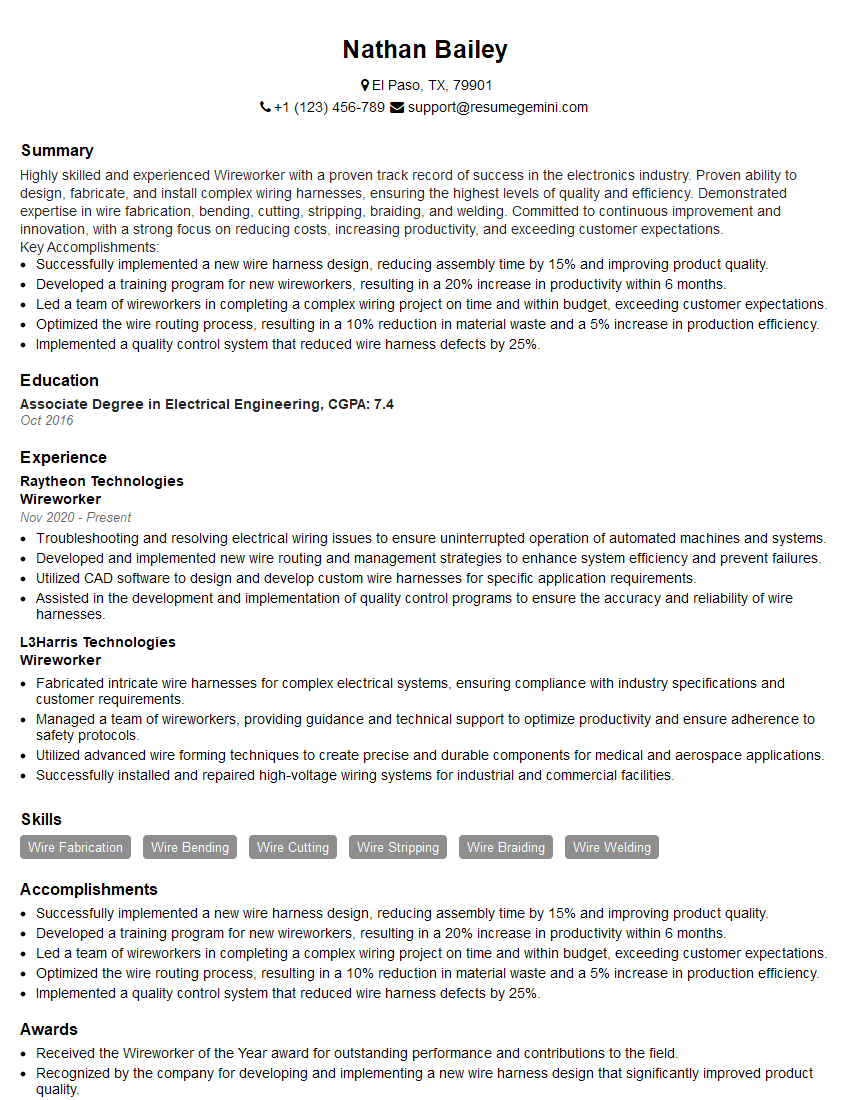
Are you gearing up for a career in Wireworker? Feeling nervous about the interview questions that might come your way? Don’t worry, you’re in the right place. In this blog post, we’ll dive deep into the most common interview questions for Wireworker and provide you with expert-backed answers. We’ll also explore the key responsibilities of this role so you can tailor your responses to showcase your perfect fit.
Acing the interview is crucial, but landing one requires a compelling resume that gets you noticed. Crafting a professional document that highlights your skills and experience is the first step toward interview success. ResumeGemini can help you build a standout resume that gets you called in for that dream job.






Essential Interview Questions For Wireworker
1. Explain the process of annealing wire. Why is it important for wireworking?
Annealing is a process of heating and cooling metal to relieve internal stresses and soften it. It is important for wireworking because it makes the wire more pliable and easier to work with, reducing the risk of breakage or cracking.
2. How do you choose the right wire gauge for a particular project?
Factors to Consider:
- The strength and weight of the wire
- The size and complexity of the project
- The tools and techniques used
Gauge Measurement:
- Wire gauge is measured in American Wire Gauge (AWG) or Birmingham Wire Gauge (BWG).
- Lower gauge numbers indicate thicker wires, while higher gauge numbers indicate thinner wires.
3. What are the different types of wireworking pliers and what are their uses?
- Round-nose pliers: Used for bending and shaping wire into loops and curves.
- Flat-nose pliers: Used for gripping and holding wire securely.
- Chain-nose pliers: Used for opening and closing jump rings and links.
- Needle-nose pliers: Used for precise bending and shaping of thin wire.
- Crimping pliers: Used for crimping wire ends onto beads or other components.
4. How do you create a wire loop using different techniques?
- Using round-nose pliers: Wrap the wire around the pliers and pull it through to create a loop.
- Using a mandrel: Insert the wire into a mandrel and wrap it around to create a loop of a specific size.
- Using a wire jig: Position the wire in a wire jig to create loops of consistent size and shape.
5. Explain how to solder wire connections properly.
- Clean the wire surfaces to be joined.
- Apply a small amount of solder flux to the surfaces.
- Heat the surfaces with a soldering iron.
- Touch the solder to the heated surfaces to melt and flow into the joint.
- Remove the heat and allow the solder to cool and solidify.
6. What are the safety precautions to observe when working with wire?
- Wear safety glasses to protect your eyes from wire fragments and heat.
- Use sharp tools to prevent wire from slipping and causing injuries.
- Handle hot wire carefully to avoid burns.
- Ensure proper ventilation when soldering to avoid inhaling fumes.
- Keep your workspace clean to prevent tripping or slipping.
7. Describe your experience in wire wrapping techniques.
In my previous role, I specialized in wire wrapping techniques to create intricate jewelry and decorative pieces. I am skilled in various wrapping styles, including:
- Simple wrapping: Overlapping wire around beads or objects.
- Spiral wrapping: Wrapping wire tightly and evenly around a base.
- Spiral cage: Interconnected spiral wraps forming a protective cage around a stone or object.
- Freeform wrapping: Using wire to create organic and sculptural forms without a predetermined pattern.
8. How do you stay updated on new wireworking techniques and trends?
- Attend workshops and classes to learn from experienced wireworkers.
- Subscribe to wireworking magazines and online publications.
- Follow wireworking artists on social media and online forums.
- Experiment with different techniques and materials to develop my own unique style.
9. What are the challenges you have faced in wireworking and how did you overcome them?
One challenge I faced was achieving intricate and precise loops. To overcome this, I practiced regularly using different loop-forming tools and techniques. I also studied the work of experienced wireworkers to learn their methods and improve my own. Another challenge was working with delicate materials, such as fine wire and gemstones. I addressed this by using specialized tools and handling the materials with great care to avoid damage.
10. How do you incorporate wireworking into your artistic style?
Wireworking is an integral part of my artistic style. I use wire to create dynamic and sculptural forms that enhance the beauty and uniqueness of each piece. I am particularly drawn to the organic and flowing nature of wire, which allows me to express my creativity and bring my designs to life. Through wireworking, I explore the interplay between form, texture, and negative space, creating wearable art that is both visually appealing and meaningful.
Interviewers often ask about specific skills and experiences. With ResumeGemini‘s customizable templates, you can tailor your resume to showcase the skills most relevant to the position, making a powerful first impression. Also check out Resume Template specially tailored for Wireworker.
Career Expert Tips:
- Ace those interviews! Prepare effectively by reviewing the Top 50 Most Common Interview Questions on ResumeGemini.
- Navigate your job search with confidence! Explore a wide range of Career Tips on ResumeGemini. Learn about common challenges and recommendations to overcome them.
- Craft the perfect resume! Master the Art of Resume Writing with ResumeGemini’s guide. Showcase your unique qualifications and achievements effectively.
- Great Savings With New Year Deals and Discounts! In 2025, boost your job search and build your dream resume with ResumeGemini’s ATS optimized templates.
Researching the company and tailoring your answers is essential. Once you have a clear understanding of the Wireworker‘s requirements, you can use ResumeGemini to adjust your resume to perfectly match the job description.
Key Job Responsibilities
Wireworkers are responsible for the installation, maintenance, and repair of electrical wiring and cabling systems in a variety of settings. They work closely with electricians and other tradespeople to ensure that all electrical systems are installed and operating properly.
1. Electrical Wiring Installation
Wireworkers install new electrical wiring and cables in residential, commercial, and industrial buildings.
- Run and secure electrical cables and wires.
- Install electrical outlets, switches, and fixtures.
- Connect electrical components to power sources.
2. Electrical Wiring Maintenance
Wireworkers maintain existing electrical wiring and cables to ensure that they are operating safely and efficiently.
- Inspect electrical wiring and cables for damage.
- Repair or replace damaged electrical wiring and cables.
- Test electrical wiring and cables to ensure that they are functioning properly.
3. Electrical Wiring Repair
Wireworkers repair damaged electrical wiring and cables.
- Troubleshoot electrical problems.
- Repair or replace damaged electrical components.
- Test electrical repairs to ensure that they are functioning properly.
4. Other Responsibilities
In addition to the responsibilities listed above, wireworkers may also be responsible for the following:
- Pulling cables
- Splicing wires
- Terminating wires
- Reading blueprints
- Working with a variety of tools and materials
Interview Tips
Preparing for an interview for a wireworker position can be daunting, but by following these tips, you can increase your chances of success.
1. Research the company and the position
Before you go to your interview, take some time to research the company and the specific position you are applying for. This will help you understand the company’s culture and values, as well as the specific skills and experience that they are looking for in a wireworker.
2. Practice your answers to common interview questions
There are a number of common interview questions that you are likely to be asked, such as “Tell me about yourself” and “Why do you want to work for this company?” It is helpful to practice answering these questions in advance so that you can deliver your answers confidently and succinctly.
3. Be prepared to talk about your experience and skills
The interviewer will want to know about your experience and skills as a wireworker. Be prepared to talk about your previous projects, the types of electrical systems you have worked on, and the tools and materials you are familiar with.
4. Be enthusiastic and positive
Interviewers are looking for candidates who are enthusiastic and positive about the job. Be sure to convey your excitement about the opportunity to work for the company and your passion for the work of a wireworker.
5. Dress professionally
First impressions matter, so be sure to dress professionally for your interview. This means wearing clean, pressed clothes that are appropriate for an office setting.
Next Step:
Armed with this knowledge, you’re now well-equipped to tackle the Wireworker interview with confidence. Remember, preparation is key. So, start crafting your resume, highlighting your relevant skills and experiences. Don’t be afraid to tailor your application to each specific job posting. With the right approach and a bit of practice, you’ll be well on your way to landing your dream job. Build your resume now from scratch or optimize your existing resume with ResumeGemini. Wish you luck in your career journey!