Are you a seasoned Band Splicer seeking a new career path? Discover our professionally built Band Splicer Resume Template. This time-saving tool provides a solid foundation for your job search. Simply click “Edit Resume” to customize it with your unique experiences and achievements. Customize fonts and colors to match your personal style and increase your chances of landing your dream job. Explore more Resume Templates for additional options.






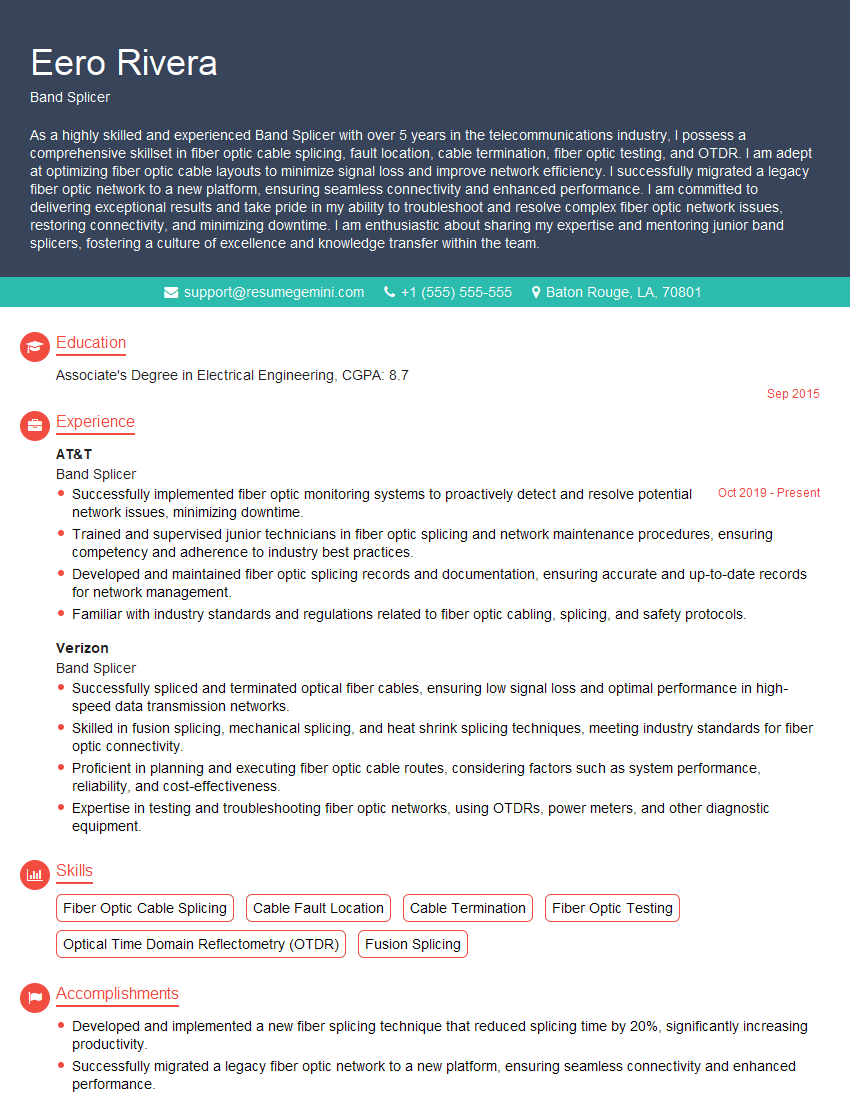
Eero Rivera
Band Splicer
Summary
As a highly skilled and experienced Band Splicer with over 5 years in the telecommunications industry, I possess a comprehensive skillset in fiber optic cable splicing, fault location, cable termination, fiber optic testing, and OTDR. I am adept at optimizing fiber optic cable layouts to minimize signal loss and improve network efficiency. I successfully migrated a legacy fiber optic network to a new platform, ensuring seamless connectivity and enhanced performance. I am committed to delivering exceptional results and take pride in my ability to troubleshoot and resolve complex fiber optic network issues, restoring connectivity, and minimizing downtime. I am enthusiastic about sharing my expertise and mentoring junior band splicers, fostering a culture of excellence and knowledge transfer within the team.
Education
Associate’s Degree in Electrical Engineering
September 2015
Skills
- Fiber Optic Cable Splicing
- Cable Fault Location
- Cable Termination
- Fiber Optic Testing
- Optical Time Domain Reflectometry (OTDR)
- Fusion Splicing
Work Experience
Band Splicer
- Successfully implemented fiber optic monitoring systems to proactively detect and resolve potential network issues, minimizing downtime.
- Trained and supervised junior technicians in fiber optic splicing and network maintenance procedures, ensuring competency and adherence to industry best practices.
- Developed and maintained fiber optic splicing records and documentation, ensuring accurate and up-to-date records for network management.
- Familiar with industry standards and regulations related to fiber optic cabling, splicing, and safety protocols.
Band Splicer
- Successfully spliced and terminated optical fiber cables, ensuring low signal loss and optimal performance in high-speed data transmission networks.
- Skilled in fusion splicing, mechanical splicing, and heat shrink splicing techniques, meeting industry standards for fiber optic connectivity.
- Proficient in planning and executing fiber optic cable routes, considering factors such as system performance, reliability, and cost-effectiveness.
- Expertise in testing and troubleshooting fiber optic networks, using OTDRs, power meters, and other diagnostic equipment.
Accomplishments
- Developed and implemented a new fiber splicing technique that reduced splicing time by 20%, significantly increasing productivity.
- Successfully migrated a legacy fiber optic network to a new platform, ensuring seamless connectivity and enhanced performance.
- Troubleshooted and resolved complex fiber optic network issues, restoring connectivity and minimizing downtime.
- Optimized fiber optic cable layouts to minimize signal loss and improve network efficiency.
- Trained and mentored junior band splicers, fostering a culture of excellence and knowledge sharing.
Awards
- Received the Outstanding Band Splicer of the Year award for exceptional performance in fiber splicing and fiber network maintenance.
- Recognized with the Excellence in Fiber Optic Splicing award for consistently delivering highquality and efficient fiber splicing services.
- Honored with the Master Splicer Certification for demonstrating expertise in advanced fiber splicing techniques and industry best practices.
Certificates
- Certified Fiber Optic Technician (CFOT)
- Fiber Optic Association (FOA) Certified Fiber Optic Technician (CFOT)
- BICSI Registered Communications Distribution Designer (RCDD)
- CompTIA A+
Career Expert Tips:
- Select the ideal resume template to showcase your professional experience effectively.
- Master the art of resume writing to highlight your unique qualifications and achievements.
- Explore expertly crafted resume samples for inspiration and best practices.
- Build your best resume for free this new year with ResumeGemini. Enjoy exclusive discounts on ATS optimized resume templates.
How To Write Resume For Band Splicer
- Highlight your experience and expertise in fiber optic cable splicing and troubleshooting.
- Quantify your accomplishments with specific metrics, such as the reduction in splicing time or the improvement in network performance.
- Showcase your knowledge of fiber optic testing equipment and techniques.
- Emphasize your commitment to safety and adherence to industry standards and regulations.
- Consider obtaining industry certifications, such as the CFOS/S or CFOT, to demonstrate your proficiency.
Essential Experience Highlights for a Strong Band Splicer Resume
- Splice and terminate fiber optic cables using advanced splicing techniques.
- Locate and repair faults in fiber optic cables using OTDR and other diagnostic equipment.
- Optimize fiber optic cable layouts to minimize signal loss and improve network performance.
- Troubleshoot and resolve complex fiber optic network issues to restore connectivity and minimize downtime.
- Test and certify fiber optic cables to ensure they meet industry standards.
- Train and mentor junior band splicers to develop their skills and knowledge.
- Stay up-to-date on the latest developments in fiber optic technology and best practices.
Frequently Asked Questions (FAQ’s) For Band Splicer
What is the primary role of a Band Splicer?
A Band Splicer is responsible for splicing and terminating fiber optic cables, ensuring reliable and high-speed data transmission in telecommunications networks.
What are the essential skills required for a Band Splicer?
Essential skills include fiber optic cable splicing, cable fault location, cable termination, fiber optic testing, and OTDR.
What are the career growth opportunities for a Band Splicer?
With experience and additional training, Band Splicers can advance to roles such as Fiber Optic Technician, Network Engineer, or Project Manager.
What are the key challenges faced by Band Splicers?
Challenges include working in confined spaces, dealing with hazardous materials, and staying up-to-date with rapidly evolving technology.
What are the safety precautions that Band Splicers must observe?
Safety precautions include wearing appropriate protective gear, following proper splicing procedures, and handling fiber optic cables with care to avoid damage.
What are some tips for writing a standout Band Splicer resume?
Emphasize your technical skills, quantify your accomplishments, highlight your industry knowledge, and tailor your resume to the specific requirements of the job you are applying for.
What is the difference between fusion splicing and mechanical splicing?
Fusion splicing involves melting the ends of two fibers together using an electric arc, while mechanical splicing uses a mechanical device to align and hold the fibers together.