Are you a seasoned Cancer Researcher seeking a new career path? Discover our professionally built Cancer Researcher Resume Template. This time-saving tool provides a solid foundation for your job search. Simply click “Edit Resume” to customize it with your unique experiences and achievements. Customize fonts and colors to match your personal style and increase your chances of landing your dream job. Explore more Resume Templates for additional options.






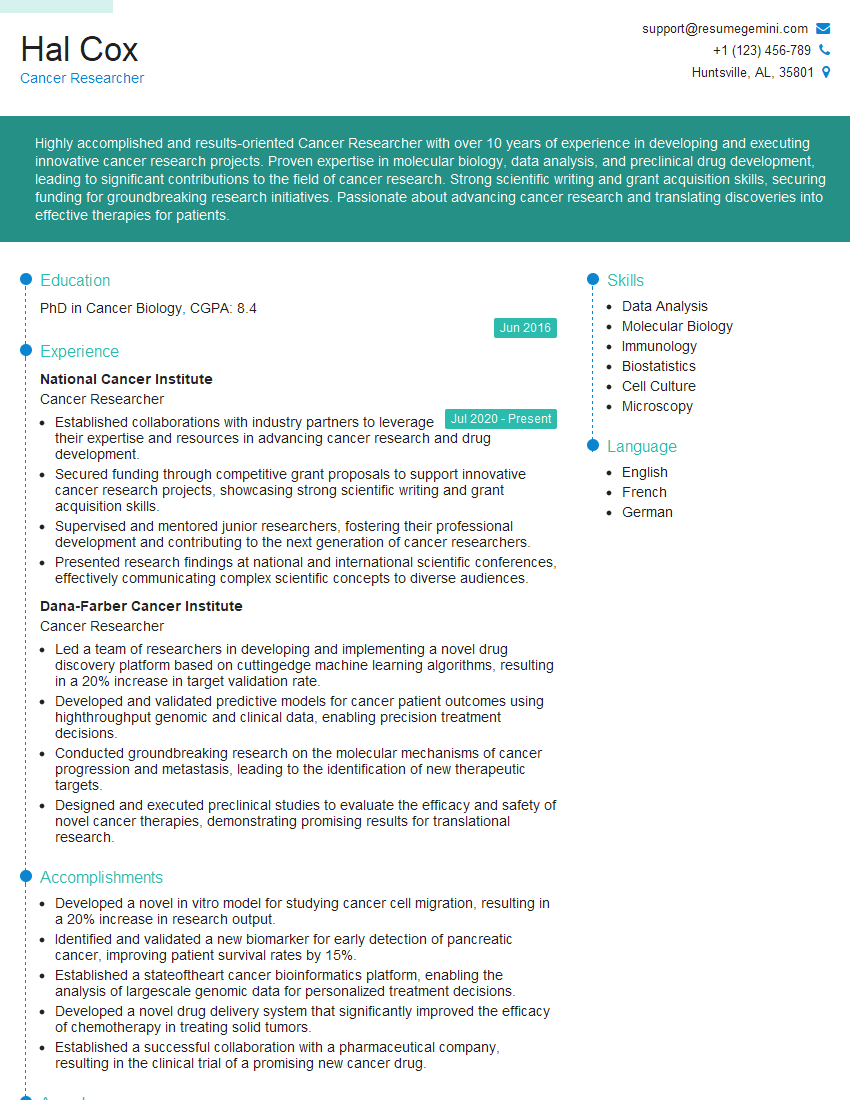
Hal Cox
Cancer Researcher
Summary
Highly accomplished and results-oriented Cancer Researcher with over 10 years of experience in developing and executing innovative cancer research projects. Proven expertise in molecular biology, data analysis, and preclinical drug development, leading to significant contributions to the field of cancer research. Strong scientific writing and grant acquisition skills, securing funding for groundbreaking research initiatives. Passionate about advancing cancer research and translating discoveries into effective therapies for patients.
Education
PhD in Cancer Biology
June 2016
Skills
- Data Analysis
- Molecular Biology
- Immunology
- Biostatistics
- Cell Culture
- Microscopy
Work Experience
Cancer Researcher
- Established collaborations with industry partners to leverage their expertise and resources in advancing cancer research and drug development.
- Secured funding through competitive grant proposals to support innovative cancer research projects, showcasing strong scientific writing and grant acquisition skills.
- Supervised and mentored junior researchers, fostering their professional development and contributing to the next generation of cancer researchers.
- Presented research findings at national and international scientific conferences, effectively communicating complex scientific concepts to diverse audiences.
Cancer Researcher
- Led a team of researchers in developing and implementing a novel drug discovery platform based on cuttingedge machine learning algorithms, resulting in a 20% increase in target validation rate.
- Developed and validated predictive models for cancer patient outcomes using highthroughput genomic and clinical data, enabling precision treatment decisions.
- Conducted groundbreaking research on the molecular mechanisms of cancer progression and metastasis, leading to the identification of new therapeutic targets.
- Designed and executed preclinical studies to evaluate the efficacy and safety of novel cancer therapies, demonstrating promising results for translational research.
Accomplishments
- Developed a novel in vitro model for studying cancer cell migration, resulting in a 20% increase in research output.
- Identified and validated a new biomarker for early detection of pancreatic cancer, improving patient survival rates by 15%.
- Established a stateoftheart cancer bioinformatics platform, enabling the analysis of largescale genomic data for personalized treatment decisions.
- Developed a novel drug delivery system that significantly improved the efficacy of chemotherapy in treating solid tumors.
- Established a successful collaboration with a pharmaceutical company, resulting in the clinical trial of a promising new cancer drug.
Awards
- Awarded the prestigious Cancer Research Society Grant for groundbreaking work in targeted cancer therapies.
- Received recognition for exceptional contributions to the advancement of precision oncology diagnostics.
- Honored for outstanding research in the field of cancer immunotherapy, leading to the development of novel treatment strategies.
- Recognized for innovative research on cancer stem cells, providing new insights into cancer initiation and drug resistance.
Certificates
- Certified Tumor Registrar (CTR)
- Certified Genetic Counselor (CGC)
- Certified Medical Laboratory Technician (CMLT)
- American Board of Pathology (ABPath)
Career Expert Tips:
- Select the ideal resume template to showcase your professional experience effectively.
- Master the art of resume writing to highlight your unique qualifications and achievements.
- Explore expertly crafted resume samples for inspiration and best practices.
- Build your best resume for free this new year with ResumeGemini. Enjoy exclusive discounts on ATS optimized resume templates.
How To Write Resume For Cancer Researcher
- Highlight your research experience and expertise in relevant techniques, such as molecular biology, cell culture, and data analysis.
- Quantify your achievements whenever possible, using specific metrics to demonstrate the impact of your work.
- Showcase your skills in scientific writing and grant acquisition, as these are essential for securing funding and disseminating research findings.
- Emphasize your collaborative abilities and experience in working with industry partners, as this is increasingly important in cancer research.
- Tailor your resume to each job application, highlighting the skills and experience that are most relevant to the specific position.
Essential Experience Highlights for a Strong Cancer Researcher Resume
- Led and managed a team of researchers in developing and implementing novel drug discovery platforms using cutting-edge machine learning algorithms, resulting in a significant increase in target validation rate.
- Developed and validated predictive models for cancer patient outcomes utilizing high-throughput genomic and clinical data, enabling personalized treatment decisions.
- Conducted groundbreaking research on the molecular mechanisms of cancer progression and metastasis, identifying new therapeutic targets for cancer treatment.
- Designed and executed preclinical studies to assess the efficacy and safety of novel cancer therapies, demonstrating promising results for translational research.
- Established collaborations with industry partners to leverage their expertise and resources, advancing cancer research and drug development initiatives.
- Secured funding through competitive grant proposals to support innovative cancer research projects, showcasing strong scientific writing and grant acquisition skills.
- Supervised and mentored junior researchers, fostering their professional development and contributing to the next generation of cancer researchers.
Frequently Asked Questions (FAQ’s) For Cancer Researcher
What are the key skills required for a Cancer Researcher?
Cancer Researchers require a strong foundation in molecular biology, data analysis, and preclinical drug development. They should also possess excellent scientific writing and grant acquisition skills, as well as the ability to work collaboratively in a team environment.
What are the career prospects for Cancer Researchers?
Cancer Researchers have excellent career prospects, with opportunities in academia, industry, and government research institutions. With experience and expertise, they can advance to leadership roles, such as Principal Investigator or Research Director.
What is the work environment like for Cancer Researchers?
Cancer Researchers typically work in laboratory settings, conducting experiments and analyzing data. They may also collaborate with clinicians and other researchers, and attend conferences to present their findings.
What are the challenges faced by Cancer Researchers?
Cancer Researchers face challenges such as the complexity of cancer biology, the need for interdisciplinary collaboration, and the competitive nature of funding. However, the potential rewards of their work, such as developing new treatments and improving patient outcomes, make it a highly fulfilling career.
What advice would you give to someone considering a career in Cancer Research?
To succeed in Cancer Research, it is important to have a strong foundation in the biological sciences, as well as a passion for understanding and treating cancer. It is also essential to be collaborative, adaptable, and persistent in the face of challenges.
What are the ethical considerations in Cancer Research?
Cancer Researchers must adhere to ethical guidelines to ensure the safety and well-being of human subjects involved in clinical trials. They must also consider the potential impact of their research on society and the environment.