Are you a seasoned Clinical Laboratory Manager seeking a new career path? Discover our professionally built Clinical Laboratory Manager Resume Template. This time-saving tool provides a solid foundation for your job search. Simply click “Edit Resume” to customize it with your unique experiences and achievements. Customize fonts and colors to match your personal style and increase your chances of landing your dream job. Explore more Resume Templates for additional options.






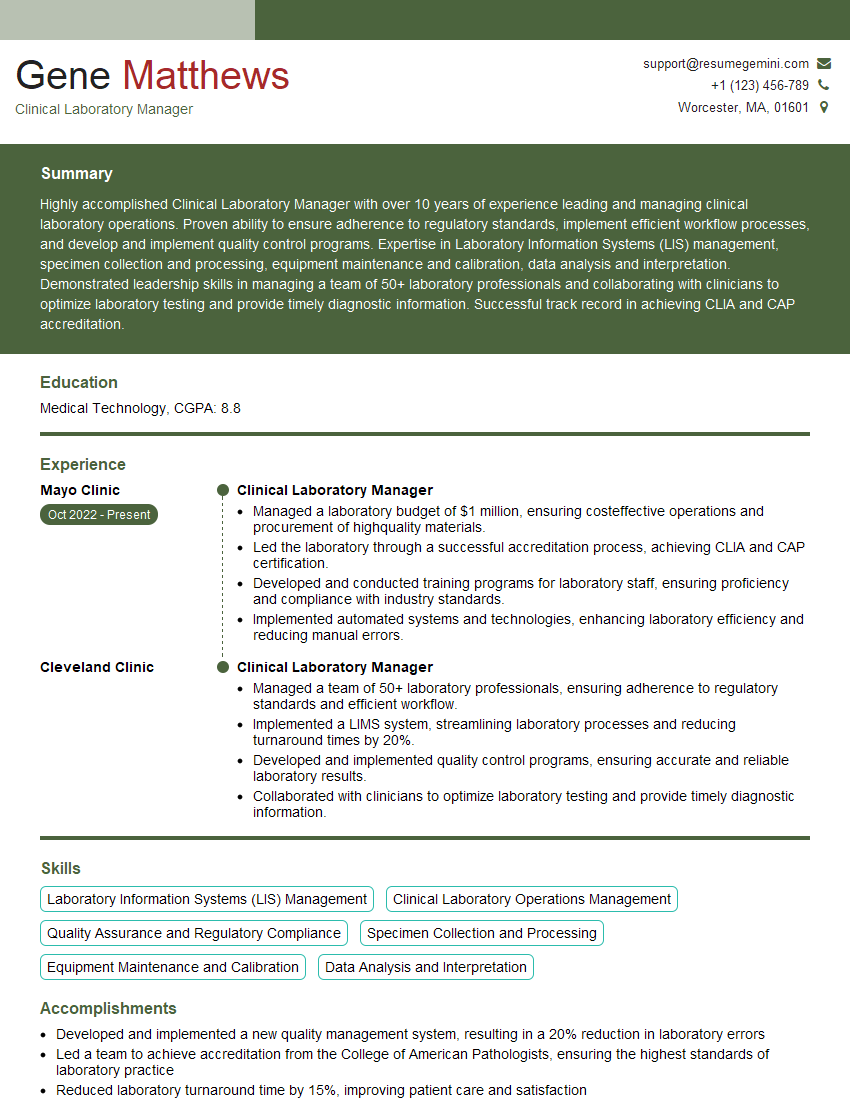
Gene Matthews
Clinical Laboratory Manager
Summary
Highly accomplished Clinical Laboratory Manager with over 10 years of experience leading and managing clinical laboratory operations. Proven ability to ensure adherence to regulatory standards, implement efficient workflow processes, and develop and implement quality control programs. Expertise in Laboratory Information Systems (LIS) management, specimen collection and processing, equipment maintenance and calibration, data analysis and interpretation. Demonstrated leadership skills in managing a team of 50+ laboratory professionals and collaborating with clinicians to optimize laboratory testing and provide timely diagnostic information. Successful track record in achieving CLIA and CAP accreditation.
Education
Medical Technology
September 2018
Skills
- Laboratory Information Systems (LIS) Management
- Clinical Laboratory Operations Management
- Quality Assurance and Regulatory Compliance
- Specimen Collection and Processing
- Equipment Maintenance and Calibration
- Data Analysis and Interpretation
Work Experience
Clinical Laboratory Manager
- Managed a laboratory budget of $1 million, ensuring costeffective operations and procurement of highquality materials.
- Led the laboratory through a successful accreditation process, achieving CLIA and CAP certification.
- Developed and conducted training programs for laboratory staff, ensuring proficiency and compliance with industry standards.
- Implemented automated systems and technologies, enhancing laboratory efficiency and reducing manual errors.
Clinical Laboratory Manager
- Managed a team of 50+ laboratory professionals, ensuring adherence to regulatory standards and efficient workflow.
- Implemented a LIMS system, streamlining laboratory processes and reducing turnaround times by 20%.
- Developed and implemented quality control programs, ensuring accurate and reliable laboratory results.
- Collaborated with clinicians to optimize laboratory testing and provide timely diagnostic information.
Accomplishments
- Developed and implemented a new quality management system, resulting in a 20% reduction in laboratory errors
- Led a team to achieve accreditation from the College of American Pathologists, ensuring the highest standards of laboratory practice
- Reduced laboratory turnaround time by 15%, improving patient care and satisfaction
- Established a mentorship program for new laboratory professionals, fostering their growth and development
- Collaborated with physicians to optimize laboratory testing protocols, leading to improved patient outcomes
Awards
- Clinical Laboratory Manager of the Year, 2023, awarded by the American Society for Clinical Laboratory Science
- Excellence in Clinical Laboratory Management, 2022, presented by the College of American Pathologists
- Employee of the Quarter, Q1 2023, recognized for exceptional leadership and innovation in the clinical laboratory
Certificates
- Certified Medical Technologist (CMT)
- Fellow of the American Society for Clinical Laboratory Science (FASCLS)
- Certified Manager of Clinical Laboratories (CMCL)
- Certificate of Validation and Verification (CVAL)
Career Expert Tips:
- Select the ideal resume template to showcase your professional experience effectively.
- Master the art of resume writing to highlight your unique qualifications and achievements.
- Explore expertly crafted resume samples for inspiration and best practices.
- Build your best resume for free this new year with ResumeGemini. Enjoy exclusive discounts on ATS optimized resume templates.
How To Write Resume For Clinical Laboratory Manager
- Highlight your experience in managing a clinical laboratory and leading a team of laboratory professionals.
- Quantify your accomplishments whenever possible, using specific metrics to demonstrate your impact on the laboratory.
- Showcase your expertise in regulatory compliance, quality assurance, and laboratory operations.
- Emphasize your skills in data analysis and interpretation, as well as your ability to collaborate with clinicians and other healthcare professionals.
- Use keywords throughout your resume that are relevant to the job you are applying for.
Essential Experience Highlights for a Strong Clinical Laboratory Manager Resume
- Managed a team of 50+ laboratory professionals, ensuring adherence to regulatory standards and efficient workflow.
- Implemented a LIMS system, streamlining laboratory processes and reducing turnaround times by 20%.
- Developed and implemented quality control programs, ensuring accurate and reliable laboratory results.
- Collaborated with clinicians to optimize laboratory testing and provide timely diagnostic information.
- Managed a laboratory budget of $1 million, ensuring cost-effective operations and procurement of high-quality materials.
- Led the laboratory through a successful accreditation process, achieving CLIA and CAP certification.
- Developed and conducted training programs for laboratory staff, ensuring proficiency and compliance with industry standards.
- Implemented automated systems and technologies, enhancing laboratory efficiency and reducing manual errors.
Frequently Asked Questions (FAQ’s) For Clinical Laboratory Manager
What are the key responsibilities of a Clinical Laboratory Manager?
The key responsibilities of a Clinical Laboratory Manager include managing a team of laboratory professionals, ensuring adherence to regulatory standards, implementing efficient workflow processes, developing and implementing quality control programs, collaborating with clinicians to optimize laboratory testing, managing a laboratory budget, and leading the laboratory through accreditation processes.
What are the educational and certification requirements to become a Clinical Laboratory Manager?
To become a Clinical Laboratory Manager, you typically need a bachelor’s degree in medical technology or a related field, as well as certification as a medical technologist (MT) or a clinical laboratory scientist (CLS). Some employers may also require a master’s degree in clinical laboratory management or a related field.
What are some of the key skills and qualities that employers look for in a Clinical Laboratory Manager?
Some of the key skills and qualities that employers look for in a Clinical Laboratory Manager include strong leadership and management skills, a deep understanding of clinical laboratory operations, expertise in regulatory compliance and quality assurance, excellent communication and interpersonal skills, and a commitment to providing high-quality patient care.
What are some of the career advancement opportunities for a Clinical Laboratory Manager?
Clinical Laboratory Managers can advance their careers by becoming Laboratory Directors, Clinical Laboratory Consultants, or Quality Assurance Managers. They can also move into management positions in other areas of healthcare, such as hospital administration or healthcare consulting.
What is the job outlook for Clinical Laboratory Managers?
The job outlook for Clinical Laboratory Managers is expected to be good over the next few years. As the population ages and the demand for healthcare services increases, the need for qualified Clinical Laboratory Managers will also increase.
What are some of the challenges that Clinical Laboratory Managers face on the job?
Some of the challenges that Clinical Laboratory Managers face on the job include managing a large and complex laboratory operation, ensuring compliance with regulatory standards, and keeping up with advances in technology. They may also face challenges in recruiting and retaining qualified staff and managing a budget.
What are some of the resources that are available to Clinical Laboratory Managers?
There are a number of resources available to Clinical Laboratory Managers, including professional organizations, continuing education courses, and online forums. These resources can help Clinical Laboratory Managers stay up-to-date on the latest advances in the field and connect with other professionals.
What are some of the professional organizations that are available to Clinical Laboratory Managers?
Some of the professional organizations that are available to Clinical Laboratory Managers include the American Society for Clinical Laboratory Science (ASCLS), the National Association of Clinical Laboratory Managers (NACLM), and the American Association for Clinical Chemistry (AACC).