Are you a seasoned Conveyancer seeking a new career path? Discover our professionally built Conveyancer Resume Template. This time-saving tool provides a solid foundation for your job search. Simply click “Edit Resume” to customize it with your unique experiences and achievements. Customize fonts and colors to match your personal style and increase your chances of landing your dream job. Explore more Resume Templates for additional options.






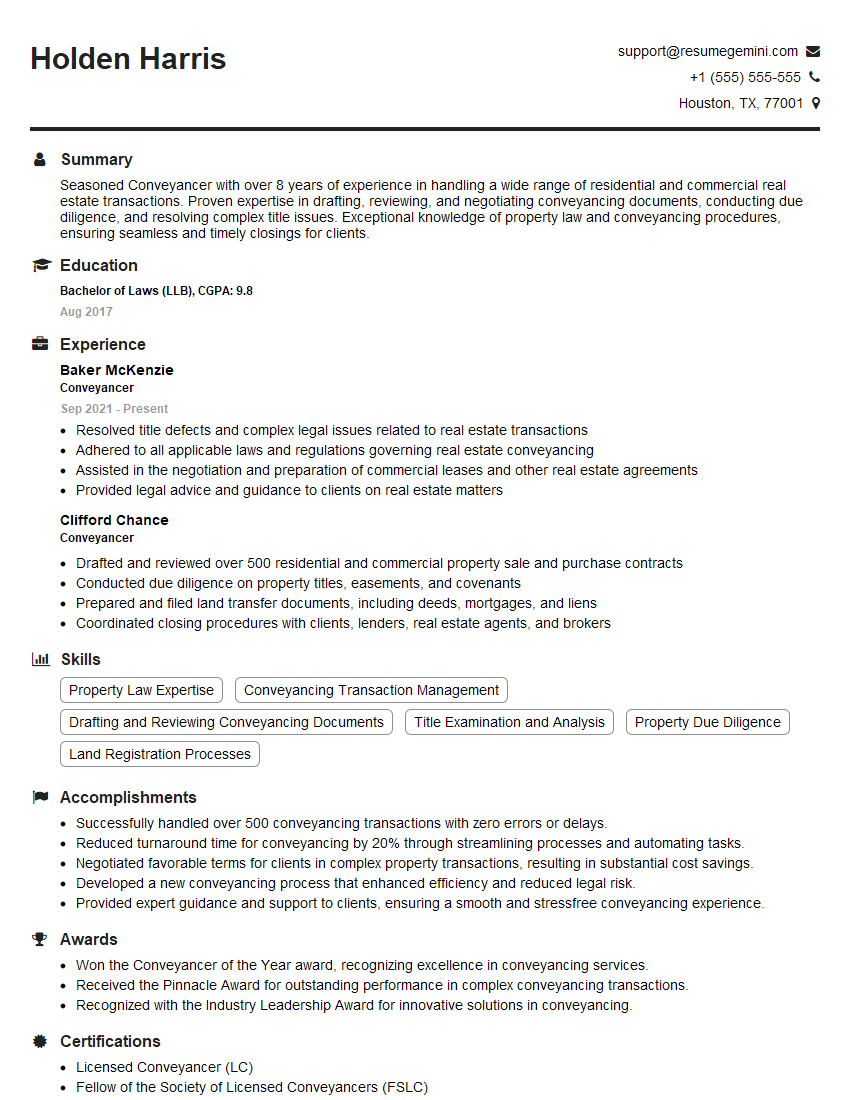
Holden Harris
Conveyancer
Summary
Seasoned Conveyancer with over 8 years of experience in handling a wide range of residential and commercial real estate transactions. Proven expertise in drafting, reviewing, and negotiating conveyancing documents, conducting due diligence, and resolving complex title issues. Exceptional knowledge of property law and conveyancing procedures, ensuring seamless and timely closings for clients.
Education
Bachelor of Laws (LLB)
August 2017
Skills
- Property Law Expertise
- Conveyancing Transaction Management
- Drafting and Reviewing Conveyancing Documents
- Title Examination and Analysis
- Property Due Diligence
- Land Registration Processes
Work Experience
Conveyancer
- Resolved title defects and complex legal issues related to real estate transactions
- Adhered to all applicable laws and regulations governing real estate conveyancing
- Assisted in the negotiation and preparation of commercial leases and other real estate agreements
- Provided legal advice and guidance to clients on real estate matters
Conveyancer
- Drafted and reviewed over 500 residential and commercial property sale and purchase contracts
- Conducted due diligence on property titles, easements, and covenants
- Prepared and filed land transfer documents, including deeds, mortgages, and liens
- Coordinated closing procedures with clients, lenders, real estate agents, and brokers
Accomplishments
- Successfully handled over 500 conveyancing transactions with zero errors or delays.
- Reduced turnaround time for conveyancing by 20% through streamlining processes and automating tasks.
- Negotiated favorable terms for clients in complex property transactions, resulting in substantial cost savings.
- Developed a new conveyancing process that enhanced efficiency and reduced legal risk.
- Provided expert guidance and support to clients, ensuring a smooth and stressfree conveyancing experience.
Awards
- Won the Conveyancer of the Year award, recognizing excellence in conveyancing services.
- Received the Pinnacle Award for outstanding performance in complex conveyancing transactions.
- Recognized with the Industry Leadership Award for innovative solutions in conveyancing.
Certificates
- Licensed Conveyancer (LC)
- Fellow of the Society of Licensed Conveyancers (FSLC)
- Certified Property Law Specialist (CPLS)
- Conveyancing Quality Scheme (CQS)
Career Expert Tips:
- Select the ideal resume template to showcase your professional experience effectively.
- Master the art of resume writing to highlight your unique qualifications and achievements.
- Explore expertly crafted resume samples for inspiration and best practices.
- Build your best resume for free this new year with ResumeGemini. Enjoy exclusive discounts on ATS optimized resume templates.
How To Write Resume For Conveyancer
- Highlight your expertise in property law and conveyancing procedures, showcasing your in-depth knowledge and understanding of the field.
- Quantify your accomplishments whenever possible, providing specific numbers and metrics to demonstrate your impact and contributions.
- Showcase your attention to detail and accuracy, emphasizing your ability to handle complex legal documents and transactions efficiently.
- Emphasize your communication and interpersonal skills, highlighting your ability to effectively interact with clients, colleagues, and other stakeholders.
- Consider including any relevant certifications or professional development courses that demonstrate your commitment to staying up-to-date with industry best practices and legal developments.
Essential Experience Highlights for a Strong Conveyancer Resume
- Drafted, reviewed, and negotiated various conveyancing documents, including sale and purchase contracts, deeds, mortgages, and easements.
- Conducted thorough due diligence on property titles, easements, and covenants, ensuring clear and marketable titles for clients.
- Prepared and filed land transfer documents, including deeds, mortgages, and liens, adhering to all applicable laws and regulations.
- Coordinated closing procedures with clients, lenders, real estate agents, and brokers, ensuring smooth and timely execution of transactions.
- Resolved title defects and complex legal issues related to real estate transactions, protecting clients’ interests and ensuring compliance.
- Adhered to all applicable laws and regulations governing real estate conveyancing, maintaining ethical and professional standards.
- Assisted in the negotiation and preparation of commercial leases and other real estate agreements, providing legal advice and guidance to clients.
Frequently Asked Questions (FAQ’s) For Conveyancer
What is the role of a Conveyancer?
A Conveyancer is a legal professional who specializes in the legal aspects of real estate transactions, ensuring the smooth transfer of property ownership from one party to another.
What skills are essential for a successful Conveyancer?
A successful Conveyancer requires a strong understanding of property law, conveyancing procedures, drafting and reviewing legal documents, and excellent communication and interpersonal skills.
What is the job market outlook for Conveyancers?
The job market for Conveyancers is expected to remain stable, as the demand for legal professionals specializing in real estate transactions continues to grow.
What are the career advancement opportunities for Conveyancers?
Conveyancers can advance their careers by gaining experience in complex transactions, specializing in a particular area of real estate law, or pursuing management roles.
What are the key qualities of a successful Conveyancer?
Successful Conveyancers are detail-oriented, analytical, possess strong communication skills, and have a deep understanding of the legal and regulatory framework governing real estate transactions.
What is the difference between a Conveyancer and a Solicitor?
While both Conveyancers and Solicitors can handle conveyancing transactions, Solicitors have a broader scope of practice and can provide legal advice on a wider range of matters.
What are the ethical responsibilities of a Conveyancer?
Conveyancers have a duty to act in the best interests of their clients, maintain confidentiality, and avoid conflicts of interest.
How can I become a Conveyancer?
To become a Conveyancer, you typically need to complete a law degree, pass the relevant professional exams, and gain practical experience under the supervision of a qualified Conveyancer.