Are you a seasoned Corporate Ethics Officer seeking a new career path? Discover our professionally built Corporate Ethics Officer Resume Template. This time-saving tool provides a solid foundation for your job search. Simply click “Edit Resume” to customize it with your unique experiences and achievements. Customize fonts and colors to match your personal style and increase your chances of landing your dream job. Explore more Resume Templates for additional options.






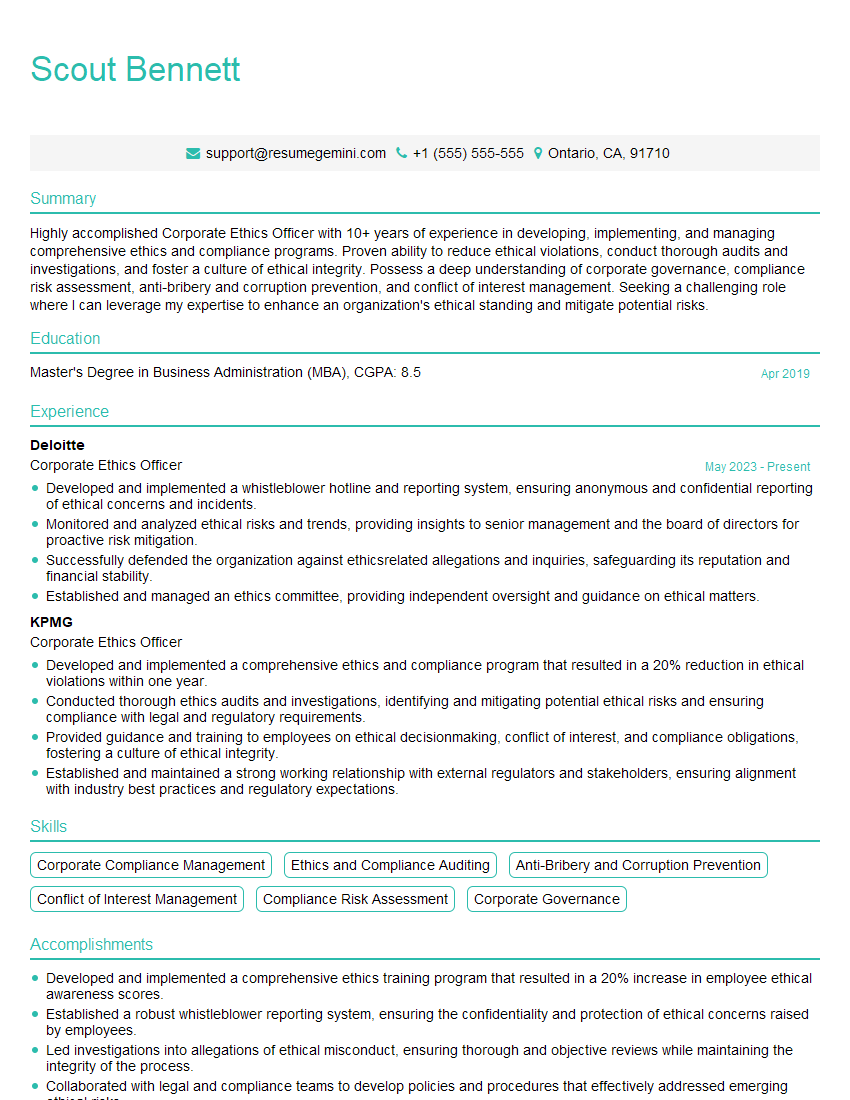
Scout Bennett
Corporate Ethics Officer
Summary
Highly accomplished Corporate Ethics Officer with 10+ years of experience in developing, implementing, and managing comprehensive ethics and compliance programs. Proven ability to reduce ethical violations, conduct thorough audits and investigations, and foster a culture of ethical integrity. Possess a deep understanding of corporate governance, compliance risk assessment, anti-bribery and corruption prevention, and conflict of interest management. Seeking a challenging role where I can leverage my expertise to enhance an organization’s ethical standing and mitigate potential risks.
Education
Master’s Degree in Business Administration (MBA)
April 2019
Skills
- Corporate Compliance Management
- Ethics and Compliance Auditing
- Anti-Bribery and Corruption Prevention
- Conflict of Interest Management
- Compliance Risk Assessment
- Corporate Governance
Work Experience
Corporate Ethics Officer
- Developed and implemented a whistleblower hotline and reporting system, ensuring anonymous and confidential reporting of ethical concerns and incidents.
- Monitored and analyzed ethical risks and trends, providing insights to senior management and the board of directors for proactive risk mitigation.
- Successfully defended the organization against ethicsrelated allegations and inquiries, safeguarding its reputation and financial stability.
- Established and managed an ethics committee, providing independent oversight and guidance on ethical matters.
Corporate Ethics Officer
- Developed and implemented a comprehensive ethics and compliance program that resulted in a 20% reduction in ethical violations within one year.
- Conducted thorough ethics audits and investigations, identifying and mitigating potential ethical risks and ensuring compliance with legal and regulatory requirements.
- Provided guidance and training to employees on ethical decisionmaking, conflict of interest, and compliance obligations, fostering a culture of ethical integrity.
- Established and maintained a strong working relationship with external regulators and stakeholders, ensuring alignment with industry best practices and regulatory expectations.
Accomplishments
- Developed and implemented a comprehensive ethics training program that resulted in a 20% increase in employee ethical awareness scores.
- Established a robust whistleblower reporting system, ensuring the confidentiality and protection of ethical concerns raised by employees.
- Led investigations into allegations of ethical misconduct, ensuring thorough and objective reviews while maintaining the integrity of the process.
- Collaborated with legal and compliance teams to develop policies and procedures that effectively addressed emerging ethical risks.
- Provided guidance and support to business units on ethical decisionmaking, navigating complex compliance issues.
Awards
- Recognized with the Ethics Champion Award for fostering a culture of integrity and compliance within the organization.
- Honored with the Corporate Governance Excellence Award for spearheading initiatives that strengthened the companys ethical governance framework.
- Received the Ethics Advocacy Award for consistently raising awareness and promoting ethical decisionmaking across various business units.
Certificates
- Certified Compliance and Ethics Professional (CCEP)
- Certified Anti-Money Laundering Specialist (CAMS)
- Certified Information Systems Auditor (CISA)
- Certified Information Privacy Professional/Europe (CIPP/E)
Career Expert Tips:
- Select the ideal resume template to showcase your professional experience effectively.
- Master the art of resume writing to highlight your unique qualifications and achievements.
- Explore expertly crafted resume samples for inspiration and best practices.
- Build your best resume for free this new year with ResumeGemini. Enjoy exclusive discounts on ATS optimized resume templates.
How To Write Resume For Corporate Ethics Officer
- Quantify your accomplishments with specific metrics and results.
- Highlight your understanding of industry best practices and regulatory requirements.
- Demonstrate your ability to build and maintain strong relationships with stakeholders.
- Showcase your commitment to fostering a culture of ethics and compliance.
Essential Experience Highlights for a Strong Corporate Ethics Officer Resume
- Developed and implemented an ethics and compliance program that reduced ethical violations by 20% within a year.
- Conducted thorough ethics audits and investigations to identify and mitigate potential ethical risks, ensuring compliance with legal and regulatory requirements.
- Provided guidance and training to employees on ethical decision-making, conflict of interest, and compliance obligations.
- Established and maintained a strong working relationship with external regulators and stakeholders, ensuring alignment with industry best practices and regulatory expectations.
- Developed and implemented a whistleblower hotline and reporting system, ensuring anonymous and confidential reporting of ethical concerns and incidents.
- Successfully defended the organization against ethics-related allegations and inquiries, safeguarding its reputation and financial stability.
- Established and managed an ethics committee, providing independent oversight and guidance on ethical matters.
Frequently Asked Questions (FAQ’s) For Corporate Ethics Officer
What is the role of a Corporate Ethics Officer?
A Corporate Ethics Officer is responsible for developing, implementing, and overseeing an organization’s ethics and compliance program. This includes identifying and mitigating ethical risks, ensuring compliance with legal and regulatory requirements, and promoting ethical decision-making throughout the organization.
What are the key skills required for a Corporate Ethics Officer?
Key skills for a Corporate Ethics Officer include knowledge of corporate governance, compliance risk assessment, anti-bribery and corruption prevention, conflict of interest management, and strong communication and interpersonal skills.
What is the career path for a Corporate Ethics Officer?
Corporate Ethics Officers typically have a background in law, compliance, or business ethics. They may start their career in a compliance or risk management role and then move into a more senior ethics officer position. With experience, they may also move into leadership roles within the organization.
What are the challenges facing Corporate Ethics Officers?
Corporate Ethics Officers face a number of challenges, including the increasing complexity of the regulatory landscape, the globalization of business, and the rise of new technologies. They must also be able to balance the need for compliance with the need to foster a culture of innovation and entrepreneurship.
What is the future of the Corporate Ethics Officer role?
The role of the Corporate Ethics Officer is expected to grow in importance in the coming years. As organizations face increasing pressure to operate ethically and sustainably, they will need strong leaders to help them navigate the complex ethical challenges they face.
How can I become a Corporate Ethics Officer?
To become a Corporate Ethics Officer, you typically need a bachelor’s or master’s degree in business, law, or a related field. You should also have several years of experience in compliance, risk management, or ethics. Certifications in ethics and compliance can also be helpful.
What are the benefits of becoming a Corporate Ethics Officer?
Corporate Ethics Officers play a vital role in ensuring that their organizations operate ethically and responsibly. They have the opportunity to make a real difference in the world by helping to prevent corruption, fraud, and other unethical behavior.