Are you a seasoned Cotton Grower seeking a new career path? Discover our professionally built Cotton Grower Resume Template. This time-saving tool provides a solid foundation for your job search. Simply click “Edit Resume” to customize it with your unique experiences and achievements. Customize fonts and colors to match your personal style and increase your chances of landing your dream job. Explore more Resume Templates for additional options.






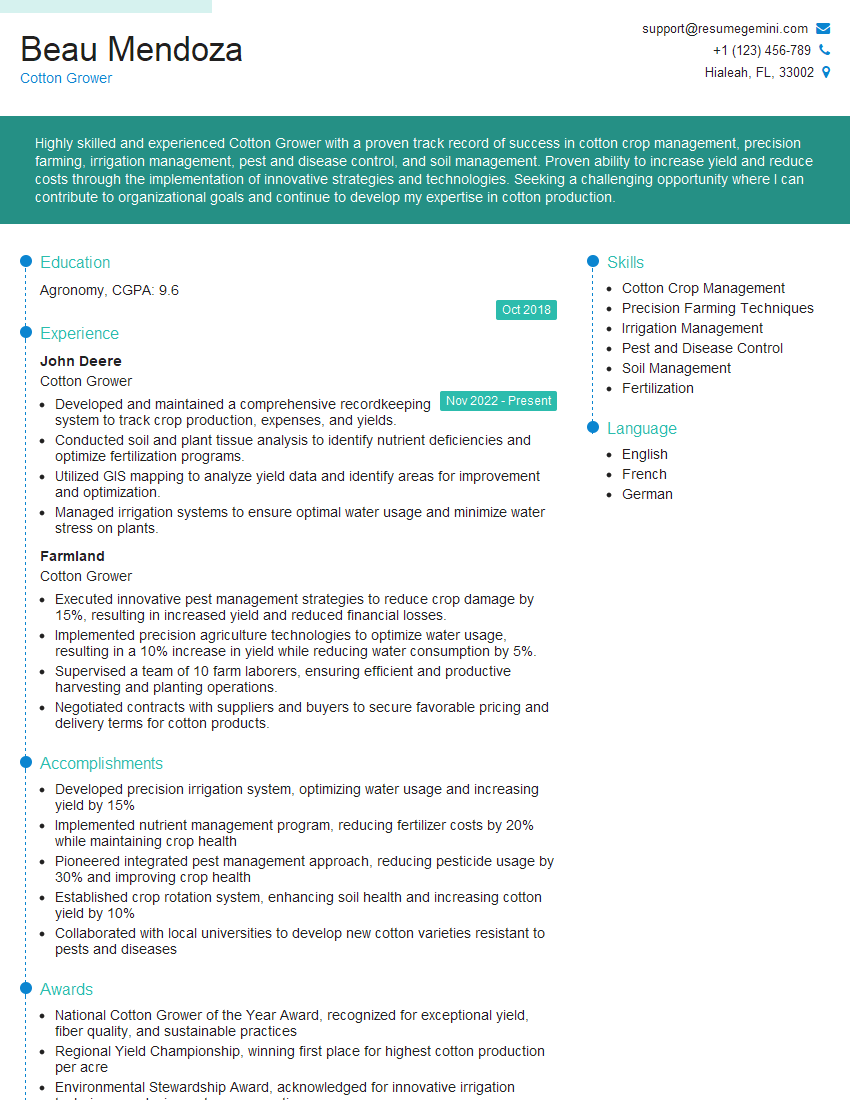
Beau Mendoza
Cotton Grower
Summary
Highly skilled and experienced Cotton Grower with a proven track record of success in cotton crop management, precision farming, irrigation management, pest and disease control, and soil management. Proven ability to increase yield and reduce costs through the implementation of innovative strategies and technologies. Seeking a challenging opportunity where I can contribute to organizational goals and continue to develop my expertise in cotton production.
Education
Agronomy
October 2018
Skills
- Cotton Crop Management
- Precision Farming Techniques
- Irrigation Management
- Pest and Disease Control
- Soil Management
- Fertilization
Work Experience
Cotton Grower
- Developed and maintained a comprehensive recordkeeping system to track crop production, expenses, and yields.
- Conducted soil and plant tissue analysis to identify nutrient deficiencies and optimize fertilization programs.
- Utilized GIS mapping to analyze yield data and identify areas for improvement and optimization.
- Managed irrigation systems to ensure optimal water usage and minimize water stress on plants.
Cotton Grower
- Executed innovative pest management strategies to reduce crop damage by 15%, resulting in increased yield and reduced financial losses.
- Implemented precision agriculture technologies to optimize water usage, resulting in a 10% increase in yield while reducing water consumption by 5%.
- Supervised a team of 10 farm laborers, ensuring efficient and productive harvesting and planting operations.
- Negotiated contracts with suppliers and buyers to secure favorable pricing and delivery terms for cotton products.
Accomplishments
- Developed precision irrigation system, optimizing water usage and increasing yield by 15%
- Implemented nutrient management program, reducing fertilizer costs by 20% while maintaining crop health
- Pioneered integrated pest management approach, reducing pesticide usage by 30% and improving crop health
- Established crop rotation system, enhancing soil health and increasing cotton yield by 10%
- Collaborated with local universities to develop new cotton varieties resistant to pests and diseases
Awards
- National Cotton Grower of the Year Award, recognized for exceptional yield, fiber quality, and sustainable practices
- Regional Yield Championship, winning first place for highest cotton production per acre
- Environmental Stewardship Award, acknowledged for innovative irrigation techniques reducing water consumption
Certificates
- Certified Cotton Grower (CCG)
- Certified Crop Advisor (CCA)
- Precision Agricultural Specialist (PAS)
- Certified Water Conservationist (CWC)
Career Expert Tips:
- Select the ideal resume template to showcase your professional experience effectively.
- Master the art of resume writing to highlight your unique qualifications and achievements.
- Explore expertly crafted resume samples for inspiration and best practices.
- Build your best resume for free this new year with ResumeGemini. Enjoy exclusive discounts on ATS optimized resume templates.
How To Write Resume For Cotton Grower
- Highlight your expertise in cotton crop management, precision farming, and irrigation management.
- Demonstrate your ability to increase yield and profitability through the implementation of innovative strategies and technologies.
- Emphasize your leadership and management skills, including your ability to supervise a team and ensure operational efficiency.
- Quantify your accomplishments with specific metrics and data whenever possible.
- Showcase your knowledge of sustainable farming practices and your commitment to environmental stewardship.
Essential Experience Highlights for a Strong Cotton Grower Resume
- Executed innovative pest management strategies to reduce crop damage by 15%, resulting in increased yield and reduced financial losses.
- Implemented precision agriculture technologies to optimize water usage, resulting in a 10% increase in yield while reducing water consumption by 5%.
- Managed irrigation systems to ensure optimal water usage and minimize water stress on plants.
- Developed and implemented fertilization programs based on soil and plant tissue analysis to optimize crop growth and yield.
- Supervised a team of farm laborers, ensuring efficient and productive harvesting and planting operations.
- Conducted training for new hires and provided ongoing guidance and support to ensure operational excellence.
- Applied sustainable farming practices to protect environmental resources and preserve soil health for future generations.
Frequently Asked Questions (FAQ’s) For Cotton Grower
What are the key skills and qualifications required to be a successful Cotton Grower?
The key skills and qualifications required to be a successful Cotton Grower include a deep understanding of cotton crop management, precision farming techniques, irrigation management, pest and disease control, soil management, and fertilization. Additionally, strong leadership and management skills are essential, along with a commitment to sustainability and environmental stewardship.
What are the career prospects for Cotton Growers?
Cotton Growers with the right skills and experience can enjoy excellent career prospects. The demand for cotton is expected to remain strong in the coming years, and growers who can produce high-quality cotton efficiently and sustainably will be in high demand. Advancement opportunities may include farm management, agricultural consulting, or research and development.
What are the challenges facing Cotton Growers today?
Cotton Growers today face a number of challenges, including climate change, pests and diseases, and volatile market prices. Climate change is leading to more extreme weather events, which can damage crops and reduce yields. Pests and diseases are also a major threat to cotton production, and growers must constantly adapt their management practices to control these threats. Additionally, the market price of cotton can fluctuate significantly, making it difficult for growers to plan their operations and secure a stable income.
What are the latest trends in Cotton Growing?
The latest trends in Cotton Growing include the adoption of precision farming technologies, the development of new pest and disease resistant varieties, and the use of sustainable farming practices. Precision farming technologies allow growers to collect data on their crops and fields, which can then be used to make informed decisions about irrigation, fertilization, and pest control. New pest and disease resistant varieties are being developed to help growers reduce their reliance on pesticides and herbicides. Sustainable farming practices are being adopted to protect the environment and ensure the long-term sustainability of cotton production.
What are the environmental impacts of Cotton Growing?
Cotton Growing can have a number of environmental impacts, including soil erosion, water pollution, and greenhouse gas emissions. Soil erosion can occur when cotton fields are not properly managed, and this can lead to the loss of topsoil and nutrients. Water pollution can occur when pesticides and herbicides are used excessively, and these chemicals can harm aquatic life and contaminate drinking water sources. Greenhouse gas emissions are produced when cotton is grown using fossil fuels, such as for irrigation and transportation.