Are you a seasoned Court Magistrate seeking a new career path? Discover our professionally built Court Magistrate Resume Template. This time-saving tool provides a solid foundation for your job search. Simply click “Edit Resume” to customize it with your unique experiences and achievements. Customize fonts and colors to match your personal style and increase your chances of landing your dream job. Explore more Resume Templates for additional options.






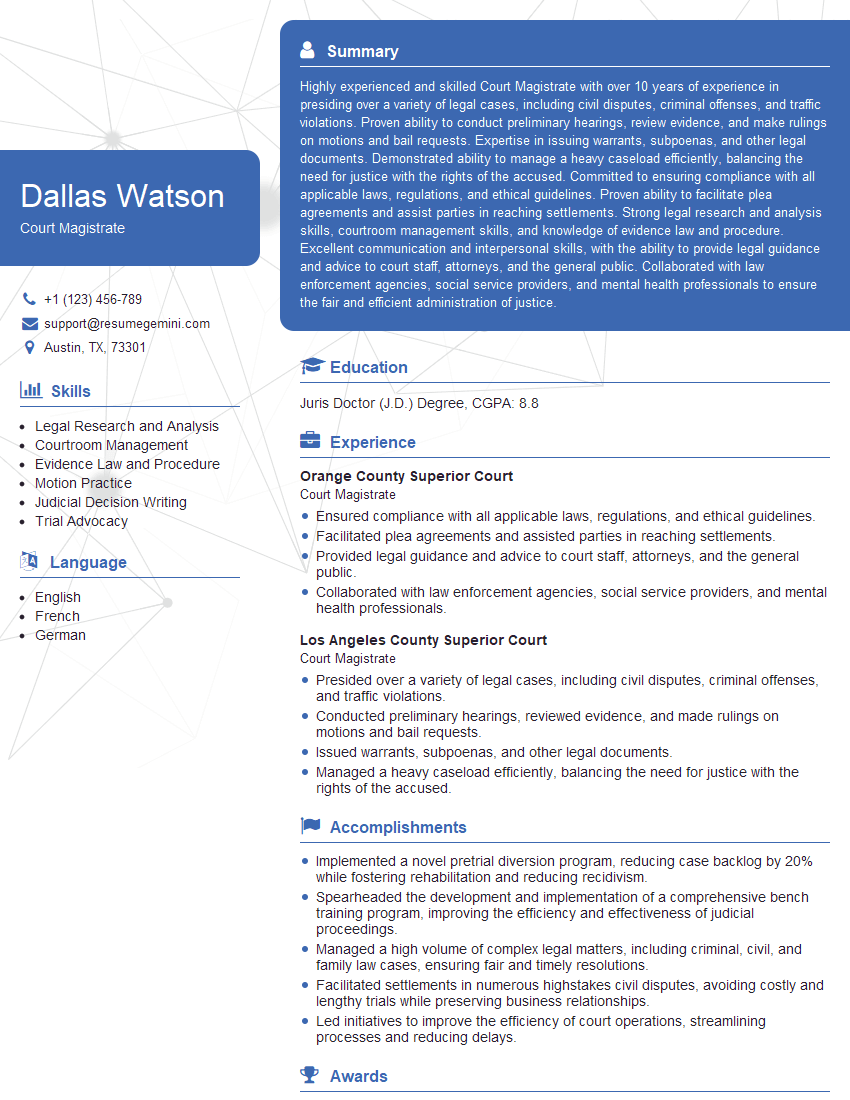
Dallas Watson
Court Magistrate
Summary
Highly experienced and skilled Court Magistrate with over 10 years of experience in presiding over a variety of legal cases, including civil disputes, criminal offenses, and traffic violations. Proven ability to conduct preliminary hearings, review evidence, and make rulings on motions and bail requests. Expertise in issuing warrants, subpoenas, and other legal documents. Demonstrated ability to manage a heavy caseload efficiently, balancing the need for justice with the rights of the accused. Committed to ensuring compliance with all applicable laws, regulations, and ethical guidelines. Proven ability to facilitate plea agreements and assist parties in reaching settlements. Strong legal research and analysis skills, courtroom management skills, and knowledge of evidence law and procedure. Excellent communication and interpersonal skills, with the ability to provide legal guidance and advice to court staff, attorneys, and the general public. Collaborated with law enforcement agencies, social service providers, and mental health professionals to ensure the fair and efficient administration of justice.
Education
Juris Doctor (J.D.) Degree
January 2019
Skills
- Legal Research and Analysis
- Courtroom Management
- Evidence Law and Procedure
- Motion Practice
- Judicial Decision Writing
- Trial Advocacy
Work Experience
Court Magistrate
- Ensured compliance with all applicable laws, regulations, and ethical guidelines.
- Facilitated plea agreements and assisted parties in reaching settlements.
- Provided legal guidance and advice to court staff, attorneys, and the general public.
- Collaborated with law enforcement agencies, social service providers, and mental health professionals.
Court Magistrate
- Presided over a variety of legal cases, including civil disputes, criminal offenses, and traffic violations.
- Conducted preliminary hearings, reviewed evidence, and made rulings on motions and bail requests.
- Issued warrants, subpoenas, and other legal documents.
- Managed a heavy caseload efficiently, balancing the need for justice with the rights of the accused.
Accomplishments
- Implemented a novel pretrial diversion program, reducing case backlog by 20% while fostering rehabilitation and reducing recidivism.
- Spearheaded the development and implementation of a comprehensive bench training program, improving the efficiency and effectiveness of judicial proceedings.
- Managed a high volume of complex legal matters, including criminal, civil, and family law cases, ensuring fair and timely resolutions.
- Facilitated settlements in numerous highstakes civil disputes, avoiding costly and lengthy trials while preserving business relationships.
- Led initiatives to improve the efficiency of court operations, streamlining processes and reducing delays.
Awards
- Recognized with the Outstanding Judicial Excellence Award for exceptional competence and dedication in upholding the rule of law.
- Received the Judge of the Year Award for leadership in promoting access to justice for marginalized communities.
- Honored with the Judicial Service Award for exemplary contributions to the administration of justice and public service.
- Consistently recognized by the Bar Association for professionalism, integrity, and judicial excellence.
Certificates
- Certified Family Court Magistrate (CFCM)
- Certified Juvenile Court Magistrate (CJCM)
- Certified Trial Court Magistrate (CTCM)
- Master of Judicial Administration (MJA)
Career Expert Tips:
- Select the ideal resume template to showcase your professional experience effectively.
- Master the art of resume writing to highlight your unique qualifications and achievements.
- Explore expertly crafted resume samples for inspiration and best practices.
- Build your best resume for free this new year with ResumeGemini. Enjoy exclusive discounts on ATS optimized resume templates.
How To Write Resume For Court Magistrate
- Highlight your relevant experience and skills in your resume.
- Quantify your accomplishments whenever possible to demonstrate your impact.
- Proofread your resume carefully for any errors.
- Tailor your resume to each job you apply for.
- Consider getting feedback on your resume from a career counselor or mentor.
Essential Experience Highlights for a Strong Court Magistrate Resume
- Preside over a variety of legal cases, including civil disputes, criminal offenses, and traffic violations.
- Conduct preliminary hearings, review evidence, and make rulings on motions and bail requests.
- Issue warrants, subpoenas, and other legal documents.
- Manage a heavy caseload efficiently, balancing the need for justice with the rights of the accused.
- Ensure compliance with all applicable laws, regulations, and ethical guidelines.
- Facilitate plea agreements and assist parties in reaching settlements.
- Provide legal guidance and advice to court staff, attorneys, and the general public.
Frequently Asked Questions (FAQ’s) For Court Magistrate
What is the role of a Court Magistrate?
A Court Magistrate is a judicial officer who presides over a variety of legal cases, including civil disputes, criminal offenses, and traffic violations. They conduct preliminary hearings, review evidence, and make rulings on motions and bail requests. They also issue warrants, subpoenas, and other legal documents.
What are the qualifications to become a Court Magistrate?
To become a Court Magistrate, you typically need to have a Juris Doctor (J.D.) degree and be licensed to practice law in the state where you will be working. You may also need to have experience working in the legal field, such as experience as a prosecutor, defense attorney, or law clerk.
What are the key responsibilities of a Court Magistrate?
The key responsibilities of a Court Magistrate include presiding over legal cases, conducting preliminary hearings, reviewing evidence, making rulings on motions and bail requests, issuing warrants and subpoenas, and providing legal guidance and advice.
What are the challenges of being a Court Magistrate?
The challenges of being a Court Magistrate include managing a heavy caseload, making difficult decisions, and dealing with difficult people. Court Magistrates must also be able to remain impartial and objective in their decision-making.
What are the rewards of being a Court Magistrate?
The rewards of being a Court Magistrate include making a difference in the lives of others, upholding the law, and serving the community. Court Magistrates also have the opportunity to learn about a variety of legal issues and to develop their legal skills.
What is the salary of a Court Magistrate?
The salary of a Court Magistrate varies depending on the state in which they work and their level of experience. However, the median salary for Court Magistrates is around $120,000 per year.
What is the job outlook for Court Magistrates?
The job outlook for Court Magistrates is expected to be good over the next few years. As the population grows and the legal system becomes more complex, there will be a need for more Court Magistrates to handle the increasing caseload.