Are you a seasoned Enterprise Systems Engineer seeking a new career path? Discover our professionally built Enterprise Systems Engineer Resume Template. This time-saving tool provides a solid foundation for your job search. Simply click “Edit Resume” to customize it with your unique experiences and achievements. Customize fonts and colors to match your personal style and increase your chances of landing your dream job. Explore more Resume Templates for additional options.






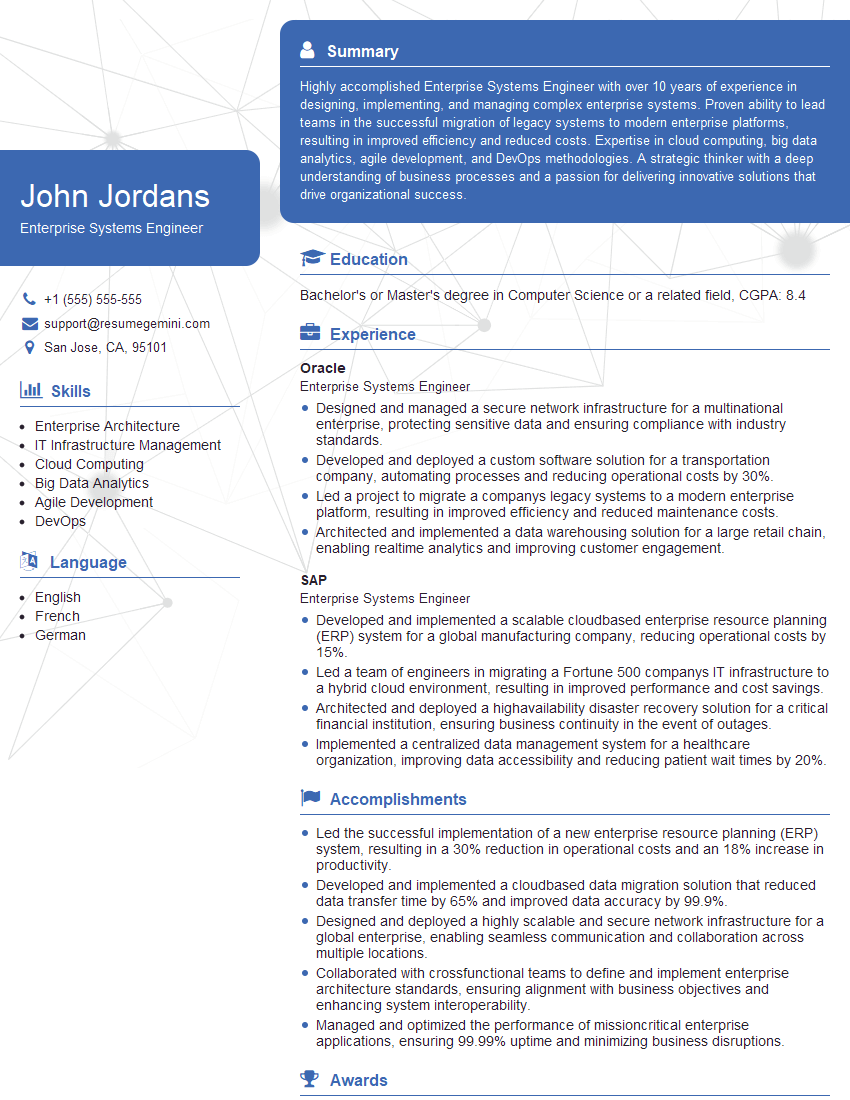
John Jordans
Enterprise Systems Engineer
Summary
Highly accomplished Enterprise Systems Engineer with over 10 years of experience in designing, implementing, and managing complex enterprise systems. Proven ability to lead teams in the successful migration of legacy systems to modern enterprise platforms, resulting in improved efficiency and reduced costs. Expertise in cloud computing, big data analytics, agile development, and DevOps methodologies. A strategic thinker with a deep understanding of business processes and a passion for delivering innovative solutions that drive organizational success.
Education
Bachelor’s or Master’s degree in Computer Science or a related field
February 2015
Skills
- Enterprise Architecture
- IT Infrastructure Management
- Cloud Computing
- Big Data Analytics
- Agile Development
- DevOps
Work Experience
Enterprise Systems Engineer
- Designed and managed a secure network infrastructure for a multinational enterprise, protecting sensitive data and ensuring compliance with industry standards.
- Developed and deployed a custom software solution for a transportation company, automating processes and reducing operational costs by 30%.
- Led a project to migrate a companys legacy systems to a modern enterprise platform, resulting in improved efficiency and reduced maintenance costs.
- Architected and implemented a data warehousing solution for a large retail chain, enabling realtime analytics and improving customer engagement.
Enterprise Systems Engineer
- Developed and implemented a scalable cloudbased enterprise resource planning (ERP) system for a global manufacturing company, reducing operational costs by 15%.
- Led a team of engineers in migrating a Fortune 500 companys IT infrastructure to a hybrid cloud environment, resulting in improved performance and cost savings.
- Architected and deployed a highavailability disaster recovery solution for a critical financial institution, ensuring business continuity in the event of outages.
- Implemented a centralized data management system for a healthcare organization, improving data accessibility and reducing patient wait times by 20%.
Accomplishments
- Led the successful implementation of a new enterprise resource planning (ERP) system, resulting in a 30% reduction in operational costs and an 18% increase in productivity.
- Developed and implemented a cloudbased data migration solution that reduced data transfer time by 65% and improved data accuracy by 99.9%.
- Designed and deployed a highly scalable and secure network infrastructure for a global enterprise, enabling seamless communication and collaboration across multiple locations.
- Collaborated with crossfunctional teams to define and implement enterprise architecture standards, ensuring alignment with business objectives and enhancing system interoperability.
- Managed and optimized the performance of missioncritical enterprise applications, ensuring 99.99% uptime and minimizing business disruptions.
Awards
- IT Rising Star of the Year Award Presented by the American IT Research Institute, awarded for outstanding leadership and innovation in the field of enterprise systems engineering.
- Microsoft Certified Solutions Expert (MCSE) Data Management and Analytics Certification recognizing advanced proficiency in Microsofts enterprise data management and analytics technologies.
- Top 10% Performer Award Consistently recognized within the top 10% of enterprise systems engineers for exceptional performance and contributions.
- Oracle Certified Professional (OCP) Database Administrator Certification demonstrating expertise in Oracle database administration and optimization techniques.
Certificates
- AWS Certified Solutions Architect – Associate
- AWS Certified Solutions Architect – Professional
- Azure Architect Design
- Azure Architect Technologies
Career Expert Tips:
- Select the ideal resume template to showcase your professional experience effectively.
- Master the art of resume writing to highlight your unique qualifications and achievements.
- Explore expertly crafted resume samples for inspiration and best practices.
- Build your best resume for free this new year with ResumeGemini. Enjoy exclusive discounts on ATS optimized resume templates.
How To Write Resume For Enterprise Systems Engineer
- Quantify your accomplishments with specific metrics and results.
- Highlight your experience in leading and managing teams.
- Tailor your resume to each specific job description.
- Proofread your resume carefully for any errors.
Essential Experience Highlights for a Strong Enterprise Systems Engineer Resume
- Design, implement, and maintain enterprise-wide systems that align with business objectives
- Lead teams in the migration of legacy systems to modern enterprise platforms
- Develop and implement cloud-based solutions to improve performance and reduce costs
- Analyze and interpret data to identify areas for process improvement
- Work closely with business stakeholders to understand their needs and develop tailored solutions
- Ensure compliance with industry standards and best practices
- Stay abreast of emerging technologies and trends to deliver innovative solutions
Frequently Asked Questions (FAQ’s) For Enterprise Systems Engineer
What is the role of an Enterprise Systems Engineer?
An Enterprise Systems Engineer is responsible for designing, implementing, and managing enterprise-wide systems that support business operations. They work closely with business stakeholders to understand their needs and develop tailored solutions that align with business objectives.
What skills are required to be an Enterprise Systems Engineer?
Enterprise Systems Engineers typically have a background in computer science or a related field. They should have experience in designing, implementing, and managing complex enterprise systems. Additionally, they should be proficient in cloud computing, big data analytics, agile development, and DevOps methodologies.
What are the career prospects for Enterprise Systems Engineers?
Enterprise Systems Engineers are in high demand as businesses increasingly rely on technology to improve their operations. They can work in a variety of industries, including finance, healthcare, manufacturing, and retail. With experience, Enterprise Systems Engineers can advance to senior-level positions, such as Enterprise Architect or Chief Technology Officer.
How can I become an Enterprise Systems Engineer?
To become an Enterprise Systems Engineer, you typically need a bachelor’s or master’s degree in computer science or a related field. You should also have experience in designing, implementing, and managing complex enterprise systems. Additionally, you should be proficient in cloud computing, big data analytics, agile development, and DevOps methodologies.
What is the salary range for Enterprise Systems Engineers?
The salary range for Enterprise Systems Engineers varies depending on experience, location, and industry. According to Glassdoor, the average salary for an Enterprise Systems Engineer in the United States is $115,000 per year.