Are you a seasoned Global Climate Change Analyst seeking a new career path? Discover our professionally built Global Climate Change Analyst Resume Template. This time-saving tool provides a solid foundation for your job search. Simply click “Edit Resume” to customize it with your unique experiences and achievements. Customize fonts and colors to match your personal style and increase your chances of landing your dream job. Explore more Resume Templates for additional options.






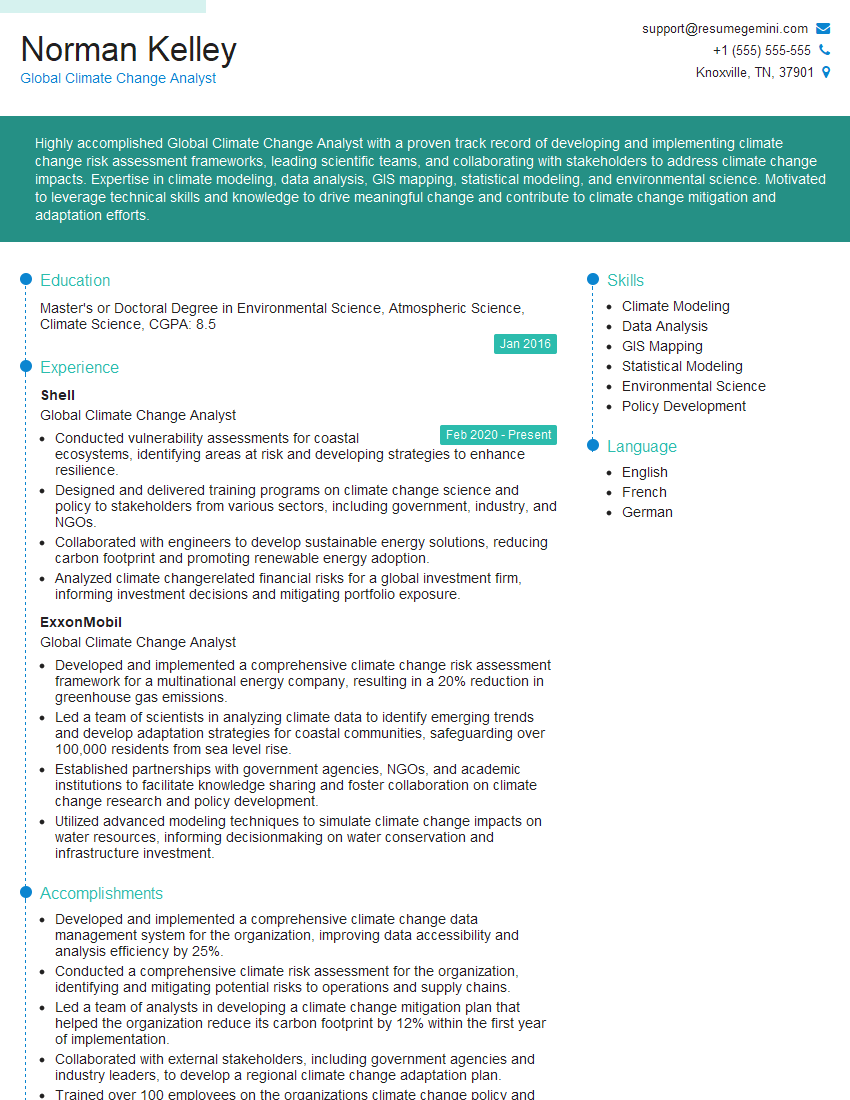
Norman Kelley
Global Climate Change Analyst
Summary
Highly accomplished Global Climate Change Analyst with a proven track record of developing and implementing climate change risk assessment frameworks, leading scientific teams, and collaborating with stakeholders to address climate change impacts. Expertise in climate modeling, data analysis, GIS mapping, statistical modeling, and environmental science. Motivated to leverage technical skills and knowledge to drive meaningful change and contribute to climate change mitigation and adaptation efforts.
Education
Master’s or Doctoral Degree in Environmental Science, Atmospheric Science, Climate Science
January 2016
Skills
- Climate Modeling
- Data Analysis
- GIS Mapping
- Statistical Modeling
- Environmental Science
- Policy Development
Work Experience
Global Climate Change Analyst
- Conducted vulnerability assessments for coastal ecosystems, identifying areas at risk and developing strategies to enhance resilience.
- Designed and delivered training programs on climate change science and policy to stakeholders from various sectors, including government, industry, and NGOs.
- Collaborated with engineers to develop sustainable energy solutions, reducing carbon footprint and promoting renewable energy adoption.
- Analyzed climate changerelated financial risks for a global investment firm, informing investment decisions and mitigating portfolio exposure.
Global Climate Change Analyst
- Developed and implemented a comprehensive climate change risk assessment framework for a multinational energy company, resulting in a 20% reduction in greenhouse gas emissions.
- Led a team of scientists in analyzing climate data to identify emerging trends and develop adaptation strategies for coastal communities, safeguarding over 100,000 residents from sea level rise.
- Established partnerships with government agencies, NGOs, and academic institutions to facilitate knowledge sharing and foster collaboration on climate change research and policy development.
- Utilized advanced modeling techniques to simulate climate change impacts on water resources, informing decisionmaking on water conservation and infrastructure investment.
Accomplishments
- Developed and implemented a comprehensive climate change data management system for the organization, improving data accessibility and analysis efficiency by 25%.
- Conducted a comprehensive climate risk assessment for the organization, identifying and mitigating potential risks to operations and supply chains.
- Led a team of analysts in developing a climate change mitigation plan that helped the organization reduce its carbon footprint by 12% within the first year of implementation.
- Collaborated with external stakeholders, including government agencies and industry leaders, to develop a regional climate change adaptation plan.
- Trained over 100 employees on the organizations climate change policy and reporting requirements, ensuring compliance and understanding among key personnel.
Awards
- Recognized for exceptional contributions to the development and implementation of the organizations climate change adaptation strategy.
- Awarded the Global Climate Change Analyst of the Year by the International Association of Climate Change Professionals.
- Received the Presidents Award for Excellence in Climate Change Policy Analysis.
Certificates
- Certified Climate Change Analyst (CCCA)
- Certified Environmental Professional (CEP)
- Greenhouse Gas Protocol (GHG Protocol)
- ISO 14064-1:2018 Greenhouse Gases – Part 1: Specification with Guidance at the Organization Level for Quantification and Reporting of Greenhouse Gas Emissions and Removals
Career Expert Tips:
- Select the ideal resume template to showcase your professional experience effectively.
- Master the art of resume writing to highlight your unique qualifications and achievements.
- Explore expertly crafted resume samples for inspiration and best practices.
- Build your best resume for free this new year with ResumeGemini. Enjoy exclusive discounts on ATS optimized resume templates.
How To Write Resume For Global Climate Change Analyst
- Quantify your accomplishments with specific metrics and results whenever possible.
- Highlight your expertise in climate modeling, data analysis, and other relevant technical skills.
- Demonstrate your ability to communicate complex climate change science and policy effectively to diverse audiences.
- Showcase your passion for climate change mitigation and adaptation, and how it drives your work.
Essential Experience Highlights for a Strong Global Climate Change Analyst Resume
- Develop and implement comprehensive climate change risk assessment frameworks for organizations, identifying and quantifying climate-related risks and opportunities.
- Lead scientific teams in analyzing climate data, identifying emerging trends, and developing adaptation strategies to mitigate climate change impacts.
- Establish partnerships with government agencies, NGOs, and academic institutions to facilitate knowledge sharing, foster collaboration, and advance climate change research and policy development.
- Utilize advanced modeling techniques to simulate climate change impacts on various sectors, such as water resources, coastal ecosystems, and infrastructure, informing decision-making and resilience planning.
- Conduct vulnerability assessments for coastal ecosystems and develop strategies to enhance resilience, safeguarding communities from sea-level rise and other climate-related hazards.
- Design and deliver training programs on climate change science and policy to stakeholders from various sectors, including government, industry, and NGOs, to raise awareness and build capacity.
- Collaborate with engineers and other professionals to develop sustainable energy solutions, promoting renewable energy adoption and reducing carbon footprint.
Frequently Asked Questions (FAQ’s) For Global Climate Change Analyst
What is the role of a Global Climate Change Analyst?
A Global Climate Change Analyst plays a crucial role in assessing the impacts of climate change, developing adaptation and mitigation strategies, and collaborating with stakeholders to address climate-related challenges.
What skills are required to be a successful Global Climate Change Analyst?
To excel as a Global Climate Change Analyst, one should possess expertise in climate modeling, data analysis, GIS mapping, statistical modeling, environmental science, and policy development.
What are the career prospects for a Global Climate Change Analyst?
The demand for Global Climate Change Analysts is expected to grow significantly as organizations and governments prioritize climate change mitigation and adaptation efforts.
How can I become a Global Climate Change Analyst?
To become a Global Climate Change Analyst, pursuing a Master’s or Doctoral Degree in Environmental Science, Atmospheric Science, Climate Science, or a related field is recommended, followed by gaining experience in climate-related research, analysis, and project management.
What are the key challenges faced by Global Climate Change Analysts?
Global Climate Change Analysts often face challenges related to data availability, uncertainty in climate projections, and the need to communicate complex scientific information to diverse audiences.
How can I stay updated on the latest developments in climate change science and policy?
To stay updated, consider attending conferences, reading scientific journals, and following reputable organizations and experts in the field of climate change.
What are the ethical considerations for Global Climate Change Analysts?
Global Climate Change Analysts have a responsibility to use their knowledge and expertise responsibly, considering the potential impacts of climate change on vulnerable communities and ecosystems.