Are you a seasoned Hood Fitter seeking a new career path? Discover our professionally built Hood Fitter Resume Template. This time-saving tool provides a solid foundation for your job search. Simply click “Edit Resume” to customize it with your unique experiences and achievements. Customize fonts and colors to match your personal style and increase your chances of landing your dream job. Explore more Resume Templates for additional options.






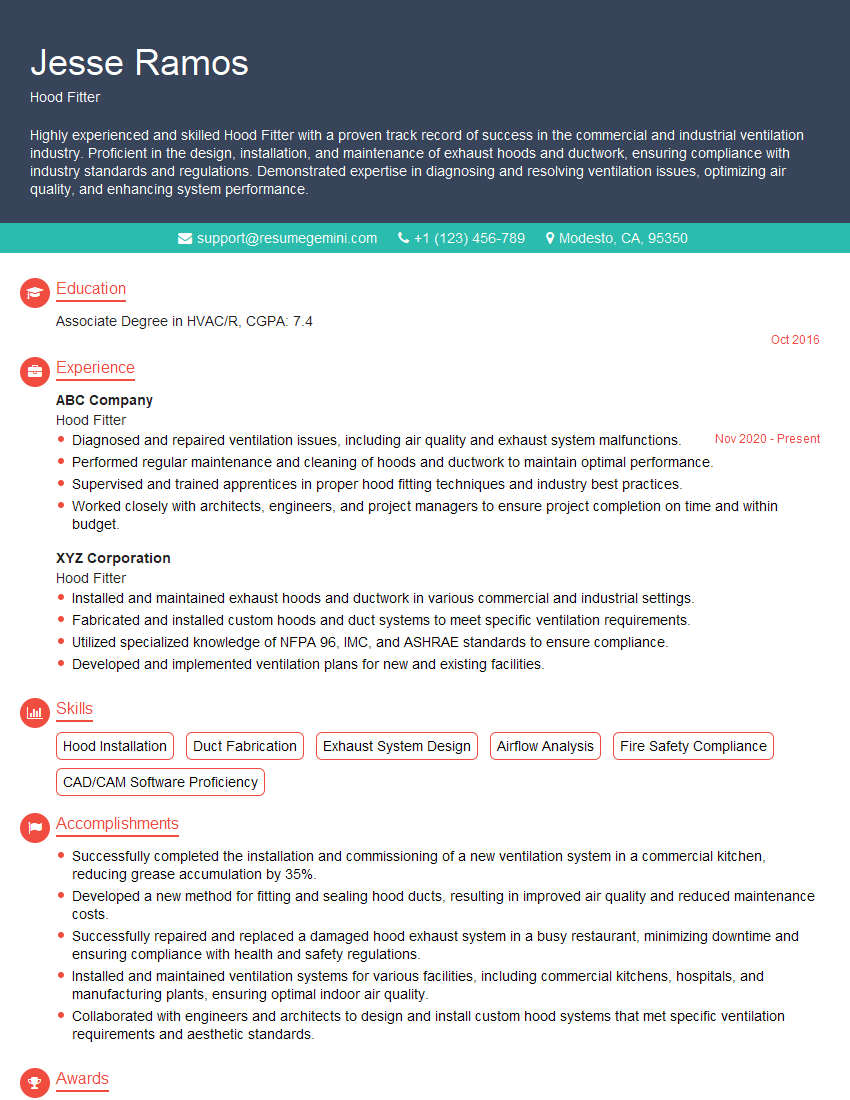
Jesse Ramos
Hood Fitter
Summary
Highly experienced and skilled Hood Fitter with a proven track record of success in the commercial and industrial ventilation industry. Proficient in the design, installation, and maintenance of exhaust hoods and ductwork, ensuring compliance with industry standards and regulations. Demonstrated expertise in diagnosing and resolving ventilation issues, optimizing air quality, and enhancing system performance.
Education
Associate Degree in HVAC/R
October 2016
Skills
- Hood Installation
- Duct Fabrication
- Exhaust System Design
- Airflow Analysis
- Fire Safety Compliance
- CAD/CAM Software Proficiency
Work Experience
Hood Fitter
- Diagnosed and repaired ventilation issues, including air quality and exhaust system malfunctions.
- Performed regular maintenance and cleaning of hoods and ductwork to maintain optimal performance.
- Supervised and trained apprentices in proper hood fitting techniques and industry best practices.
- Worked closely with architects, engineers, and project managers to ensure project completion on time and within budget.
Hood Fitter
- Installed and maintained exhaust hoods and ductwork in various commercial and industrial settings.
- Fabricated and installed custom hoods and duct systems to meet specific ventilation requirements.
- Utilized specialized knowledge of NFPA 96, IMC, and ASHRAE standards to ensure compliance.
- Developed and implemented ventilation plans for new and existing facilities.
Accomplishments
- Successfully completed the installation and commissioning of a new ventilation system in a commercial kitchen, reducing grease accumulation by 35%.
- Developed a new method for fitting and sealing hood ducts, resulting in improved air quality and reduced maintenance costs.
- Successfully repaired and replaced a damaged hood exhaust system in a busy restaurant, minimizing downtime and ensuring compliance with health and safety regulations.
- Installed and maintained ventilation systems for various facilities, including commercial kitchens, hospitals, and manufacturing plants, ensuring optimal indoor air quality.
- Collaborated with engineers and architects to design and install custom hood systems that met specific ventilation requirements and aesthetic standards.
Awards
- Recognized as Fitter of the Year by the National Institute of Kitchen Equipment Manufacturers (NIKAEM).
- Received the Safety Excellence Award from the Associated Builders and Contractors (ABC) for maintaining an exemplary safety record on all projects.
- Honored with the Craftsmanship Award from the American Society of Heating, Refrigerating and AirConditioning Engineers (ASHRAE) for exceptional workmanship on a ventilation project.
- Recognized as a Master Fitter by the Sheet Metal and Air Conditioning Contractors National Association (SMACNA) for superior skills and knowledge.
Certificates
- Certified Hood Fitter (CHF)
- National Fire Protection Association (NFPA) 96 Inspector
- Occupational Safety and Health Administration (OSHA) 30-Hour Construction Safety Training
- American Welding Society (AWS) Certified Welder
Career Expert Tips:
- Select the ideal resume template to showcase your professional experience effectively.
- Master the art of resume writing to highlight your unique qualifications and achievements.
- Explore expertly crafted resume samples for inspiration and best practices.
- Build your best resume for free this new year with ResumeGemini. Enjoy exclusive discounts on ATS optimized resume templates.
How To Write Resume For Hood Fitter
- Quantify your accomplishments with specific metrics and data to demonstrate your impact on the organization.
- Highlight your knowledge of industry codes and standards, such as NFPA 96 and IMC, showcasing your commitment to safety and compliance.
- Emphasize your ability to work independently and as part of a team, highlighting your adaptability and collaborative nature.
- Showcase your commitment to continuous learning and professional development, indicating your eagerness to stay up-to-date with industry trends and best practices.
- Include keywords relevant to the Hood Fitter role, such as exhaust hood installation, duct fabrication, ventilation design, and fire safety compliance, to enhance your resume’s visibility to potential employers.
Essential Experience Highlights for a Strong Hood Fitter Resume
- Installed and maintained exhaust hoods and ductwork in various commercial and industrial settings, ensuring compliance with NFPA 96, IMC, and ASHRAE standards.
- Fabricated and installed custom hoods and duct systems to meet specific ventilation requirements, ensuring optimal performance and efficiency.
- Developed and implemented ventilation plans for new and existing facilities, considering airflow analysis, fire safety compliance, and energy efficiency.
- Diagnosed and repaired ventilation issues, including air quality and exhaust system malfunctions, ensuring timely resolution and system integrity.
- Performed regular maintenance and cleaning of hoods and ductwork to maintain optimal performance, prevent breakdowns, and extend equipment lifespan.
- Supervised and trained apprentices in proper hood fitting techniques and industry best practices, fostering knowledge transfer and skill development.
- Collaborated closely with architects, engineers, and project managers to ensure project completion on time and within budget, facilitating effective communication and coordination.
Frequently Asked Questions (FAQ’s) For Hood Fitter
What is the primary role of a Hood Fitter?
A Hood Fitter is responsible for the design, installation, maintenance, and repair of exhaust hoods and ductwork in commercial and industrial settings, ensuring proper ventilation and compliance with safety standards.
What qualifications are required to become a Hood Fitter?
Typically, an Associate Degree in HVAC/R or a related field, along with hands-on experience in sheet metal fabrication and installation, is required to become a Hood Fitter.
What industry standards and regulations should Hood Fitters be familiar with?
Hood Fitters should be well-versed in industry standards and regulations, including NFPA 96, IMC, and ASHRAE standards, which provide guidelines for the design, installation, and maintenance of ventilation systems.
What are the essential skills for a successful Hood Fitter?
Strong knowledge of sheet metal fabrication techniques, proficiency in CAD/CAM software for ductwork design, understanding of airflow analysis and fire safety compliance, and excellent problem-solving and troubleshooting abilities are crucial for Hood Fitters.
What career advancement opportunities are available for Hood Fitters?
With experience and additional training, Hood Fitters can advance to roles such as Ventilation System Designer, Project Manager, or even start their own ventilation contracting business.
Is certification necessary for Hood Fitters?
While not mandatory, obtaining certifications from organizations like the Sheet Metal and Air Conditioning Contractors’ National Association (SMACNA) can enhance credibility and demonstrate professional competence.
What are the safety precautions that Hood Fitters should observe?
Hood Fitters should prioritize safety by wearing appropriate protective gear, following lockout/tagout procedures, working at heights with proper fall protection, and adhering to established safety protocols to minimize risks.
How can Hood Fitters stay updated with industry trends and best practices?
Attending industry conferences, workshops, and training programs, as well as reading trade publications and participating in online forums, helps Hood Fitters stay informed about the latest advancements and best practices in the field.