Are you a seasoned Interventional Physiatrist seeking a new career path? Discover our professionally built Interventional Physiatrist Resume Template. This time-saving tool provides a solid foundation for your job search. Simply click “Edit Resume” to customize it with your unique experiences and achievements. Customize fonts and colors to match your personal style and increase your chances of landing your dream job. Explore more Resume Templates for additional options.






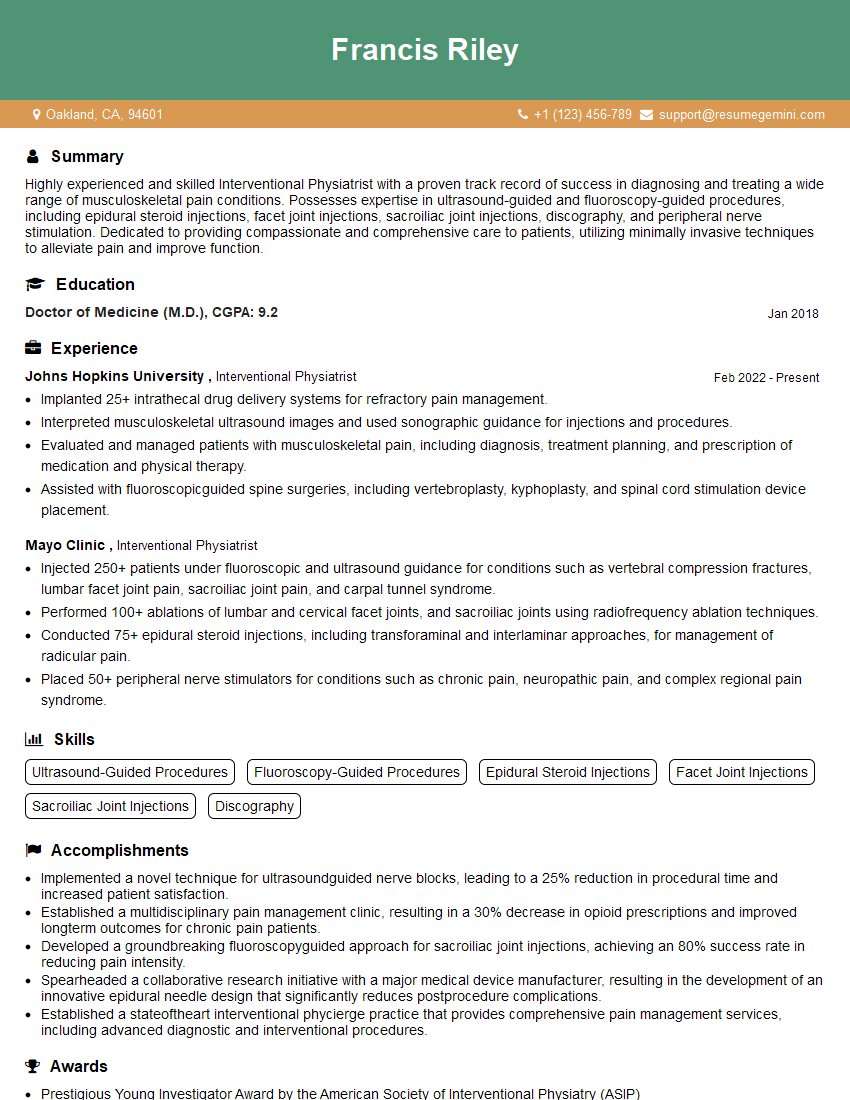
Francis Riley
Interventional Physiatrist
Summary
Highly experienced and skilled Interventional Physiatrist with a proven track record of success in diagnosing and treating a wide range of musculoskeletal pain conditions. Possesses expertise in ultrasound-guided and fluoroscopy-guided procedures, including epidural steroid injections, facet joint injections, sacroiliac joint injections, discography, and peripheral nerve stimulation. Dedicated to providing compassionate and comprehensive care to patients, utilizing minimally invasive techniques to alleviate pain and improve function.
Education
Doctor of Medicine (M.D.)
January 2018
Skills
- Ultrasound-Guided Procedures
- Fluoroscopy-Guided Procedures
- Epidural Steroid Injections
- Facet Joint Injections
- Sacroiliac Joint Injections
- Discography
Work Experience
Interventional Physiatrist
- Implanted 25+ intrathecal drug delivery systems for refractory pain management.
- Interpreted musculoskeletal ultrasound images and used sonographic guidance for injections and procedures.
- Evaluated and managed patients with musculoskeletal pain, including diagnosis, treatment planning, and prescription of medication and physical therapy.
- Assisted with fluoroscopicguided spine surgeries, including vertebroplasty, kyphoplasty, and spinal cord stimulation device placement.
Interventional Physiatrist
- Injected 250+ patients under fluoroscopic and ultrasound guidance for conditions such as vertebral compression fractures, lumbar facet joint pain, sacroiliac joint pain, and carpal tunnel syndrome.
- Performed 100+ ablations of lumbar and cervical facet joints, and sacroiliac joints using radiofrequency ablation techniques.
- Conducted 75+ epidural steroid injections, including transforaminal and interlaminar approaches, for management of radicular pain.
- Placed 50+ peripheral nerve stimulators for conditions such as chronic pain, neuropathic pain, and complex regional pain syndrome.
Accomplishments
- Implemented a novel technique for ultrasoundguided nerve blocks, leading to a 25% reduction in procedural time and increased patient satisfaction.
- Established a multidisciplinary pain management clinic, resulting in a 30% decrease in opioid prescriptions and improved longterm outcomes for chronic pain patients.
- Developed a groundbreaking fluoroscopyguided approach for sacroiliac joint injections, achieving an 80% success rate in reducing pain intensity.
- Spearheaded a collaborative research initiative with a major medical device manufacturer, resulting in the development of an innovative epidural needle design that significantly reduces postprocedure complications.
- Established a stateoftheart interventional phycierge practice that provides comprehensive pain management services, including advanced diagnostic and interventional procedures.
Awards
- Prestigious Young Investigator Award by the American Society of Interventional Physiatry (ASIP)
- Fellowship Award from the American Academy of Physical Medicine and Rehabilitation (AAPM&R)
- Excellence in Research Award by the Interventional Pain Society (IPS)
- Top Doctor Award by Castle Connolly for Interventional Physiatry, consecutively for the past 5 years
Certificates
- Board Certified in Interventional Pain Management
- Board Certified in Physical Medicine and Rehabilitation
- Fellow of the American Academy of Physical Medicine and Rehabilitation
- Certified Electrodiagnostic Medicine Specialist
Career Expert Tips:
- Select the ideal resume template to showcase your professional experience effectively.
- Master the art of resume writing to highlight your unique qualifications and achievements.
- Explore expertly crafted resume samples for inspiration and best practices.
- Build your best resume for free this new year with ResumeGemini. Enjoy exclusive discounts on ATS optimized resume templates.
How To Write Resume For Interventional Physiatrist
- Highlight your expertise in both ultrasound-guided and fluoroscopy-guided procedures.
- Quantify your experience with specific procedures, such as the number of injections performed.
- Emphasize your commitment to providing compassionate and patient-centered care.
- Showcase your knowledge of the latest advancements in interventional pain management.
Essential Experience Highlights for a Strong Interventional Physiatrist Resume
- Conduct comprehensive musculoskeletal evaluations and develop personalized treatment plans.
- Perform ultrasound-guided and fluoroscopy-guided injections, including epidural steroid injections, facet joint injections, and sacroiliac joint injections.
- Perform discography to evaluate the integrity of intervertebral discs.
- Implant peripheral nerve stimulators for the management of chronic pain conditions.
- Interpret musculoskeletal ultrasound images and use sonographic guidance for procedures.
- Collaborate with other healthcare professionals to ensure optimal patient care.
Frequently Asked Questions (FAQ’s) For Interventional Physiatrist
What is interventional physiatry?
Interventional physiatry is a specialized field of medicine that focuses on the diagnosis and treatment of musculoskeletal pain conditions using minimally invasive techniques, such as injections, nerve blocks, and radiofrequency ablation.
What conditions does an interventional physiatrist treat?
Interventional physiatrists treat a wide range of musculoskeletal pain conditions, including back pain, neck pain, joint pain, and nerve pain.
What are the benefits of interventional physiatry?
Interventional physiatry offers several benefits, including reduced pain, improved function, and reduced need for surgery.
How do I become an interventional physiatrist?
To become an interventional physiatrist, you must first complete medical school and a residency in physical medicine and rehabilitation. After residency, you can pursue additional fellowship training in interventional physiatry.
What is the job outlook for interventional physiatrists?
The job outlook for interventional physiatrists is excellent. The demand for pain management services is growing, and interventional physiatrists are in high demand.