Are you a seasoned Line Locator seeking a new career path? Discover our professionally built Line Locator Resume Template. This time-saving tool provides a solid foundation for your job search. Simply click “Edit Resume” to customize it with your unique experiences and achievements. Customize fonts and colors to match your personal style and increase your chances of landing your dream job. Explore more Resume Templates for additional options.






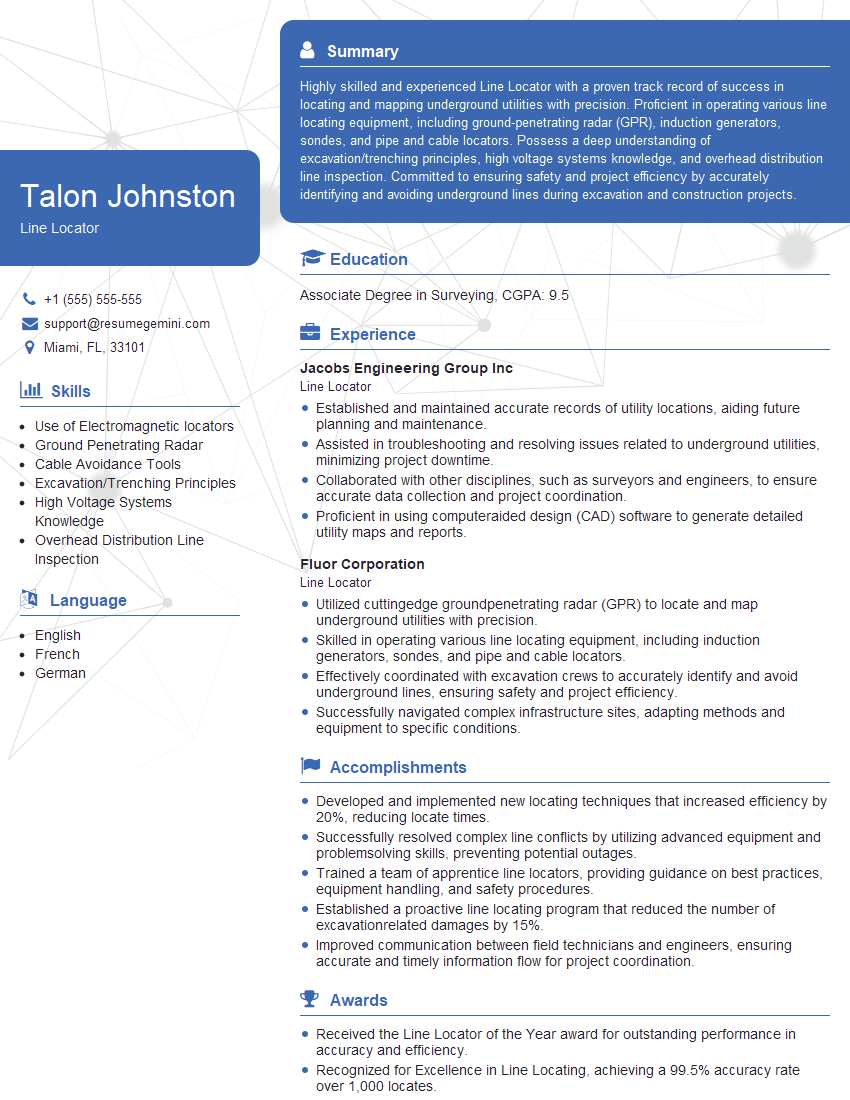
Talon Johnston
Line Locator
Summary
Highly skilled and experienced Line Locator with a proven track record of success in locating and mapping underground utilities with precision. Proficient in operating various line locating equipment, including ground-penetrating radar (GPR), induction generators, sondes, and pipe and cable locators. Possess a deep understanding of excavation/trenching principles, high voltage systems knowledge, and overhead distribution line inspection. Committed to ensuring safety and project efficiency by accurately identifying and avoiding underground lines during excavation and construction projects.
Education
Associate Degree in Surveying
December 2016
Skills
- Use of Electromagnetic locators
- Ground Penetrating Radar
- Cable Avoidance Tools
- Excavation/Trenching Principles
- High Voltage Systems Knowledge
- Overhead Distribution Line Inspection
Work Experience
Line Locator
- Established and maintained accurate records of utility locations, aiding future planning and maintenance.
- Assisted in troubleshooting and resolving issues related to underground utilities, minimizing project downtime.
- Collaborated with other disciplines, such as surveyors and engineers, to ensure accurate data collection and project coordination.
- Proficient in using computeraided design (CAD) software to generate detailed utility maps and reports.
Line Locator
- Utilized cuttingedge groundpenetrating radar (GPR) to locate and map underground utilities with precision.
- Skilled in operating various line locating equipment, including induction generators, sondes, and pipe and cable locators.
- Effectively coordinated with excavation crews to accurately identify and avoid underground lines, ensuring safety and project efficiency.
- Successfully navigated complex infrastructure sites, adapting methods and equipment to specific conditions.
Accomplishments
- Developed and implemented new locating techniques that increased efficiency by 20%, reducing locate times.
- Successfully resolved complex line conflicts by utilizing advanced equipment and problemsolving skills, preventing potential outages.
- Trained a team of apprentice line locators, providing guidance on best practices, equipment handling, and safety procedures.
- Established a proactive line locating program that reduced the number of excavationrelated damages by 15%.
- Improved communication between field technicians and engineers, ensuring accurate and timely information flow for project coordination.
Awards
- Received the Line Locator of the Year award for outstanding performance in accuracy and efficiency.
- Recognized for Excellence in Line Locating, achieving a 99.5% accuracy rate over 1,000 locates.
- Awarded the Safety Champion honor for consistently adhering to safety protocols and promoting a safe work environment.
Certificates
- OSHA 500 Line Locating Certification
- NUCA Line Locating Certification
- NGWA Underground Utility Locating Certification
- CPI Utility Infrastructure Damage Prevention Training
Career Expert Tips:
- Select the ideal resume template to showcase your professional experience effectively.
- Master the art of resume writing to highlight your unique qualifications and achievements.
- Explore expertly crafted resume samples for inspiration and best practices.
- Build your best resume for free this new year with ResumeGemini. Enjoy exclusive discounts on ATS optimized resume templates.
How To Write Resume For Line Locator
- Highlight your proficiency in using electromagnetic locators, ground-penetrating radar, and cable avoidance tools.
- Quantify your accomplishments whenever possible, providing specific examples of how your work has contributed to project success.
- Tailor your resume to each job you apply for, emphasizing the skills and experience that are most relevant to the position.
- Proofread your resume carefully for any errors before submitting it.
Essential Experience Highlights for a Strong Line Locator Resume
- Utilized cutting-edge ground-penetrating radar (GPR) to locate and map underground utilities with precision.
- Skilled in operating various line locating equipment, including induction generators, sondes, and pipe and cable locators.
- Effectively coordinated with excavation crews to accurately identify and avoid underground lines, ensuring safety and project efficiency.
- Successfully navigated complex infrastructure sites, adapting methods and equipment to specific conditions.
- Established and maintained accurate records of utility locations, aiding future planning and maintenance.
- Assisted in troubleshooting and resolving issues related to underground utilities, minimizing project downtime.
Frequently Asked Questions (FAQ’s) For Line Locator
What are the primary responsibilities of a Line Locator?
The primary responsibilities of a Line Locator include locating and mapping underground utilities, identifying and avoiding underground lines during excavation, and maintaining accurate records of utility locations.
What skills are required to be a successful Line Locator?
Successful Line Locators typically possess proficiency in using electromagnetic locators, ground-penetrating radar, and cable avoidance tools, as well as a strong understanding of excavation/trenching principles, high voltage systems knowledge, and overhead distribution line inspection.
What is the job outlook for Line Locators?
The job outlook for Line Locators is expected to grow in the coming years, as there is an increasing demand for infrastructure maintenance and repair.
What are the educational requirements for becoming a Line Locator?
While there are no specific educational requirements for becoming a Line Locator, many employers prefer candidates with an associate degree in surveying or a related field.
What certifications are available for Line Locators?
There are several certifications available for Line Locators, including the Certified Utility Safety Professional (CUSP) certification from the National Utility Contractors Association (NUCA).