Are you a seasoned Lithographic Artist seeking a new career path? Discover our professionally built Lithographic Artist Resume Template. This time-saving tool provides a solid foundation for your job search. Simply click “Edit Resume” to customize it with your unique experiences and achievements. Customize fonts and colors to match your personal style and increase your chances of landing your dream job. Explore more Resume Templates for additional options.






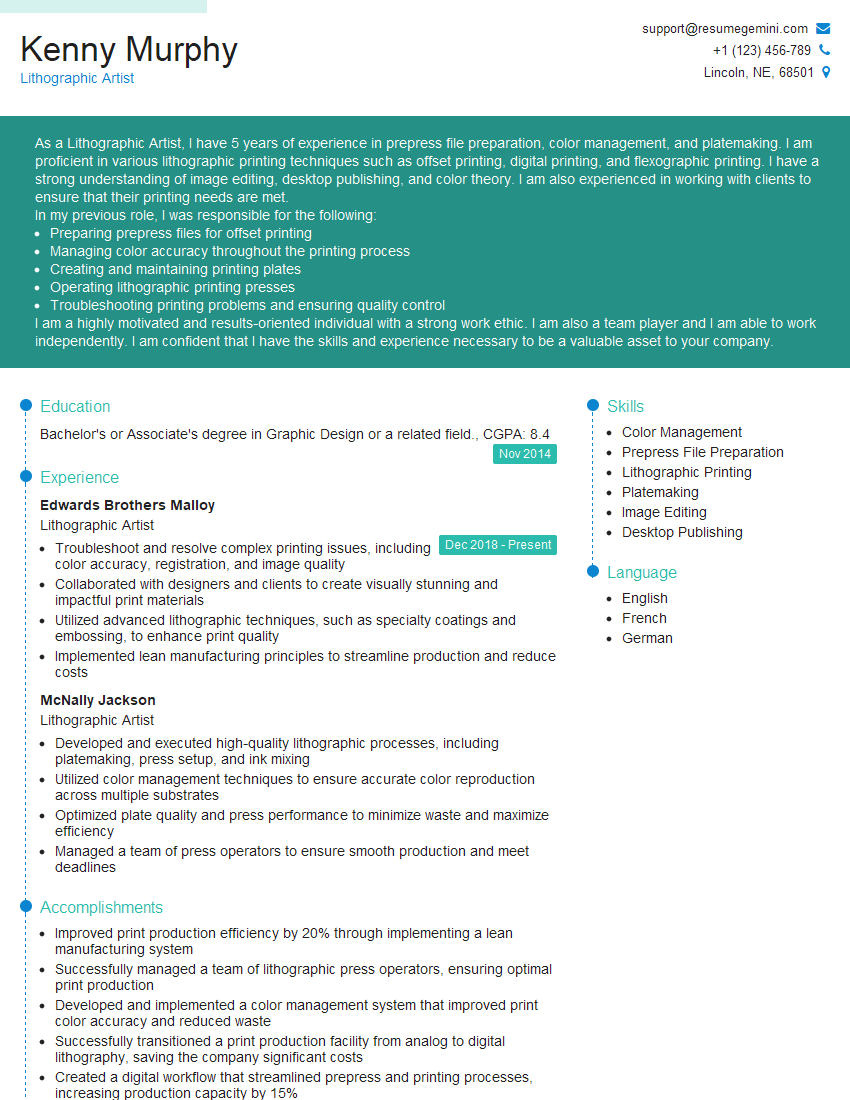
Kenny Murphy
Lithographic Artist
Summary
As a Lithographic Artist, I have 5 years of experience in prepress file preparation, color management, and platemaking. I am proficient in various lithographic printing techniques such as offset printing, digital printing, and flexographic printing. I have a strong understanding of image editing, desktop publishing, and color theory. I am also experienced in working with clients to ensure that their printing needs are met.
In my previous role, I was responsible for the following:
- Preparing prepress files for offset printing
- Managing color accuracy throughout the printing process
- Creating and maintaining printing plates
- Operating lithographic printing presses
- Troubleshooting printing problems and ensuring quality control
I am a highly motivated and results-oriented individual with a strong work ethic. I am also a team player and I am able to work independently. I am confident that I have the skills and experience necessary to be a valuable asset to your company.
Education
Bachelor’s or Associate’s degree in Graphic Design or a related field.
November 2014
Skills
- Color Management
- Prepress File Preparation
- Lithographic Printing
- Platemaking
- Image Editing
- Desktop Publishing
Work Experience
Lithographic Artist
- Troubleshoot and resolve complex printing issues, including color accuracy, registration, and image quality
- Collaborated with designers and clients to create visually stunning and impactful print materials
- Utilized advanced lithographic techniques, such as specialty coatings and embossing, to enhance print quality
- Implemented lean manufacturing principles to streamline production and reduce costs
Lithographic Artist
- Developed and executed high-quality lithographic processes, including platemaking, press setup, and ink mixing
- Utilized color management techniques to ensure accurate color reproduction across multiple substrates
- Optimized plate quality and press performance to minimize waste and maximize efficiency
- Managed a team of press operators to ensure smooth production and meet deadlines
Accomplishments
- Improved print production efficiency by 20% through implementing a lean manufacturing system
- Successfully managed a team of lithographic press operators, ensuring optimal print production
- Developed and implemented a color management system that improved print color accuracy and reduced waste
- Successfully transitioned a print production facility from analog to digital lithography, saving the company significant costs
- Created a digital workflow that streamlined prepress and printing processes, increasing production capacity by 15%
Awards
- Won the Gold Award in the Lithographic Excellence Awards for outstanding print quality
- Recognized as the Lithographic Artist of the Year by the National Association of Lithographers
- Received an Award of Excellence from the Printing Industries of America for exceptional prepress work
- Honored with the Pinnacle Award from the International Prepress Association for outstanding contributions to the industry
Certificates
- G7 Master Printer
- ISO 9001 Certified
- PMP (Project Management Professional)
- Adobe Certified Expert
Career Expert Tips:
- Select the ideal resume template to showcase your professional experience effectively.
- Master the art of resume writing to highlight your unique qualifications and achievements.
- Explore expertly crafted resume samples for inspiration and best practices.
- Build your best resume for free this new year with ResumeGemini. Enjoy exclusive discounts on ATS optimized resume templates.
How To Write Resume For Lithographic Artist
- Highlight your skills and experience. Make sure to list all of your relevant skills and experience in your resume, including your proficiency in prepress file preparation, color management, platemaking, and lithographic printing. You should also mention any specific software or equipment that you are familiar with.
- Showcase your portfolio. If you have a portfolio of your work, be sure to include it with your resume. This will give potential employers a chance to see your skills and experience firsthand.
- Tailor your resume to the job. Make sure to tailor your resume to the specific job you are applying for. Highlight the skills and experience that are most relevant to the job requirements. You should also research the company to learn more about their culture and values.
- Proofread your resume. Make sure to proofread your resume carefully before submitting it. There should be no errors in grammar or spelling.
Essential Experience Highlights for a Strong Lithographic Artist Resume
- Prepare prepress files for offset printing
- Manage color accuracy throughout the printing process
- Create and maintain printing plates
- Operate lithographic printing presses
- Troubleshoot printing problems and ensure quality control
- Work with clients to ensure that their printing needs are met
- Stay up-to-date on the latest lithographic printing techniques and technologies
Frequently Asked Questions (FAQ’s) For Lithographic Artist
What is a lithographic artist?
A lithographic artist is a skilled professional who creates and produces lithographic prints. Lithography is a printing technique that uses a flat stone or metal plate to create an image. The artist creates the image on the plate using a greasy crayon or tusche, and then the plate is moistened with water. The water repels the grease, so when ink is applied to the plate, it only adheres to the greasy areas. The inked plate is then pressed onto paper, transferring the image. Lithographic artists can create a wide range of images, from simple line drawings to complex, multi-colored prints.
What are the different types of lithographic printing?
There are several different types of lithographic printing, including offset printing, digital printing, and flexographic printing. Offset printing is the most common type of lithographic printing, and it is used to create a wide range of printed materials, such as books, magazines, newspapers, and brochures. Digital printing is a newer type of lithographic printing that uses a computer to create the image on the plate. Flexographic printing is a type of lithographic printing that is used to print on flexible materials, such as plastic and foil.
What are the skills and qualifications needed to be a lithographic artist?
Lithographic artists typically need a bachelor’s or associate’s degree in graphic design or a related field. They also need to have strong skills in prepress file preparation, color management, platemaking, and lithographic printing. Lithographic artists should also be proficient in image editing, desktop publishing, and color theory. In addition, lithographic artists must be able to work independently and as part of a team.
What is the job outlook for lithographic artists?
The job outlook for lithographic artists is expected to be good over the next few years. The demand for lithographic printing is expected to increase as more and more businesses and organizations use printed materials to market their products and services. Lithographic artists with strong skills and experience will be in high demand.
How can I become a lithographic artist?
To become a lithographic artist, you can earn a bachelor’s or associate’s degree in graphic design or a related field. You can also take classes in lithographic printing at a local community college or art center. Once you have the necessary skills and qualifications, you can apply for jobs as a lithographic artist with printing companies, design firms, and other businesses.
What are the benefits of being a lithographic artist?
There are many benefits to being a lithographic artist, including the opportunity to work in a creative field, the chance to use your artistic skills to create beautiful prints, and the potential to earn a good living. Lithographic artists can also enjoy the satisfaction of knowing that their work is helping to promote businesses and organizations.
What are the challenges of being a lithographic artist?
There are some challenges to being a lithographic artist, including the need to work long hours, the potential for repetitive work, and the exposure to chemicals. Lithographic artists must also be able to work independently and as part of a team.