Are you a seasoned Lubricating Engineer seeking a new career path? Discover our professionally built Lubricating Engineer Resume Template. This time-saving tool provides a solid foundation for your job search. Simply click “Edit Resume” to customize it with your unique experiences and achievements. Customize fonts and colors to match your personal style and increase your chances of landing your dream job. Explore more Resume Templates for additional options.






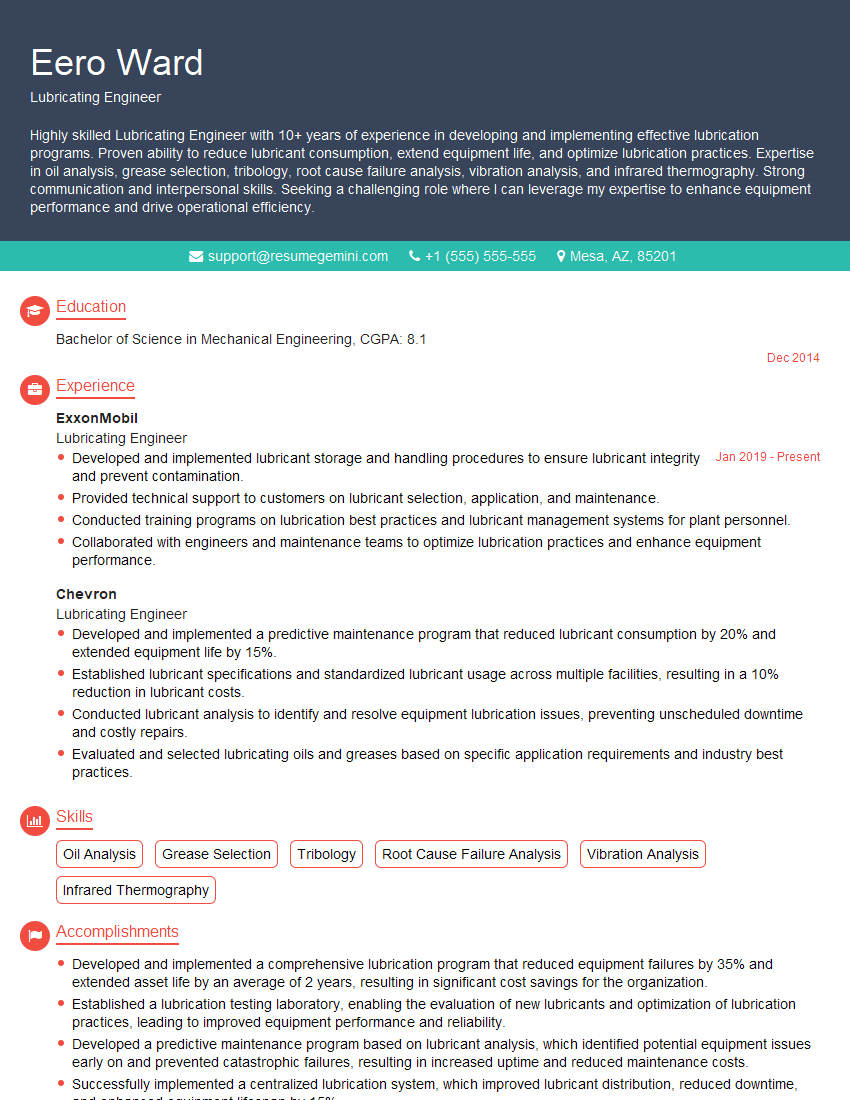
Eero Ward
Lubricating Engineer
Summary
Highly skilled Lubricating Engineer with 10+ years of experience in developing and implementing effective lubrication programs. Proven ability to reduce lubricant consumption, extend equipment life, and optimize lubrication practices. Expertise in oil analysis, grease selection, tribology, root cause failure analysis, vibration analysis, and infrared thermography. Strong communication and interpersonal skills. Seeking a challenging role where I can leverage my expertise to enhance equipment performance and drive operational efficiency.
Education
Bachelor of Science in Mechanical Engineering
December 2014
Skills
- Oil Analysis
- Grease Selection
- Tribology
- Root Cause Failure Analysis
- Vibration Analysis
- Infrared Thermography
Work Experience
Lubricating Engineer
- Developed and implemented lubricant storage and handling procedures to ensure lubricant integrity and prevent contamination.
- Provided technical support to customers on lubricant selection, application, and maintenance.
- Conducted training programs on lubrication best practices and lubricant management systems for plant personnel.
- Collaborated with engineers and maintenance teams to optimize lubrication practices and enhance equipment performance.
Lubricating Engineer
- Developed and implemented a predictive maintenance program that reduced lubricant consumption by 20% and extended equipment life by 15%.
- Established lubricant specifications and standardized lubricant usage across multiple facilities, resulting in a 10% reduction in lubricant costs.
- Conducted lubricant analysis to identify and resolve equipment lubrication issues, preventing unscheduled downtime and costly repairs.
- Evaluated and selected lubricating oils and greases based on specific application requirements and industry best practices.
Accomplishments
- Developed and implemented a comprehensive lubrication program that reduced equipment failures by 35% and extended asset life by an average of 2 years, resulting in significant cost savings for the organization.
- Established a lubrication testing laboratory, enabling the evaluation of new lubricants and optimization of lubrication practices, leading to improved equipment performance and reliability.
- Developed a predictive maintenance program based on lubricant analysis, which identified potential equipment issues early on and prevented catastrophic failures, resulting in increased uptime and reduced maintenance costs.
- Successfully implemented a centralized lubrication system, which improved lubricant distribution, reduced downtime, and enhanced equipment lifespan by 15%.
- Established a condition monitoring program that tracked lubricant health and equipment vibration, enabling proactive maintenance and preventing unplanned shutdowns.
Awards
- Recipient of the Lubricating Engineer of the Year Award from the Society of Tribologists and Lubrication Engineers (STLE), recognizing outstanding contributions to the field.
- Awarded the STLE Service Award for exceptional dedication and contributions to the advancement of lubricant technology.
- Recognized with the National Lubricating Grease Institute (NLGI) Outstanding Achievement Award for innovative research and development in grease lubrication.
- Recipient of the American Society for Testing and Materials (ASTM) International Award of Merit for contributions to the standardization of lubricant testing methods.
Certificates
- Certified Lubrication Specialist (CLS)
- Certified Maintenance and Reliability Professional (CMRP)
- Certified Machinery Lubrication Technician (CMLT)
- Reliability Leadership Certification (RLC)
Career Expert Tips:
- Select the ideal resume template to showcase your professional experience effectively.
- Master the art of resume writing to highlight your unique qualifications and achievements.
- Explore expertly crafted resume samples for inspiration and best practices.
- Build your best resume for free this new year with ResumeGemini. Enjoy exclusive discounts on ATS optimized resume templates.
How To Write Resume For Lubricating Engineer
- Quantify your accomplishments with specific metrics whenever possible.
- Highlight your expertise in oil analysis and other lubrication-related techniques.
- Demonstrate your understanding of the latest lubrication technologies and best practices.
- Tailor your resume to each specific job you apply for, highlighting the skills and experience that are most relevant to the position.
Essential Experience Highlights for a Strong Lubricating Engineer Resume
- Develop and implement lubrication programs to reduce lubricant consumption, extend equipment life, and enhance equipment performance.
- Conduct oil analysis to identify and resolve equipment lubrication issues, preventing unscheduled downtime and costly repairs.
- Evaluate and select lubricating oils and greases based on specific application requirements and industry best practices.
- Collaborate with engineers and maintenance teams to optimize lubrication practices and enhance equipment performance.
- Provide technical support to customers on lubricant selection, application, and maintenance.
- Conduct training programs on lubrication best practices and lubricant management systems for plant personnel.
Frequently Asked Questions (FAQ’s) For Lubricating Engineer
What is the role of a Lubricating Engineer?
Lubricating Engineers are responsible for developing and implementing lubrication programs to ensure the efficient and reliable operation of machinery and equipment. They work closely with engineers, maintenance personnel, and other stakeholders to identify and resolve lubrication-related issues, optimize lubrication practices, and reduce operating costs.
What are the key skills and qualifications required for a Lubricating Engineer?
Lubricating Engineers typically have a Bachelor’s degree in Mechanical Engineering or a related field, as well as several years of experience in the lubrication field. They should have a strong understanding of lubrication principles, oil analysis, grease selection, and other lubrication-related techniques. Excellent communication and interpersonal skills are also essential.
What are the career prospects for a Lubricating Engineer?
Lubricating Engineers can find employment in a variety of industries, including manufacturing, oil and gas, mining, and transportation. With experience, they can advance to management positions or specialize in a particular area of lubrication, such as oil analysis or grease selection.
What is the average salary for a Lubricating Engineer?
The average salary for a Lubricating Engineer in the United States is around $75,000 per year. However, salaries can vary depending on experience, location, and industry.
What are the benefits of working as a Lubricating Engineer?
Working as a Lubricating Engineer offers a number of benefits, including: the opportunity to work with a variety of machinery and equipment; the opportunity to learn about the latest lubrication technologies and best practices; the opportunity to make a positive impact on the efficiency and reliability of machinery and equipment; and the opportunity to earn a competitive salary and benefits package.