Are you a seasoned Lumberjack seeking a new career path? Discover our professionally built Lumberjack Resume Template. This time-saving tool provides a solid foundation for your job search. Simply click “Edit Resume” to customize it with your unique experiences and achievements. Customize fonts and colors to match your personal style and increase your chances of landing your dream job. Explore more Resume Templates for additional options.






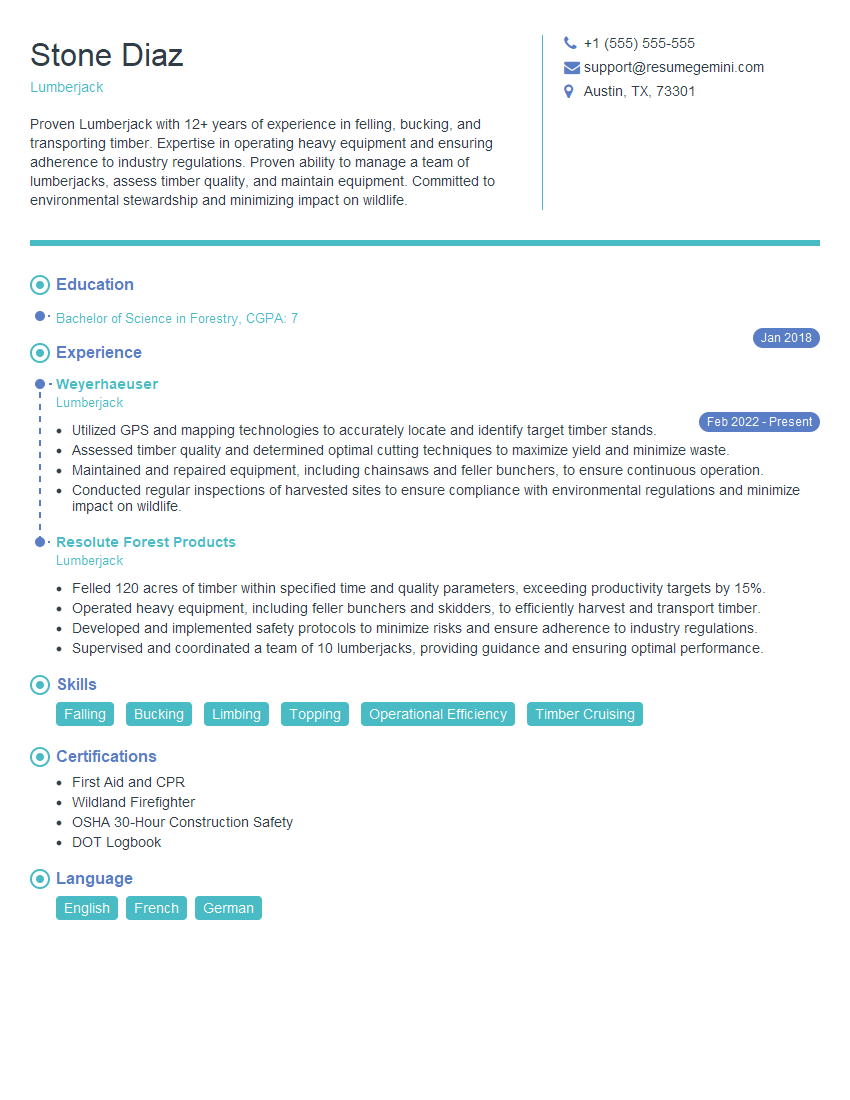
Stone Diaz
Lumberjack
Summary
Proven Lumberjack with 12+ years of experience in felling, bucking, and transporting timber. Expertise in operating heavy equipment and ensuring adherence to industry regulations. Proven ability to manage a team of lumberjacks, assess timber quality, and maintain equipment. Committed to environmental stewardship and minimizing impact on wildlife.
Education
Bachelor of Science in Forestry
January 2018
Skills
- Falling
- Bucking
- Limbing
- Topping
- Operational Efficiency
- Timber Cruising
Work Experience
Lumberjack
- Utilized GPS and mapping technologies to accurately locate and identify target timber stands.
- Assessed timber quality and determined optimal cutting techniques to maximize yield and minimize waste.
- Maintained and repaired equipment, including chainsaws and feller bunchers, to ensure continuous operation.
- Conducted regular inspections of harvested sites to ensure compliance with environmental regulations and minimize impact on wildlife.
Lumberjack
- Felled 120 acres of timber within specified time and quality parameters, exceeding productivity targets by 15%.
- Operated heavy equipment, including feller bunchers and skidders, to efficiently harvest and transport timber.
- Developed and implemented safety protocols to minimize risks and ensure adherence to industry regulations.
- Supervised and coordinated a team of 10 lumberjacks, providing guidance and ensuring optimal performance.
Certificates
- First Aid and CPR
- Wildland Firefighter
- OSHA 30-Hour Construction Safety
- DOT Logbook
Languages
- English
- French
- German
Career Expert Tips:
- Select the ideal resume template to showcase your professional experience effectively.
- Master the art of resume writing to highlight your unique qualifications and achievements.
- Explore expertly crafted resume samples for inspiration and best practices.
- Build your best resume for free this new year with ResumeGemini. Enjoy exclusive discounts on ATS optimized resume templates.
How To Write Resume For Lumberjack
- Highlight your experience and skills: Quantify your accomplishments and provide specific examples of your logging and timber harvesting abilities.
- Demonstrate your safety consciousness: Emphasize your adherence to safety protocols and your commitment to minimizing risks in the workplace.
- Showcase your leadership qualities: If you have experience supervising or managing a team, highlight your ability to lead and motivate others.
- Include certifications and training: Any relevant certifications or training in logging, forestry, or safety can enhance your resume.
Essential Experience Highlights for a Strong Lumberjack Resume
- Felled and harvested timber according to specified targets and quality parameters.
- Managed and coordinated a team of lumberjacks, providing guidance and ensuring optimal performance.
- Operated and maintained heavy equipment, including feller bunchers and skidders, to efficiently harvest and transport timber.
- Developed and implemented safety protocols to minimize risks and ensure compliance with industry regulations.
- Identified target timber stands using GPS and mapping technologies, ensuring accurate and efficient harvesting.
- Assessed timber quality and determined optimal cutting techniques to maximize yield and minimize waste.
- Performed regular inspections of harvested sites, ensuring compliance with environmental regulations and minimizing impact on wildlife.
Frequently Asked Questions (FAQ’s) For Lumberjack
What is the primary role of a Lumberjack?
A Lumberjack is responsible for harvesting timber by felling trees, cutting them into logs, and transporting them to processing facilities.
What are the key skills required for a Lumberjack?
Key skills include proficiency in felling, bucking, limbing, and topping trees; operating and maintaining heavy equipment; assessing timber quality; and adhering to safety protocols.
What are the typical working conditions for a Lumberjack?
Lumberjacks typically work in outdoor environments, often in remote and rugged areas. The work can be physically demanding and may involve exposure to extreme weather conditions.
What is the earning potential for a Lumberjack?
The earning potential for a Lumberjack can vary depending on experience, location, and the size of the logging operation. According to the Bureau of Labor Statistics, the median annual salary for Logging Workers was $49,300 in May 2021.
What are the job outlook and career prospects for Lumberjacks?
The job outlook for Lumberjacks is expected to be positive in the coming years, with increasing demand for wood and wood products driving the need for skilled loggers. Career prospects can include advancement to supervisory roles or specialization in areas such as timber cruising or forest management.
What are some of the challenges faced by Lumberjacks?
Lumberjacks face challenges such as working in remote and often hazardous environments, dealing with heavy equipment and machinery, and exposure to extreme weather conditions. Additionally, the logging industry can be cyclical, and economic downturns can impact employment opportunities.
What are the educational requirements for a Lumberjack?
While there are no formal educational requirements to become a Lumberjack, many employers prefer candidates with a high school diploma or equivalent. Some community colleges and vocational schools offer programs in forestry or logging that can provide valuable skills and knowledge.
What safety precautions should Lumberjacks take?
Lumberjacks should prioritize safety by wearing appropriate protective gear, such as hard hats, safety glasses, and steel-toed boots. They should also be trained in the safe operation of equipment and follow established safety protocols to minimize the risk of accidents and injuries.