Are you a seasoned Marine Equipment Test Engineer seeking a new career path? Discover our professionally built Marine Equipment Test Engineer Resume Template. This time-saving tool provides a solid foundation for your job search. Simply click “Edit Resume” to customize it with your unique experiences and achievements. Customize fonts and colors to match your personal style and increase your chances of landing your dream job. Explore more Resume Templates for additional options.






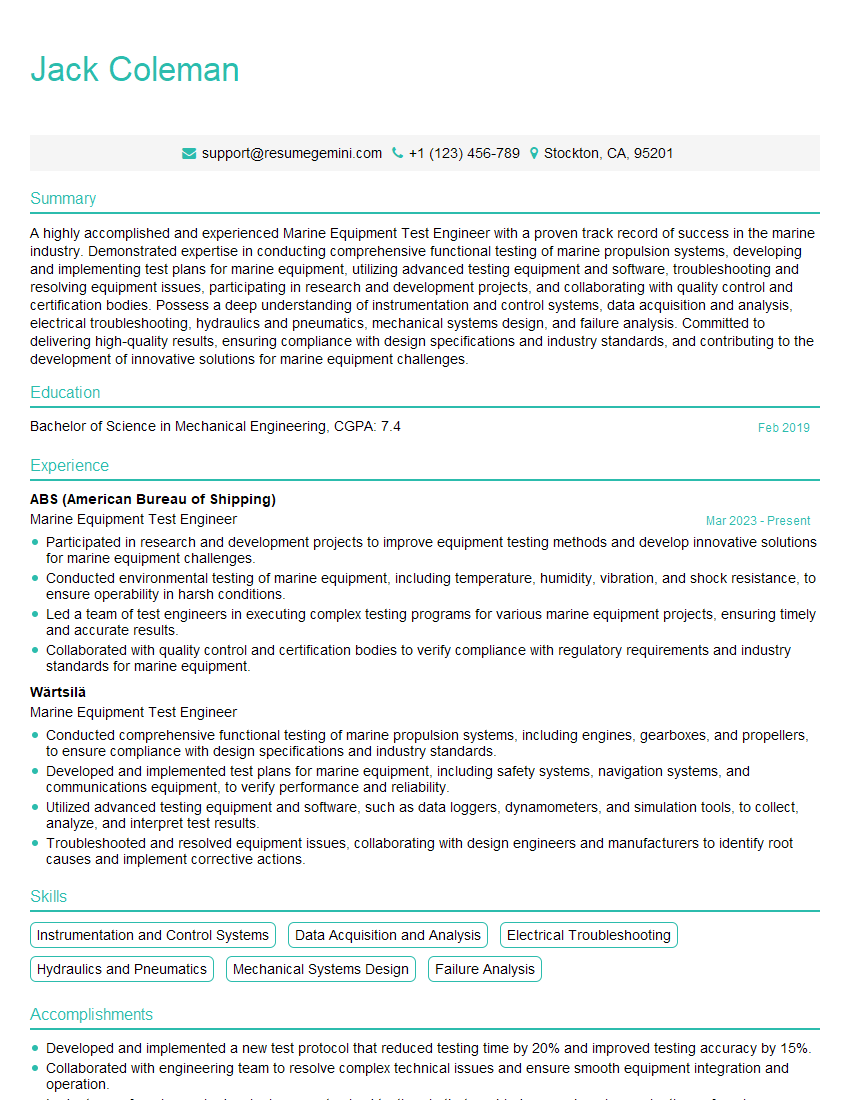
Jack Coleman
Marine Equipment Test Engineer
Summary
A highly accomplished and experienced Marine Equipment Test Engineer with a proven track record of success in the marine industry. Demonstrated expertise in conducting comprehensive functional testing of marine propulsion systems, developing and implementing test plans for marine equipment, utilizing advanced testing equipment and software, troubleshooting and resolving equipment issues, participating in research and development projects, and collaborating with quality control and certification bodies. Possess a deep understanding of instrumentation and control systems, data acquisition and analysis, electrical troubleshooting, hydraulics and pneumatics, mechanical systems design, and failure analysis. Committed to delivering high-quality results, ensuring compliance with design specifications and industry standards, and contributing to the development of innovative solutions for marine equipment challenges.
Education
Bachelor of Science in Mechanical Engineering
February 2019
Skills
- Instrumentation and Control Systems
- Data Acquisition and Analysis
- Electrical Troubleshooting
- Hydraulics and Pneumatics
- Mechanical Systems Design
- Failure Analysis
Work Experience
Marine Equipment Test Engineer
- Participated in research and development projects to improve equipment testing methods and develop innovative solutions for marine equipment challenges.
- Conducted environmental testing of marine equipment, including temperature, humidity, vibration, and shock resistance, to ensure operability in harsh conditions.
- Led a team of test engineers in executing complex testing programs for various marine equipment projects, ensuring timely and accurate results.
- Collaborated with quality control and certification bodies to verify compliance with regulatory requirements and industry standards for marine equipment.
Marine Equipment Test Engineer
- Conducted comprehensive functional testing of marine propulsion systems, including engines, gearboxes, and propellers, to ensure compliance with design specifications and industry standards.
- Developed and implemented test plans for marine equipment, including safety systems, navigation systems, and communications equipment, to verify performance and reliability.
- Utilized advanced testing equipment and software, such as data loggers, dynamometers, and simulation tools, to collect, analyze, and interpret test results.
- Troubleshooted and resolved equipment issues, collaborating with design engineers and manufacturers to identify root causes and implement corrective actions.
Accomplishments
- Developed and implemented a new test protocol that reduced testing time by 20% and improved testing accuracy by 15%.
- Collaborated with engineering team to resolve complex technical issues and ensure smooth equipment integration and operation.
- Led a team of engineers in developing a customized testing rig that enabled comprehensive evaluations of marine equipment under realworld conditions.
- Developed and conducted training programs for new test engineers, ensuring their proficiency in marine equipment testing techniques.
- Collaborated with external vendors to evaluate and select the latest testing technologies and equipment, ensuring optimal performance.
Awards
- Received the Marine Equipment Test Engineer of the Year award for consistently exceeding expectations in testing and validating marine equipment.
- Honored with the Innovation Award for developing a novel testing method that significantly improved the reliability of marine equipment.
- Recognized with the Excellence in Testing award for maintaining exceptional standards in marine equipment testing and analysis.
- Received the Safety Award for implementing comprehensive safety protocols and procedures during marine equipment testing operations.
Certificates
- Certified Marine Equipment Test Engineer
- Certified Instrumentation and Control Engineer
- Project Management Professional (PMP)
- Certified Quality Engineer (CQE)
Career Expert Tips:
- Select the ideal resume template to showcase your professional experience effectively.
- Master the art of resume writing to highlight your unique qualifications and achievements.
- Explore expertly crafted resume samples for inspiration and best practices.
- Build your best resume for free this new year with ResumeGemini. Enjoy exclusive discounts on ATS optimized resume templates.
How To Write Resume For Marine Equipment Test Engineer
- Highlight your skills and experience relevant to the job description: When tailoring your resume to a specific job posting, carefully review the job description and identify the key skills and experience required. Make sure to prominently feature these qualifications in your resume, using specific examples that demonstrate your proficiency.
- Showcase your understanding of the marine industry: Employers in the marine industry are looking for candidates with a solid understanding of the unique challenges and requirements of marine equipment. Use your resume to highlight your knowledge of marine propulsion systems, navigation systems, and other marine equipment.
- Quantify your accomplishments: Whenever possible, use numbers to quantify your accomplishments. This will help you stand out from other candidates and demonstrate the impact of your work.
- Proofread carefully: Before submitting your resume, proofread it carefully for any errors in grammar, spelling, or formatting. A polished resume will make a positive impression on potential employers.
Essential Experience Highlights for a Strong Marine Equipment Test Engineer Resume
- Conduct comprehensive functional testing of marine propulsion systems, including engines, gearboxes, and propellers, to ensure compliance with design specifications and industry standards.
- Develop and implement test plans for marine equipment, including safety systems, navigation systems, and communications equipment, to verify performance and reliability.
- Utilize advanced testing equipment and software, such as data loggers, dynamometers, and simulation tools, to collect, analyze, and interpret test results.
- Troubleshoot and resolve equipment issues, collaborating with design engineers and manufacturers to identify root causes and implement corrective actions.
- Participate in research and development projects to improve equipment testing methods and develop innovative solutions for marine equipment challenges.
- Conduct environmental testing of marine equipment, including temperature, humidity, vibration, and shock resistance, to ensure the operability of Harsh conditions.
- Collaborate with quality control and certification bodies to verify compliance with regulatory requirements and industry standards for marine equipment.
- Lead a team of test engineers in executing complex testing programs for various marine equipment projects, ensuring timely and accurate results.
Frequently Asked Questions (FAQ’s) For Marine Equipment Test Engineer
What are the key responsibilities of a Marine Equipment Test Engineer?
The key responsibilities of a Marine Equipment Test Engineer include conducting comprehensive functional testing of marine propulsion systems, developing and implementing test plans for marine equipment, utilizing advanced testing equipment and software, troubleshooting and resolving equipment issues, participating in research and development projects, and collaborating with quality control and certification bodies.
What are the educational requirements for a Marine Equipment Test Engineer?
The educational requirements for a Marine Equipment Test Engineer typically include a Bachelor of Science degree in Mechanical Engineering or a related field.
What skills and experience are required for a Marine Equipment Test Engineer?
The skills and experience required for a Marine Equipment Test Engineer include instrumentation and control systems, data acquisition and analysis, electrical troubleshooting, hydraulics and pneumatics, mechanical systems design, and failure analysis.
What is the job outlook for Marine Equipment Test Engineers?
The job outlook for Marine Equipment Test Engineers is expected to be good in the coming years due to the increasing demand for marine equipment and the need for qualified engineers to ensure the safety and reliability of these systems.
What are the career opportunities for Marine Equipment Test Engineers?
The career opportunities for Marine Equipment Test Engineers include working for shipyards, marine engineering firms, and equipment manufacturers. They may also work as independent consultants or in research and development.
What is the salary range for Marine Equipment Test Engineers?
The salary range for Marine Equipment Test Engineers varies depending on experience, location, and employer. According to Salary.com, the average salary for Marine Equipment Test Engineers in the United States is $85,000 per year.
What are the benefits of working as a Marine Equipment Test Engineer?
The benefits of working as a Marine Equipment Test Engineer include working on cutting-edge technology, the opportunity to travel and work on a variety of projects, and the satisfaction of knowing that you are helping to ensure the safety and reliability of marine equipment.