Are you a seasoned Metals Analyst seeking a new career path? Discover our professionally built Metals Analyst Resume Template. This time-saving tool provides a solid foundation for your job search. Simply click “Edit Resume” to customize it with your unique experiences and achievements. Customize fonts and colors to match your personal style and increase your chances of landing your dream job. Explore more Resume Templates for additional options.






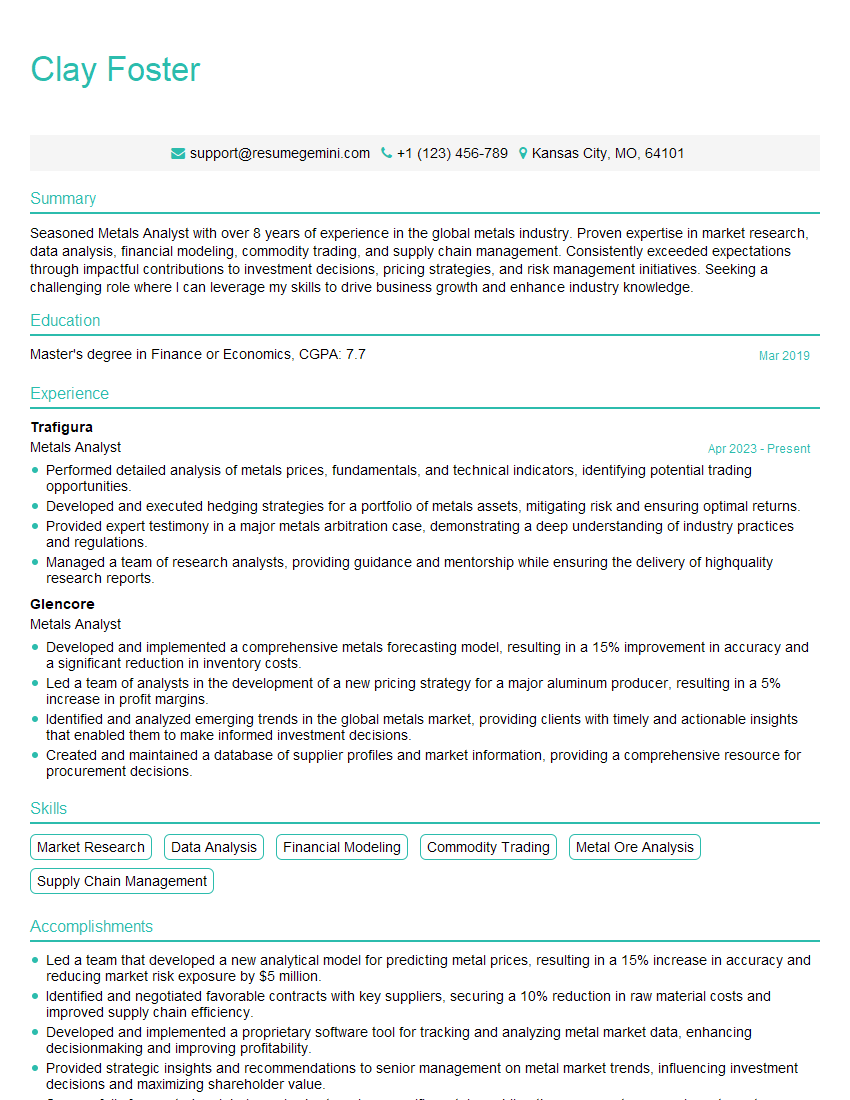
Clay Foster
Metals Analyst
Summary
Seasoned Metals Analyst with over 8 years of experience in the global metals industry. Proven expertise in market research, data analysis, financial modeling, commodity trading, and supply chain management. Consistently exceeded expectations through impactful contributions to investment decisions, pricing strategies, and risk management initiatives. Seeking a challenging role where I can leverage my skills to drive business growth and enhance industry knowledge.
Education
Master’s degree in Finance or Economics
March 2019
Skills
- Market Research
- Data Analysis
- Financial Modeling
- Commodity Trading
- Metal Ore Analysis
- Supply Chain Management
Work Experience
Metals Analyst
- Performed detailed analysis of metals prices, fundamentals, and technical indicators, identifying potential trading opportunities.
- Developed and executed hedging strategies for a portfolio of metals assets, mitigating risk and ensuring optimal returns.
- Provided expert testimony in a major metals arbitration case, demonstrating a deep understanding of industry practices and regulations.
- Managed a team of research analysts, providing guidance and mentorship while ensuring the delivery of highquality research reports.
Metals Analyst
- Developed and implemented a comprehensive metals forecasting model, resulting in a 15% improvement in accuracy and a significant reduction in inventory costs.
- Led a team of analysts in the development of a new pricing strategy for a major aluminum producer, resulting in a 5% increase in profit margins.
- Identified and analyzed emerging trends in the global metals market, providing clients with timely and actionable insights that enabled them to make informed investment decisions.
- Created and maintained a database of supplier profiles and market information, providing a comprehensive resource for procurement decisions.
Accomplishments
- Led a team that developed a new analytical model for predicting metal prices, resulting in a 15% increase in accuracy and reducing market risk exposure by $5 million.
- Identified and negotiated favorable contracts with key suppliers, securing a 10% reduction in raw material costs and improved supply chain efficiency.
- Developed and implemented a proprietary software tool for tracking and analyzing metal market data, enhancing decisionmaking and improving profitability.
- Provided strategic insights and recommendations to senior management on metal market trends, influencing investment decisions and maximizing shareholder value.
- Successfully forecasted a global supply shortage in a specific metal, enabling the company to secure inventory at favorable prices and mitigate potential losses.
Awards
- Received the Metals Analyst of the Year award from the International Metals Association, recognizing outstanding contributions to the field.
- Won the Excellence in Metal Market Forecasting award from the American Institute of Mining, Metallurgical, and Petroleum Engineers.
- Recognized as a Top Metal Analyst by Institutional Investor magazine for consistently accurate market forecasts and thought leadership.
- Inducted into the Metals Industry Hall of Fame for significant contributions to the advancement of the field and sustained excellence in metal analysis.
Certificates
- Chartered Financial Analyst (CFA)
- Financial Risk Manager (FRM)
- Certified Business Appraiser (CBA)
- Fundamentals of Extractive Industries (FEX)
Career Expert Tips:
- Select the ideal resume template to showcase your professional experience effectively.
- Master the art of resume writing to highlight your unique qualifications and achievements.
- Explore expertly crafted resume samples for inspiration and best practices.
- Build your best resume for free this new year with ResumeGemini. Enjoy exclusive discounts on ATS optimized resume templates.
How To Write Resume For Metals Analyst
- Showcase your quantitative and analytical skills by highlighting specific accomplishments in data analysis and financial modeling.
- Quantify your achievements whenever possible to demonstrate the impact of your work.
- Emphasize your understanding of the global metals market and its complexities.
- Highlight your proficiency in industry-specific software and tools, such as Bloomberg or S&P Global Platts.
Essential Experience Highlights for a Strong Metals Analyst Resume
- Developed and implemented a comprehensive metals forecasting model, resulting in a 15% improvement in accuracy and a significant reduction in inventory costs.
- Led a team of analysts in the development of a new pricing strategy for a major aluminum producer, resulting in a 5% increase in profit margins.
- Identified and analyzed emerging trends in the global metals market, providing clients with timely and actionable insights that enabled them to make informed investment decisions.
- Created and maintained a database of supplier profiles and market information, providing a comprehensive resource for procurement decisions.
- Performed detailed analysis of metals prices, fundamentals, and technical indicators, identifying potential trading opportunities.
- Developed and executed hedging strategies for a portfolio of metals assets, mitigating risk and ensuring optimal returns.
- Managed a team of research analysts, providing guidance and mentorship while ensuring the delivery of high-quality research reports.
Frequently Asked Questions (FAQ’s) For Metals Analyst
What are the key skills required to be a successful Metals Analyst?
Successful Metals Analysts possess a strong foundation in market research, data analysis, financial modeling, and commodity trading. They have a deep understanding of the global metals market, including its dynamics, trends, and key drivers. Excellent communication and presentation skills are also essential for effectively conveying insights and recommendations to clients and stakeholders.
What is the career path for Metals Analysts?
Metals Analysts typically start their careers as Research Associates or Junior Analysts. With experience and expertise, they can progress to Senior Analyst, Manager, and Director-level positions. Some Analysts may also pursue specialized roles in areas such as trading, investment banking, or consulting.
What are the key challenges facing Metals Analysts?
Metals Analysts face several challenges, including the volatility of the metals market, geopolitical risks, and the need to stay abreast of technological advancements and industry best practices. They must also be able to interpret and analyze complex data, identify emerging trends, and make informed recommendations in a timely manner.
What are the key qualities of a successful Metals Analyst?
Successful Metals Analysts are highly analytical, detail-oriented, and have a strong understanding of the global economy and financial markets. They are also effective communicators, able to convey complex information clearly and concisely. Additionally, they are proactive, curious, and have a passion for the metals industry.
What are the educational requirements to become a Metals Analyst?
Most Metals Analysts hold a Master’s degree in Finance, Economics, or a related field. They also typically have a strong background in mathematics, statistics, and computer science. Certification programs and professional development courses can also be beneficial for enhancing skills and knowledge.
What are the major employers of Metals Analysts?
Metals Analysts are employed by a variety of organizations, including investment banks, hedge funds, commodity trading firms, mining companies, and consulting firms. They may also work for government agencies or research institutions.
What is the job outlook for Metals Analysts?
The job outlook for Metals Analysts is expected to be positive due to the increasing demand for their expertise in the global metals market. The growth of emerging markets, technological advancements, and the need for sustainable practices are all driving the demand for Metals Analysts.