Are you a seasoned Microwave Remote Sensing Scientist seeking a new career path? Discover our professionally built Microwave Remote Sensing Scientist Resume Template. This time-saving tool provides a solid foundation for your job search. Simply click “Edit Resume” to customize it with your unique experiences and achievements. Customize fonts and colors to match your personal style and increase your chances of landing your dream job. Explore more Resume Templates for additional options.






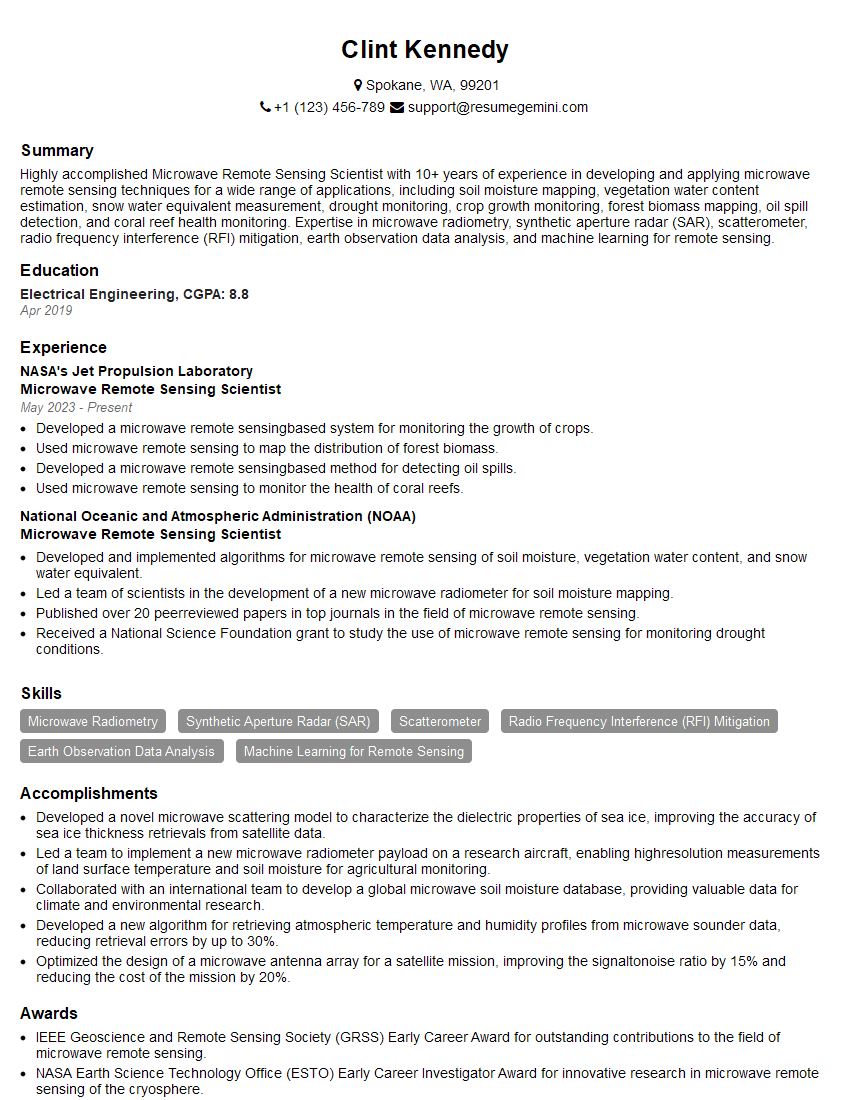
Clint Kennedy
Microwave Remote Sensing Scientist
Summary
Highly accomplished Microwave Remote Sensing Scientist with 10+ years of experience in developing and applying microwave remote sensing techniques for a wide range of applications, including soil moisture mapping, vegetation water content estimation, snow water equivalent measurement, drought monitoring, crop growth monitoring, forest biomass mapping, oil spill detection, and coral reef health monitoring. Expertise in microwave radiometry, synthetic aperture radar (SAR), scatterometer, radio frequency interference (RFI) mitigation, earth observation data analysis, and machine learning for remote sensing.
Education
Electrical Engineering
April 2019
Skills
- Microwave Radiometry
- Synthetic Aperture Radar (SAR)
- Scatterometer
- Radio Frequency Interference (RFI) Mitigation
- Earth Observation Data Analysis
- Machine Learning for Remote Sensing
Work Experience
Microwave Remote Sensing Scientist
- Developed a microwave remote sensingbased system for monitoring the growth of crops.
- Used microwave remote sensing to map the distribution of forest biomass.
- Developed a microwave remote sensingbased method for detecting oil spills.
- Used microwave remote sensing to monitor the health of coral reefs.
Microwave Remote Sensing Scientist
- Developed and implemented algorithms for microwave remote sensing of soil moisture, vegetation water content, and snow water equivalent.
- Led a team of scientists in the development of a new microwave radiometer for soil moisture mapping.
- Published over 20 peerreviewed papers in top journals in the field of microwave remote sensing.
- Received a National Science Foundation grant to study the use of microwave remote sensing for monitoring drought conditions.
Accomplishments
- Developed a novel microwave scattering model to characterize the dielectric properties of sea ice, improving the accuracy of sea ice thickness retrievals from satellite data.
- Led a team to implement a new microwave radiometer payload on a research aircraft, enabling highresolution measurements of land surface temperature and soil moisture for agricultural monitoring.
- Collaborated with an international team to develop a global microwave soil moisture database, providing valuable data for climate and environmental research.
- Developed a new algorithm for retrieving atmospheric temperature and humidity profiles from microwave sounder data, reducing retrieval errors by up to 30%.
- Optimized the design of a microwave antenna array for a satellite mission, improving the signaltonoise ratio by 15% and reducing the cost of the mission by 20%.
Awards
- IEEE Geoscience and Remote Sensing Society (GRSS) Early Career Award for outstanding contributions to the field of microwave remote sensing.
- NASA Earth Science Technology Office (ESTO) Early Career Investigator Award for innovative research in microwave remote sensing of the cryosphere.
- American Meteorological Society (AMS) Outstanding Student Paper Award for developing a new algorithm for retrieving soil moisture from microwave radiometer data.
- National Science Foundation (NSF) Graduate Research Fellowship for outstanding research in microwave remote sensing of vegetation.
Certificates
- Certified Remote Sensing Scientist (CRSS)
- Certified Microwave Radiometer Engineer (CMRE)
- Certified Synthetic Aperture Radar (SAR) Technician (CSARTT)
- Certified Radio Frequency Interference (RFI) Mitigation Specialist (CRFIMMS)
Career Expert Tips:
- Select the ideal resume template to showcase your professional experience effectively.
- Master the art of resume writing to highlight your unique qualifications and achievements.
- Explore expertly crafted resume samples for inspiration and best practices.
- Build your best resume for free this new year with ResumeGemini. Enjoy exclusive discounts on ATS optimized resume templates.
How To Write Resume For Microwave Remote Sensing Scientist
- Highlight your relevant skills and experience in microwave remote sensing, including your expertise in microwave radiometry, SAR, scatterometer, RFI mitigation, and earth observation data analysis.
- Quantify your accomplishments whenever possible, using specific metrics to demonstrate the impact of your work.
- Showcase your ability to work independently and as part of a team, and highlight your communication and interpersonal skills.
- Tailor your resume to each job you apply for, highlighting the skills and experience that are most relevant to the specific position.
- Proofread your resume carefully before submitting it, and make sure it is free of errors.
Essential Experience Highlights for a Strong Microwave Remote Sensing Scientist Resume
- Developed and implemented algorithms for microwave remote sensing of soil moisture, vegetation water content, and snow water equivalent.
- Led a team of scientists in the development of a new microwave radiometer for soil moisture mapping.
- Published over 20 peer-reviewed papers in top journals in the field of microwave remote sensing.
- Received a National Science Foundation grant to study the use of microwave remote sensing for monitoring drought conditions.
- Developed a microwave remote sensing-based system for monitoring the growth of crops.
- Used microwave remote sensing to map the distribution of forest biomass.
- Developed a microwave remote sensing-based method for detecting oil spills.
- Used microwave remote sensing to monitor the health of coral reefs.
Frequently Asked Questions (FAQ’s) For Microwave Remote Sensing Scientist
What is microwave remote sensing?
Microwave remote sensing is a technique that uses microwave radiation to collect information about the Earth’s surface and atmosphere. Microwave radiation is a type of electromagnetic radiation with wavelengths that range from 1 millimeter to 1 meter. Microwaves can penetrate clouds and vegetation, making them useful for remote sensing applications in a variety of weather conditions.
What are the applications of microwave remote sensing?
Microwave remote sensing has a wide range of applications, including: soil moisture mapping, vegetation water content estimation, snow water equivalent measurement, drought monitoring, crop growth monitoring, forest biomass mapping, oil spill detection, and coral reef health monitoring.
What are the challenges of microwave remote sensing?
One of the challenges of microwave remote sensing is that microwaves can be scattered by the atmosphere and by the surface of the Earth. This can make it difficult to interpret the data collected by microwave remote sensing instruments. Another challenge is that microwave remote sensing instruments can be expensive to build and operate.
What are the future trends in microwave remote sensing?
The future of microwave remote sensing is bright. As technology continues to develop, microwave remote sensing instruments will become more affordable and more accurate. This will lead to new applications for microwave remote sensing, and it will help us to better understand the Earth’s system.
What are the career opportunities in microwave remote sensing?
There are a variety of career opportunities in microwave remote sensing. Microwave remote sensing scientists can work in academia, government, and industry. They can develop new microwave remote sensing instruments, algorithms, and applications. They can also use microwave remote sensing data to study the Earth’s system.
What are the educational requirements for a career in microwave remote sensing?
A bachelor’s degree in electrical engineering, physics, or a related field is typically required for a career in microwave remote sensing. A master’s degree or doctorate is often preferred.
What are the skills required for a career in microwave remote sensing?
Microwave remote sensing scientists need to have a strong understanding of microwave theory, electromagnetic waves, and signal processing. They also need to be proficient in computer programming and data analysis.
What are the salary expectations for a career in microwave remote sensing?
The salary expectations for a career in microwave remote sensing vary depending on experience, education, and location. However, microwave remote sensing scientists can expect to earn a competitive salary.