Are you a seasoned Military Aircraft Designer seeking a new career path? Discover our professionally built Military Aircraft Designer Resume Template. This time-saving tool provides a solid foundation for your job search. Simply click “Edit Resume” to customize it with your unique experiences and achievements. Customize fonts and colors to match your personal style and increase your chances of landing your dream job. Explore more Resume Templates for additional options.






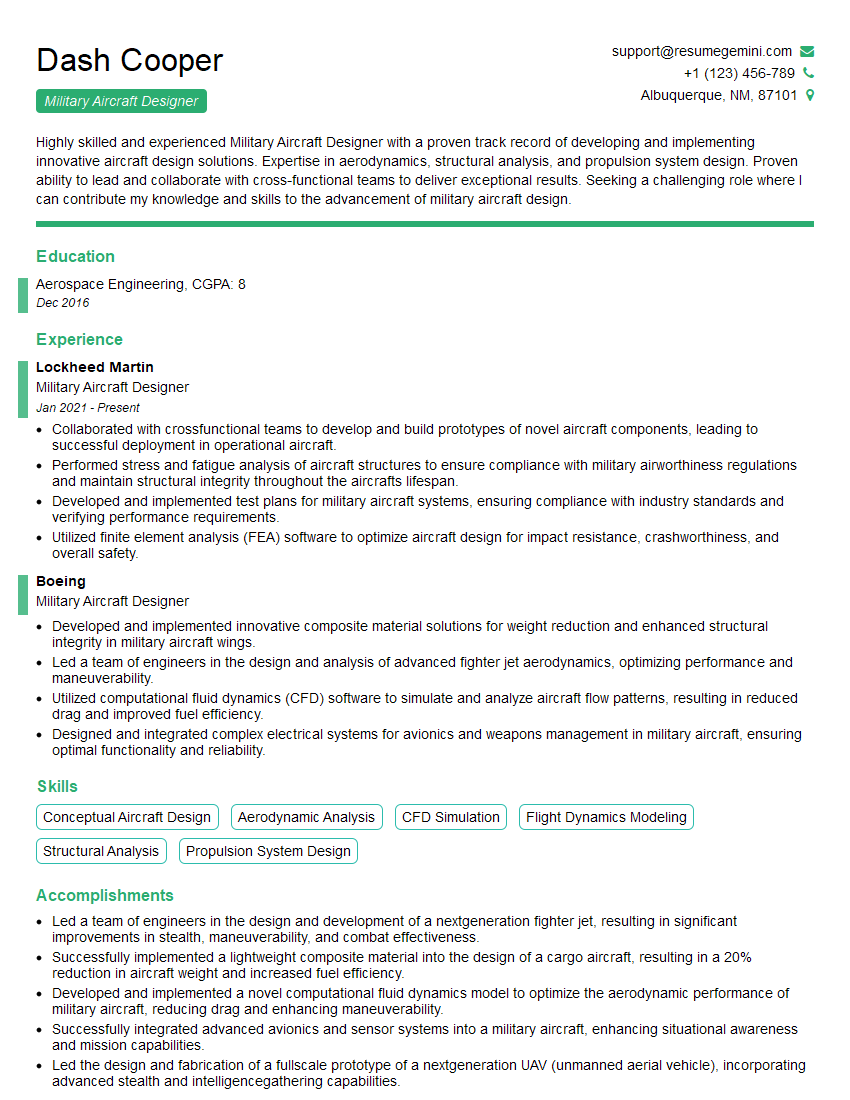
Dash Cooper
Military Aircraft Designer
Summary
Highly skilled and experienced Military Aircraft Designer with a proven track record of developing and implementing innovative aircraft design solutions. Expertise in aerodynamics, structural analysis, and propulsion system design. Proven ability to lead and collaborate with cross-functional teams to deliver exceptional results. Seeking a challenging role where I can contribute my knowledge and skills to the advancement of military aircraft design.
Education
Aerospace Engineering
December 2016
Skills
- Conceptual Aircraft Design
- Aerodynamic Analysis
- CFD Simulation
- Flight Dynamics Modeling
- Structural Analysis
- Propulsion System Design
Work Experience
Military Aircraft Designer
- Collaborated with crossfunctional teams to develop and build prototypes of novel aircraft components, leading to successful deployment in operational aircraft.
- Performed stress and fatigue analysis of aircraft structures to ensure compliance with military airworthiness regulations and maintain structural integrity throughout the aircrafts lifespan.
- Developed and implemented test plans for military aircraft systems, ensuring compliance with industry standards and verifying performance requirements.
- Utilized finite element analysis (FEA) software to optimize aircraft design for impact resistance, crashworthiness, and overall safety.
Military Aircraft Designer
- Developed and implemented innovative composite material solutions for weight reduction and enhanced structural integrity in military aircraft wings.
- Led a team of engineers in the design and analysis of advanced fighter jet aerodynamics, optimizing performance and maneuverability.
- Utilized computational fluid dynamics (CFD) software to simulate and analyze aircraft flow patterns, resulting in reduced drag and improved fuel efficiency.
- Designed and integrated complex electrical systems for avionics and weapons management in military aircraft, ensuring optimal functionality and reliability.
Accomplishments
- Led a team of engineers in the design and development of a nextgeneration fighter jet, resulting in significant improvements in stealth, maneuverability, and combat effectiveness.
- Successfully implemented a lightweight composite material into the design of a cargo aircraft, resulting in a 20% reduction in aircraft weight and increased fuel efficiency.
- Developed and implemented a novel computational fluid dynamics model to optimize the aerodynamic performance of military aircraft, reducing drag and enhancing maneuverability.
- Successfully integrated advanced avionics and sensor systems into a military aircraft, enhancing situational awareness and mission capabilities.
- Led the design and fabrication of a fullscale prototype of a nextgeneration UAV (unmanned aerial vehicle), incorporating advanced stealth and intelligencegathering capabilities.
Awards
- Received the Air Force Materiel Command Engineering Excellence Award for exceptional contributions to the development of advanced aircraft technologies.
- Awarded the AIAA (American Institute of Aeronautics and Astronautics) Young Professional Award for outstanding achievement in the field of military aircraft design.
- Honored with the Department of Defense Service Medal for meritorious service in the design and development of military aircraft.
- Recognized with the SAE (Society of Automotive Engineers) Aerospace Engineering Award for contributions to the advancement of military aircraft design.
Certificates
- Certified Professional Engineer (PE)
- Certified Flight Test Engineer (CFTE)
- Certified Systems Professional (CSP)
- Certified Professional in Supply Chain Management (CPSCM)
Career Expert Tips:
- Select the ideal resume template to showcase your professional experience effectively.
- Master the art of resume writing to highlight your unique qualifications and achievements.
- Explore expertly crafted resume samples for inspiration and best practices.
- Build your best resume for free this new year with ResumeGemini. Enjoy exclusive discounts on ATS optimized resume templates.
How To Write Resume For Military Aircraft Designer
- Highlight your expertise in aerodynamics, structural analysis, and propulsion system design.
- Showcase your experience in using CFD software and other relevant design tools.
- Quantify your accomplishments with specific metrics and results whenever possible.
- Tailor your resume to each job you apply for, emphasizing the skills and experience that are most relevant to the position.
Essential Experience Highlights for a Strong Military Aircraft Designer Resume
- Design and analyze military aircraft aerodynamics to optimize performance and maneuverability.
- Utilize CFD software to simulate and analyze aircraft flow patterns, resulting in reduced drag and improved fuel efficiency.
- Develop and implement innovative composite material solutions for weight reduction and enhanced structural integrity in military aircraft wings.
- Design and integrate complex electrical systems for avionics and weapons management in military aircraft, ensuring optimal functionality and reliability.
- Collaborate with cross-functional teams to develop and build prototypes of novel aircraft components, leading to successful deployment in operational aircraft.
- Perform stress and fatigue analysis of aircraft structures to ensure compliance with military airworthiness regulations and maintain structural integrity throughout the aircraft’s lifespan.
- Develop and implement test plans for military aircraft systems, ensuring compliance with industry standards and verifying performance requirements.
Frequently Asked Questions (FAQ’s) For Military Aircraft Designer
What are the key skills required to be a successful Military Aircraft Designer?
The key skills required to be a successful Military Aircraft Designer include expertise in aerodynamics, structural analysis, and propulsion system design. Additionally, strong skills in CFD software and other relevant design tools are essential. Excellent communication and teamwork skills are also important, as Military Aircraft Designers often work on collaborative projects with engineers from other disciplines.
What are the career prospects for Military Aircraft Designers?
The career prospects for Military Aircraft Designers are excellent. There is a growing demand for skilled professionals in this field, as militaries around the world are investing in the development of new and advanced aircraft. With experience, Military Aircraft Designers can advance to senior positions, such as Chief Engineer or Program Manager.
What is the work environment like for Military Aircraft Designers?
Military Aircraft Designers typically work in a fast-paced and challenging environment. They often work on multiple projects simultaneously, and they must be able to meet tight deadlines. However, the work is also very rewarding, as Military Aircraft Designers play a vital role in the development of new aircraft that protect our country.
What are the educational requirements to become a Military Aircraft Designer?
The educational requirements to become a Military Aircraft Designer typically include a Bachelor’s degree in Aerospace Engineering or a related field. Some employers may also require a Master’s degree or PhD. Additionally, Military Aircraft Designers must be certified by the Federal Aviation Administration (FAA).
What are the key challenges facing Military Aircraft Designers?
The key challenges facing Military Aircraft Designers include the need to develop aircraft that are more efficient, more maneuverable, and more survivable. Additionally, Military Aircraft Designers must also address the challenges of designing aircraft that are affordable to build and operate.