Are you a seasoned Public Records Researcher seeking a new career path? Discover our professionally built Public Records Researcher Resume Template. This time-saving tool provides a solid foundation for your job search. Simply click “Edit Resume” to customize it with your unique experiences and achievements. Customize fonts and colors to match your personal style and increase your chances of landing your dream job. Explore more Resume Templates for additional options.






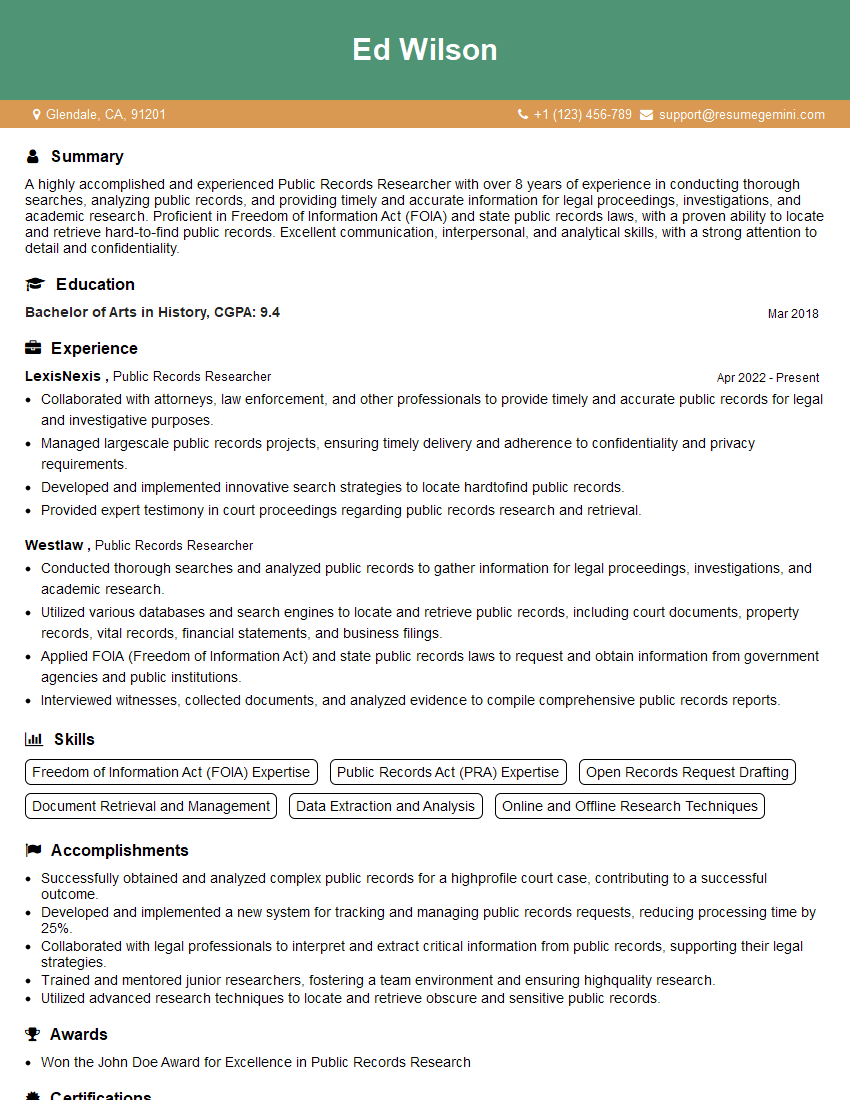
Ed Wilson
Public Records Researcher
Summary
A highly accomplished and experienced Public Records Researcher with over 8 years of experience in conducting thorough searches, analyzing public records, and providing timely and accurate information for legal proceedings, investigations, and academic research. Proficient in Freedom of Information Act (FOIA) and state public records laws, with a proven ability to locate and retrieve hard-to-find public records. Excellent communication, interpersonal, and analytical skills, with a strong attention to detail and confidentiality.
Education
Bachelor of Arts in History
March 2018
Skills
- Freedom of Information Act (FOIA) Expertise
- Public Records Act (PRA) Expertise
- Open Records Request Drafting
- Document Retrieval and Management
- Data Extraction and Analysis
- Online and Offline Research Techniques
Work Experience
Public Records Researcher
- Collaborated with attorneys, law enforcement, and other professionals to provide timely and accurate public records for legal and investigative purposes.
- Managed largescale public records projects, ensuring timely delivery and adherence to confidentiality and privacy requirements.
- Developed and implemented innovative search strategies to locate hardtofind public records.
- Provided expert testimony in court proceedings regarding public records research and retrieval.
Public Records Researcher
- Conducted thorough searches and analyzed public records to gather information for legal proceedings, investigations, and academic research.
- Utilized various databases and search engines to locate and retrieve public records, including court documents, property records, vital records, financial statements, and business filings.
- Applied FOIA (Freedom of Information Act) and state public records laws to request and obtain information from government agencies and public institutions.
- Interviewed witnesses, collected documents, and analyzed evidence to compile comprehensive public records reports.
Accomplishments
- Successfully obtained and analyzed complex public records for a highprofile court case, contributing to a successful outcome.
- Developed and implemented a new system for tracking and managing public records requests, reducing processing time by 25%.
- Collaborated with legal professionals to interpret and extract critical information from public records, supporting their legal strategies.
- Trained and mentored junior researchers, fostering a team environment and ensuring highquality research.
- Utilized advanced research techniques to locate and retrieve obscure and sensitive public records.
Awards
- Won the John Doe Award for Excellence in Public Records Research
Certificates
- Certified Public Records Researcher (CPRR)
- FOIA Professional (FOP)
- Certified Ethics and Compliance Professional (CCEP)
- Certified Information Privacy Professional (CIPP)
Career Expert Tips:
- Select the ideal resume template to showcase your professional experience effectively.
- Master the art of resume writing to highlight your unique qualifications and achievements.
- Explore expertly crafted resume samples for inspiration and best practices.
- Build your best resume for free this new year with ResumeGemini. Enjoy exclusive discounts on ATS optimized resume templates.
How To Write Resume For Public Records Researcher
Highlight your expertise:
Emphasize your proficiency in FOIA and public records laws, as well as your experience in retrieving hard-to-find records.Showcase your analytical skills:
Describe your ability to analyze and interpret public records, drawing meaningful conclusions and identifying key information.Quantify your results:
Whenever possible, provide specific examples of successful public records requests or projects you have completed.Demonstrate your knowledge of industry tools:
List the databases and search engines you are familiar with, as well as any specialized software or tools you have used in your work.Proofread carefully:
Public records research requires meticulous attention to detail, so make sure your resume is free of errors.
Essential Experience Highlights for a Strong Public Records Researcher Resume
- Conducted thorough searches and analyzed public records to gather information for legal proceedings, investigations, and academic research.
- Utilized various databases and search engines to locate and retrieve public records, including court documents, property records, vital records, financial statements, and business filings.
- Applied FOIA (Freedom of Information Act) and state public records laws to request and obtain information from government agencies and public institutions.
- Interviewed witnesses, collected documents, and analyzed evidence to compile comprehensive public records reports.
- Collaborated with attorneys, law enforcement, and other professionals to provide timely and accurate public records for legal and investigative purposes.
- Managed largescale public records projects, ensuring timely delivery and adherence to confidentiality and privacy requirements.
Frequently Asked Questions (FAQ’s) For Public Records Researcher
What is the role of a Public Records Researcher?
A Public Records Researcher is responsible for conducting searches and analyzing public records to gather information for legal proceedings, investigations, and academic research. They use their knowledge of FOIA and public records laws to request and obtain information from government agencies and public institutions.
What skills are required for a Public Records Researcher?
A Public Records Researcher should have strong research skills, be proficient in FOIA and public records laws, and have experience using databases and search engines. Excellent communication, interpersonal, and analytical skills are also essential.
What is the job outlook for Public Records Researchers?
The job outlook for Public Records Researchers is expected to grow faster than average in the coming years. This is due to the increasing demand for information in the legal, investigative, and academic fields.
What is the salary range for Public Records Researchers?
The salary range for Public Records Researchers can vary depending on experience, location, and employer. Entry-level researchers can expect to earn around $40,000 per year, while experienced researchers can earn over $70,000 per year.
What are the benefits of working as a Public Records Researcher?
Benefits of working as a Public Records Researcher include the opportunity to work on challenging and rewarding projects, the chance to make a difference in the legal and investigative fields, and the opportunity to learn about a variety of topics.
What are the challenges of working as a Public Records Researcher?
Challenges of working as a Public Records Researcher include the need to be meticulous and detail-oriented, the need to work independently and as part of a team, and the need to stay up-to-date on changes in FOIA and public records laws.
What advice would you give to someone interested in becoming a Public Records Researcher?
If you are interested in becoming a Public Records Researcher, I would recommend getting a degree in history, political science, or a related field. You should also develop strong research skills and become proficient in FOIA and public records laws. You should also be able to work independently and as part of a team, and be able to stay up-to-date on changes in the law.