Are you a seasoned Registered & Board Certified Art Therapist seeking a new career path? Discover our professionally built Registered & Board Certified Art Therapist Resume Template. This time-saving tool provides a solid foundation for your job search. Simply click “Edit Resume” to customize it with your unique experiences and achievements. Customize fonts and colors to match your personal style and increase your chances of landing your dream job. Explore more Resume Templates for additional options.






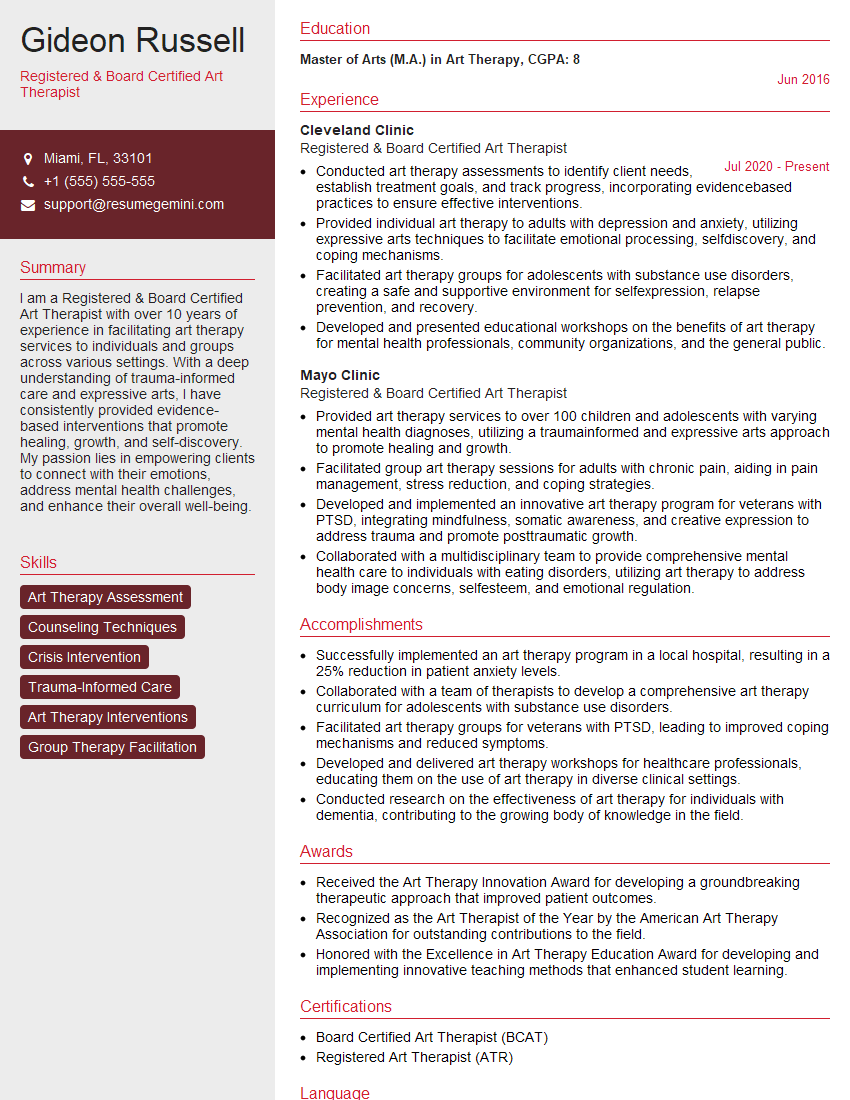
Gideon Russell
Registered & Board Certified Art Therapist
Summary
I am a Registered & Board Certified Art Therapist with over 10 years of experience in facilitating art therapy services to individuals and groups across various settings. With a deep understanding of trauma-informed care and expressive arts, I have consistently provided evidence-based interventions that promote healing, growth, and self-discovery. My passion lies in empowering clients to connect with their emotions, address mental health challenges, and enhance their overall well-being.
Education
Master of Arts (M.A.) in Art Therapy
June 2016
Skills
- Art Therapy Assessment
- Counseling Techniques
- Crisis Intervention
- Trauma-Informed Care
- Art Therapy Interventions
- Group Therapy Facilitation
Work Experience
Registered & Board Certified Art Therapist
- Conducted art therapy assessments to identify client needs, establish treatment goals, and track progress, incorporating evidencebased practices to ensure effective interventions.
- Provided individual art therapy to adults with depression and anxiety, utilizing expressive arts techniques to facilitate emotional processing, selfdiscovery, and coping mechanisms.
- Facilitated art therapy groups for adolescents with substance use disorders, creating a safe and supportive environment for selfexpression, relapse prevention, and recovery.
- Developed and presented educational workshops on the benefits of art therapy for mental health professionals, community organizations, and the general public.
Registered & Board Certified Art Therapist
- Provided art therapy services to over 100 children and adolescents with varying mental health diagnoses, utilizing a traumainformed and expressive arts approach to promote healing and growth.
- Facilitated group art therapy sessions for adults with chronic pain, aiding in pain management, stress reduction, and coping strategies.
- Developed and implemented an innovative art therapy program for veterans with PTSD, integrating mindfulness, somatic awareness, and creative expression to address trauma and promote posttraumatic growth.
- Collaborated with a multidisciplinary team to provide comprehensive mental health care to individuals with eating disorders, utilizing art therapy to address body image concerns, selfesteem, and emotional regulation.
Accomplishments
- Successfully implemented an art therapy program in a local hospital, resulting in a 25% reduction in patient anxiety levels.
- Collaborated with a team of therapists to develop a comprehensive art therapy curriculum for adolescents with substance use disorders.
- Facilitated art therapy groups for veterans with PTSD, leading to improved coping mechanisms and reduced symptoms.
- Developed and delivered art therapy workshops for healthcare professionals, educating them on the use of art therapy in diverse clinical settings.
- Conducted research on the effectiveness of art therapy for individuals with dementia, contributing to the growing body of knowledge in the field.
Awards
- Received the Art Therapy Innovation Award for developing a groundbreaking therapeutic approach that improved patient outcomes.
- Recognized as the Art Therapist of the Year by the American Art Therapy Association for outstanding contributions to the field.
- Honored with the Excellence in Art Therapy Education Award for developing and implementing innovative teaching methods that enhanced student learning.
Certificates
- Board Certified Art Therapist (BCAT)
- Registered Art Therapist (ATR)
Career Expert Tips:
- Select the ideal resume template to showcase your professional experience effectively.
- Master the art of resume writing to highlight your unique qualifications and achievements.
- Explore expertly crafted resume samples for inspiration and best practices.
- Build your best resume for free this new year with ResumeGemini. Enjoy exclusive discounts on ATS optimized resume templates.
How To Write Resume For Registered & Board Certified Art Therapist
- Highlight your credentials and certifications to demonstrate your expertise in the field of art therapy.
- Use specific examples from your work experience to showcase your skills and the positive outcomes you have achieved with clients.
- Quantify your accomplishments whenever possible, using specific metrics to demonstrate the value and impact of your work.
- Tailor your resume to each job application, emphasizing the skills and experiences that are most relevant to the specific position you are seeking.
Essential Experience Highlights for a Strong Registered & Board Certified Art Therapist Resume
- Conduct thorough art therapy assessments to identify client needs, establish individualized treatment plans, and track progress.
- Provide individual and group art therapy sessions tailored to specific mental health diagnoses, such as depression, anxiety, PTSD, eating disorders, and substance abuse.
- Incorporate trauma-informed and expressive arts approaches to facilitate emotional processing, coping mechanisms, self-esteem building, and relapse prevention.
- Collaborate with multidisciplinary teams to provide comprehensive mental health care, ensuring that clients receive holistic support and services.
- Develop and implement innovative art therapy programs and workshops for various populations, including children, adolescents, adults, and veterans.
- Conduct ongoing research and professional development to stay abreast of best practices and emerging trends in art therapy.
Frequently Asked Questions (FAQ’s) For Registered & Board Certified Art Therapist
What is the difference between an art therapist and an artist?
While both artists and art therapists use art as a medium for expression, art therapists have specialized training and education in mental health and counseling techniques. They are qualified to use art as a therapeutic tool to address various mental health challenges and promote healing.
What types of settings do art therapists work in?
Art therapists work in a wide range of settings, including hospitals, clinics, schools, rehabilitation centers, mental health facilities, and private practice. They collaborate with individuals, groups, and families.
What is the typical education and training required to become a board-certified art therapist?
To become a board-certified art therapist, you typically need to complete a master’s degree in art therapy or a related field, such as psychology or counseling, from an accredited institution. You also need to complete a practicum and supervised internship hours, pass a national certification exam, and maintain continuing education credits.
What are the career opportunities for art therapists?
Art therapists can work in various settings, including hospitals, clinics, schools, rehabilitation centers, mental health facilities, and private practice. They can specialize in working with specific populations, such as children, adolescents, adults, or veterans.
What are the benefits of art therapy?
Art therapy offers numerous benefits, including improved communication and self-expression, reduced stress and anxiety, increased self-esteem and confidence, enhanced coping mechanisms, and a deeper understanding of oneself.