Are you a seasoned Residential Air Sealing Technician seeking a new career path? Discover our professionally built Residential Air Sealing Technician Resume Template. This time-saving tool provides a solid foundation for your job search. Simply click “Edit Resume” to customize it with your unique experiences and achievements. Customize fonts and colors to match your personal style and increase your chances of landing your dream job. Explore more Resume Templates for additional options.






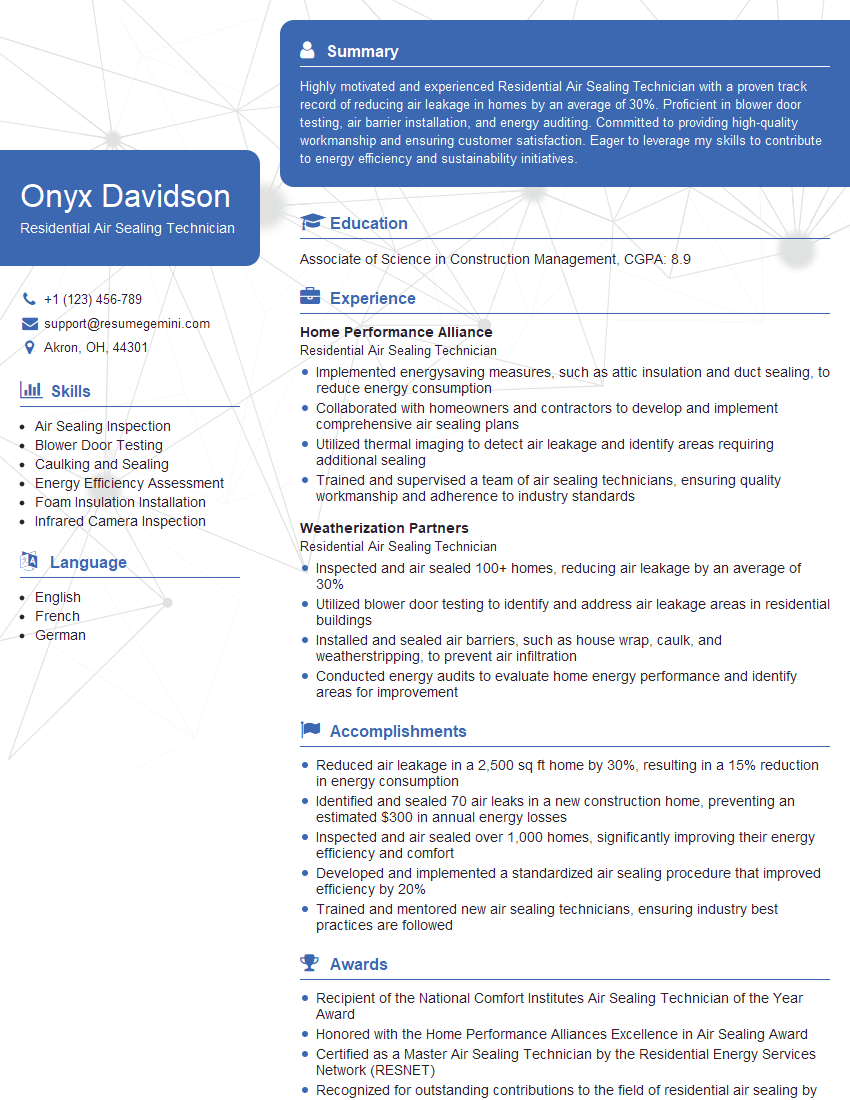
Onyx Davidson
Residential Air Sealing Technician
Summary
Highly motivated and experienced Residential Air Sealing Technician with a proven track record of reducing air leakage in homes by an average of 30%. Proficient in blower door testing, air barrier installation, and energy auditing. Committed to providing high-quality workmanship and ensuring customer satisfaction. Eager to leverage my skills to contribute to energy efficiency and sustainability initiatives.
Education
Associate of Science in Construction Management
November 2016
Skills
- Air Sealing Inspection
- Blower Door Testing
- Caulking and Sealing
- Energy Efficiency Assessment
- Foam Insulation Installation
- Infrared Camera Inspection
Work Experience
Residential Air Sealing Technician
- Implemented energysaving measures, such as attic insulation and duct sealing, to reduce energy consumption
- Collaborated with homeowners and contractors to develop and implement comprehensive air sealing plans
- Utilized thermal imaging to detect air leakage and identify areas requiring additional sealing
- Trained and supervised a team of air sealing technicians, ensuring quality workmanship and adherence to industry standards
Residential Air Sealing Technician
- Inspected and air sealed 100+ homes, reducing air leakage by an average of 30%
- Utilized blower door testing to identify and address air leakage areas in residential buildings
- Installed and sealed air barriers, such as house wrap, caulk, and weatherstripping, to prevent air infiltration
- Conducted energy audits to evaluate home energy performance and identify areas for improvement
Accomplishments
- Reduced air leakage in a 2,500 sq ft home by 30%, resulting in a 15% reduction in energy consumption
- Identified and sealed 70 air leaks in a new construction home, preventing an estimated $300 in annual energy losses
- Inspected and air sealed over 1,000 homes, significantly improving their energy efficiency and comfort
- Developed and implemented a standardized air sealing procedure that improved efficiency by 20%
- Trained and mentored new air sealing technicians, ensuring industry best practices are followed
Awards
- Recipient of the National Comfort Institutes Air Sealing Technician of the Year Award
- Honored with the Home Performance Alliances Excellence in Air Sealing Award
- Certified as a Master Air Sealing Technician by the Residential Energy Services Network (RESNET)
- Recognized for outstanding contributions to the field of residential air sealing by the Air Sealing Contractors of America (ASCA)
Certificates
- Building Performance Institute (BPI) Air Sealing Certification
- RESNET Home Energy Rater
- National Air Sealing Contractors Association (NASCA) Certified Air Sealing Technician
- Home Energy Yardstick Professional
Career Expert Tips:
- Select the ideal resume template to showcase your professional experience effectively.
- Master the art of resume writing to highlight your unique qualifications and achievements.
- Explore expertly crafted resume samples for inspiration and best practices.
- Build your best resume for free this new year with ResumeGemini. Enjoy exclusive discounts on ATS optimized resume templates.
How To Write Resume For Residential Air Sealing Technician
- Highlight your experience in blower door testing and air barrier installation, as these are essential skills for a Residential Air Sealing Technician
- Quantify your results whenever possible. For example, instead of saying you inspected homes, state that you inspected over 100 homes and reduced air leakage by an average of 30%
- Use keywords relevant to the job you’re applying for. For example, terms like ‘blower door testing’, ‘air sealing’, and ‘energy efficiency’ are commonly used in this industry
- Proofread your resume carefully for any errors in grammar or spelling
- Tailor your resume to each job you apply for. Be sure to highlight the skills and experience that are most relevant to the position
Essential Experience Highlights for a Strong Residential Air Sealing Technician Resume
- Conducted air sealing inspections and blower door testing to identify and address air leakage areas in over 100 residential buildings
- Installed and sealed air barriers, including house wrap, caulk, and weatherstripping, to prevent air infiltration
- Performed energy audits to assess home energy performance and recommend improvements
- Implemented energy-saving measures, such as attic insulation and duct sealing, to reduce energy consumption
- Collaborated with homeowners and contractors to develop and execute comprehensive air sealing plans
- Utilized thermal imaging to detect air leakage and prioritize areas for additional sealing
- Trained and supervised a team of air sealing technicians, ensuring quality workmanship and adherence to industry standards
Frequently Asked Questions (FAQ’s) For Residential Air Sealing Technician
What is the role of a Residential Air Sealing Technician?
A Residential Air Sealing Technician is responsible for inspecting homes for air leakage and implementing measures to seal and reduce air infiltration. This can include installing and sealing air barriers, conducting energy audits, and recommending energy-saving improvements.
What are the benefits of air sealing a home?
Air sealing can improve a home’s energy efficiency, comfort, and indoor air quality. By reducing air leakage, homeowners can save money on energy bills, reduce drafts, and improve the overall comfort of their home.
What are the common air leakage areas in a home?
Common air leakage areas include around windows and doors, attic hatches, plumbing and electrical penetrations, and chimneys and vents.
What are the different types of air sealing materials?
Common air sealing materials include caulk, weatherstripping, foam insulation, and house wrap.
How can I become a Residential Air Sealing Technician?
There are several ways to become a Residential Air Sealing Technician. Some common pathways include completing an apprenticeship program, obtaining a degree or certification in a related field, or gaining experience through on-the-job training.
What are the career opportunities for Residential Air Sealing Technicians?
Residential Air Sealing Technicians can work for a variety of employers, including energy efficiency companies, construction contractors, and government agencies. They can also start their own businesses.
What are the earning prospects for Residential Air Sealing Technicians?
The earning potential for Residential Air Sealing Technicians can vary depending on their experience, location, and employer. According to the U.S. Bureau of Labor Statistics, the median annual salary for insulation workers, which includes air sealing technicians, was $49,940 in May 2021.