Are you a seasoned Rice Farmworker seeking a new career path? Discover our professionally built Rice Farmworker Resume Template. This time-saving tool provides a solid foundation for your job search. Simply click “Edit Resume” to customize it with your unique experiences and achievements. Customize fonts and colors to match your personal style and increase your chances of landing your dream job. Explore more Resume Templates for additional options.






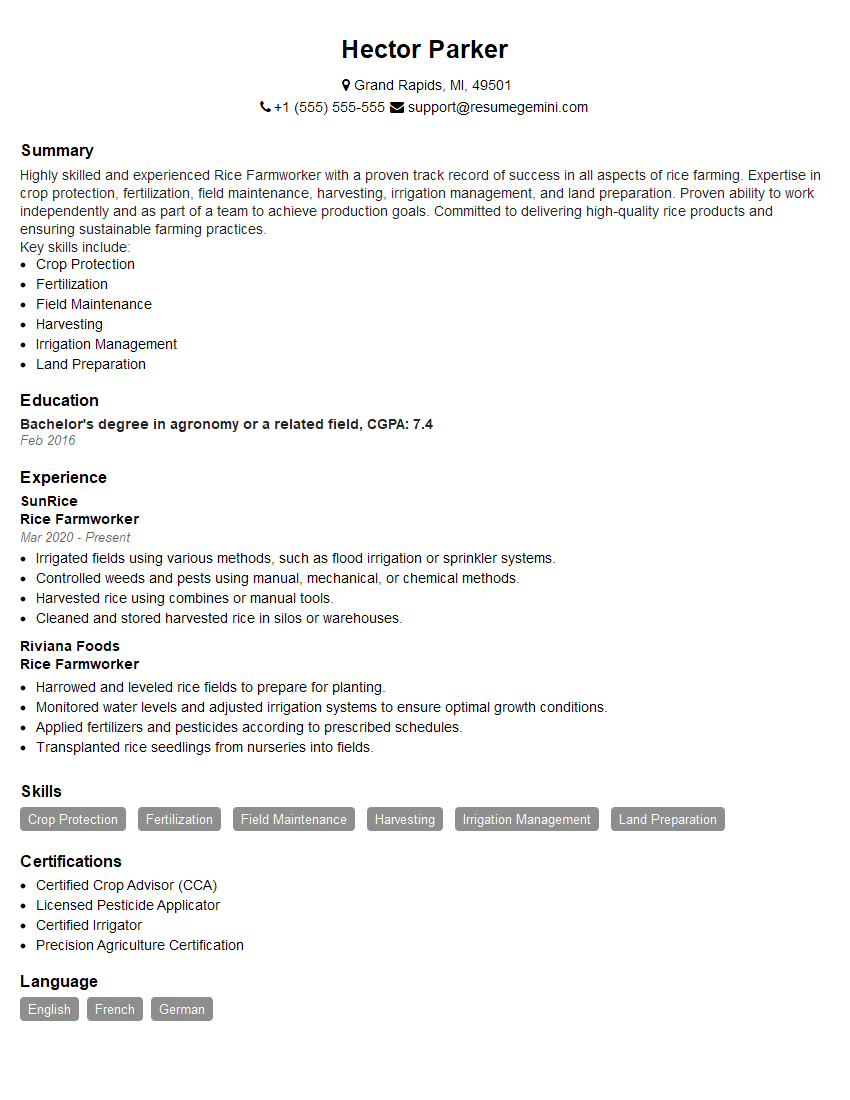
Hector Parker
Rice Farmworker
Summary
Highly skilled and experienced Rice Farmworker with a proven track record of success in all aspects of rice farming. Expertise in crop protection, fertilization, field maintenance, harvesting, irrigation management, and land preparation. Proven ability to work independently and as part of a team to achieve production goals. Committed to delivering high-quality rice products and ensuring sustainable farming practices.
Key skills include:
- Crop Protection
- Fertilization
- Field Maintenance
- Harvesting
- Irrigation Management
- Land Preparation
Education
Bachelor’s degree in agronomy or a related field
February 2016
Skills
- Crop Protection
- Fertilization
- Field Maintenance
- Harvesting
- Irrigation Management
- Land Preparation
Work Experience
Rice Farmworker
- Irrigated fields using various methods, such as flood irrigation or sprinkler systems.
- Controlled weeds and pests using manual, mechanical, or chemical methods.
- Harvested rice using combines or manual tools.
- Cleaned and stored harvested rice in silos or warehouses.
Rice Farmworker
- Harrowed and leveled rice fields to prepare for planting.
- Monitored water levels and adjusted irrigation systems to ensure optimal growth conditions.
- Applied fertilizers and pesticides according to prescribed schedules.
- Transplanted rice seedlings from nurseries into fields.
Certificates
- Certified Crop Advisor (CCA)
- Licensed Pesticide Applicator
- Certified Irrigator
- Precision Agriculture Certification
Languages
- English
- French
- German
Career Expert Tips:
- Select the ideal resume template to showcase your professional experience effectively.
- Master the art of resume writing to highlight your unique qualifications and achievements.
- Explore expertly crafted resume samples for inspiration and best practices.
- Build your best resume for free this new year with ResumeGemini. Enjoy exclusive discounts on ATS optimized resume templates.
How To Write Resume For Rice Farmworker
Highlight relevant skills and experience.
Make sure to list your skills and experience in a way that is relevant to the job you are applying for. For example, if you have experience in operating heavy machinery, be sure to mention this in your resume.Quantify your accomplishments.
Whenever possible, use numbers to quantify your accomplishments. For example, instead of saying “I increased crop yields,” you could say “I increased crop yields by 15%.”Use keywords.
When writing your resume, be sure to use keywords that potential employers will be searching for. For example, if you are applying for a job as a rice farmworker, you should use keywords such as “rice farming,” “crop production,” and “irrigation management.”Proofread carefully.
Before you submit your resume, be sure to proofread it carefully for any errors. This will help you make a good impression on potential employers.
Essential Experience Highlights for a Strong Rice Farmworker Resume
- Prepared rice fields for planting by harrowing and leveling the soil
- Monitored water levels and adjusted irrigation systems to ensure optimal growth conditions for rice crops
- Applied fertilizers and pesticides according to prescribed schedules to promote crop health and yield
- Transplanted rice seedlings from nurseries into fields to establish new crops
- Irrigated fields using various methods, such as flood irrigation or sprinkler systems, to provide water for crop growth
- Controlled weeds and pests using manual, mechanical, or chemical methods to protect crops from damage and ensure quality
- Harvested rice using combines or manual tools to gather the mature grain for processing and storage
Frequently Asked Questions (FAQ’s) For Rice Farmworker
What are the job duties of a rice farmworker?
Rice farmworkers are responsible for a variety of tasks, including preparing rice fields for planting, monitoring water levels and adjusting irrigation systems, applying fertilizers and pesticides, transplanting rice seedlings, irrigating fields, controlling weeds and pests, harvesting rice, and cleaning and storing harvested rice.
What are the qualifications for a rice farmworker?
Rice farmworkers typically need at least a high school diploma or equivalent. Some employers may prefer candidates with a bachelor’s degree in agronomy or a related field. Rice farmworkers should also have experience in operating farm machinery and equipment, and they should be able to work independently and as part of a team.
What is the work environment of a rice farmworker?
Rice farmworkers typically work outdoors in all types of weather conditions. They may be exposed to pesticides and other chemicals, and they may have to work long hours during planting and harvesting seasons.
What is the salary of a rice farmworker?
The salary of a rice farmworker varies depending on experience, location, and employer. According to the U.S. Bureau of Labor Statistics, the median annual salary for agricultural workers was $26,940 in May 2021.
What is the job outlook for rice farmworkers?
The job outlook for rice farmworkers is expected to be good over the next few years. The demand for rice is expected to increase as the global population grows. However, the number of rice farmworkers is expected to decline as more farmers use mechanization to automate tasks.
What are the benefits of working as a rice farmworker?
Rice farmworkers can enjoy a variety of benefits, including health insurance, paid time off, and retirement benefits. They may also have the opportunity to work outdoors and be part of a team that produces food for the world.
What are the challenges of working as a rice farmworker?
Rice farmworkers may face a variety of challenges, including working in all types of weather conditions, being exposed to pesticides and other chemicals, and having to work long hours during planting and harvesting seasons.