Are you a seasoned Safety Investigator/Cause Analyst seeking a new career path? Discover our professionally built Safety Investigator/Cause Analyst Resume Template. This time-saving tool provides a solid foundation for your job search. Simply click “Edit Resume” to customize it with your unique experiences and achievements. Customize fonts and colors to match your personal style and increase your chances of landing your dream job. Explore more Resume Templates for additional options.






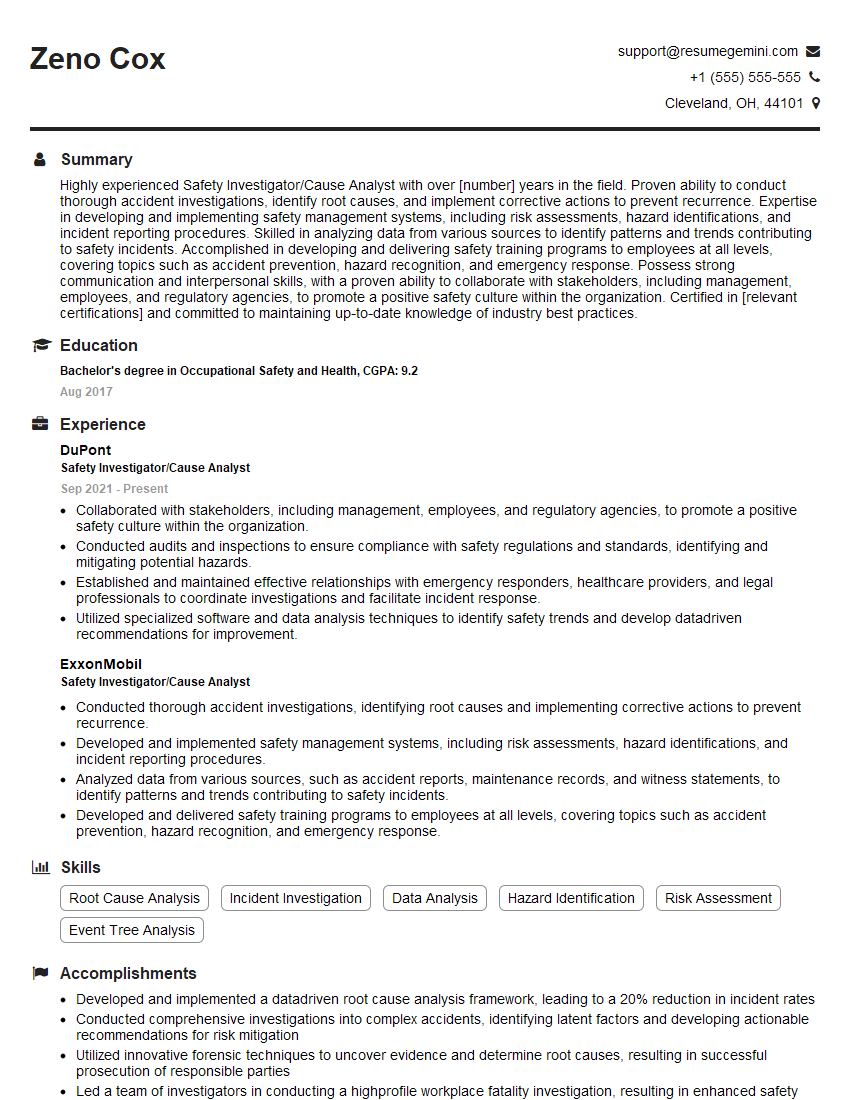
Zeno Cox
Safety Investigator/Cause Analyst
Summary
Highly experienced Safety Investigator/Cause Analyst with over [number] years in the field. Proven ability to conduct thorough accident investigations, identify root causes, and implement corrective actions to prevent recurrence. Expertise in developing and implementing safety management systems, including risk assessments, hazard identifications, and incident reporting procedures. Skilled in analyzing data from various sources to identify patterns and trends contributing to safety incidents. Accomplished in developing and delivering safety training programs to employees at all levels, covering topics such as accident prevention, hazard recognition, and emergency response. Possess strong communication and interpersonal skills, with a proven ability to collaborate with stakeholders, including management, employees, and regulatory agencies, to promote a positive safety culture within the organization. Certified in [relevant certifications] and committed to maintaining up-to-date knowledge of industry best practices.
Education
Bachelor’s degree in Occupational Safety and Health
August 2017
Skills
- Root Cause Analysis
- Incident Investigation
- Data Analysis
- Hazard Identification
- Risk Assessment
- Event Tree Analysis
Work Experience
Safety Investigator/Cause Analyst
- Collaborated with stakeholders, including management, employees, and regulatory agencies, to promote a positive safety culture within the organization.
- Conducted audits and inspections to ensure compliance with safety regulations and standards, identifying and mitigating potential hazards.
- Established and maintained effective relationships with emergency responders, healthcare providers, and legal professionals to coordinate investigations and facilitate incident response.
- Utilized specialized software and data analysis techniques to identify safety trends and develop datadriven recommendations for improvement.
Safety Investigator/Cause Analyst
- Conducted thorough accident investigations, identifying root causes and implementing corrective actions to prevent recurrence.
- Developed and implemented safety management systems, including risk assessments, hazard identifications, and incident reporting procedures.
- Analyzed data from various sources, such as accident reports, maintenance records, and witness statements, to identify patterns and trends contributing to safety incidents.
- Developed and delivered safety training programs to employees at all levels, covering topics such as accident prevention, hazard recognition, and emergency response.
Accomplishments
- Developed and implemented a datadriven root cause analysis framework, leading to a 20% reduction in incident rates
- Conducted comprehensive investigations into complex accidents, identifying latent factors and developing actionable recommendations for risk mitigation
- Utilized innovative forensic techniques to uncover evidence and determine root causes, resulting in successful prosecution of responsible parties
- Led a team of investigators in conducting a highprofile workplace fatality investigation, resulting in enhanced safety protocols and industry best practices
- Collaborated with crossfunctional teams to develop and implement a comprehensive incident reporting and analysis system
Awards
- National Safety Award for Excellence in Root Cause Analysis, 2023
- Award of Merit for Outstanding Contribution to Safety Investigation Practices, Safety Institute of America, 2022
- National Safety Council Distinguished Service Award for Contribution to Safety Risk Management, 2021
- Industry Recognition for Excellence in Safety Training and Development, Safety Training Council, 2020
Certificates
- Certified Safety Professional (CSP)
- Certified Cause Analyst (CCA)
- Certified Safety Manager (CSM)
- Occupational Safety and Health Administration (OSHA) Training for Investigators
Career Expert Tips:
- Select the ideal resume template to showcase your professional experience effectively.
- Master the art of resume writing to highlight your unique qualifications and achievements.
- Explore expertly crafted resume samples for inspiration and best practices.
- Build your best resume for free this new year with ResumeGemini. Enjoy exclusive discounts on ATS optimized resume templates.
How To Write Resume For Safety Investigator/Cause Analyst
- Highlight your experience and skills in conducting thorough accident investigations and identifying root causes.
- Demonstrate your ability to develop and implement effective safety management systems, including risk assessments and incident reporting procedures.
- Quantify your accomplishments whenever possible, using specific metrics to showcase the impact of your work.
- Tailor your resume to each job you apply for, highlighting the skills and experience that are most relevant to the position.
- Proofread your resume carefully before submitting it, paying attention to grammar, spelling, and formatting.
Essential Experience Highlights for a Strong Safety Investigator/Cause Analyst Resume
- Conduct thorough accident investigations, identifying root causes and implementing corrective actions to prevent recurrence.
- Develop and implement safety management systems, including risk assessments, hazard identifications, and incident reporting procedures.
- Analyze data from various sources, such as accident reports, maintenance records, and witness statements, to identify patterns and trends contributing to safety incidents.
- Develop and deliver safety training programs to employees at all levels, covering topics such as accident prevention, hazard recognition, and emergency response.
- Collaborate with stakeholders, including management, employees, and regulatory agencies, to promote a positive safety culture within the organization.
- Conduct audits and inspections to ensure compliance with safety regulations and standards, identifying and mitigating potential hazards.
- Establish and maintain effective relationships with emergency responders, healthcare providers, and legal professionals to coordinate investigations and facilitate incident response.
- Utilize specialized software and data analysis techniques to identify safety trends and develop data-driven recommendations for improvement.
Frequently Asked Questions (FAQ’s) For Safety Investigator/Cause Analyst
What are the key skills required for a successful Safety Investigator/Cause Analyst?
The key skills required for a successful Safety Investigator/Cause Analyst include strong analytical and problem-solving skills, as well as a deep understanding of safety regulations and standards. Excellent communication and interpersonal skills are also essential, as well as the ability to work independently and as part of a team.
What are the career prospects for a Safety Investigator/Cause Analyst?
The career prospects for a Safety Investigator/Cause Analyst are excellent, as there is a growing demand for qualified professionals in this field. With experience, Safety Investigators/Cause Analysts can advance to management positions, such as Safety Manager or Director of Safety.
What are the challenges faced by Safety Investigators/Cause Analysts?
Safety Investigators/Cause Analysts face a number of challenges, including the need to work in potentially hazardous environments, the need to deal with difficult and emotionally charged situations, and the need to maintain objectivity and impartiality.
What are the rewards of being a Safety Investigator/Cause Analyst?
The rewards of being a Safety Investigator/Cause Analyst include the opportunity to make a real difference in the world by helping to prevent accidents and injuries, the opportunity to work with a variety of people, and the opportunity to learn about new technologies and industries.
What are the educational requirements for a Safety Investigator/Cause Analyst?
The educational requirements for a Safety Investigator/Cause Analyst typically include a bachelor’s degree in occupational safety and health, or a related field, such as engineering or environmental science.
What are the certification requirements for a Safety Investigator/Cause Analyst?
There are a number of certifications available for Safety Investigators/Cause Analysts, including the Certified Safety Professional (CSP) certification, the Certified Safety and Health Manager (CSHM) certification, and the Certified Loss Control Manager (CLCM) certification.
What are the salary expectations for a Safety Investigator/Cause Analyst?
The salary expectations for a Safety Investigator/Cause Analyst vary depending on experience, education, and location. However, according to the U.S. Bureau of Labor Statistics, the median annual salary for Safety Engineers, which includes Safety Investigators/Cause Analysts, was $107,820 in May 2021.
What are the job titles for Safety Investigators/Cause Analysts?
Safety Investigators/Cause Analysts may also be known as Accident Investigators, Safety Engineers, or Risk Analysts.