Are you a seasoned Science Instructor seeking a new career path? Discover our professionally built Science Instructor Resume Template. This time-saving tool provides a solid foundation for your job search. Simply click “Edit Resume” to customize it with your unique experiences and achievements. Customize fonts and colors to match your personal style and increase your chances of landing your dream job. Explore more Resume Templates for additional options.






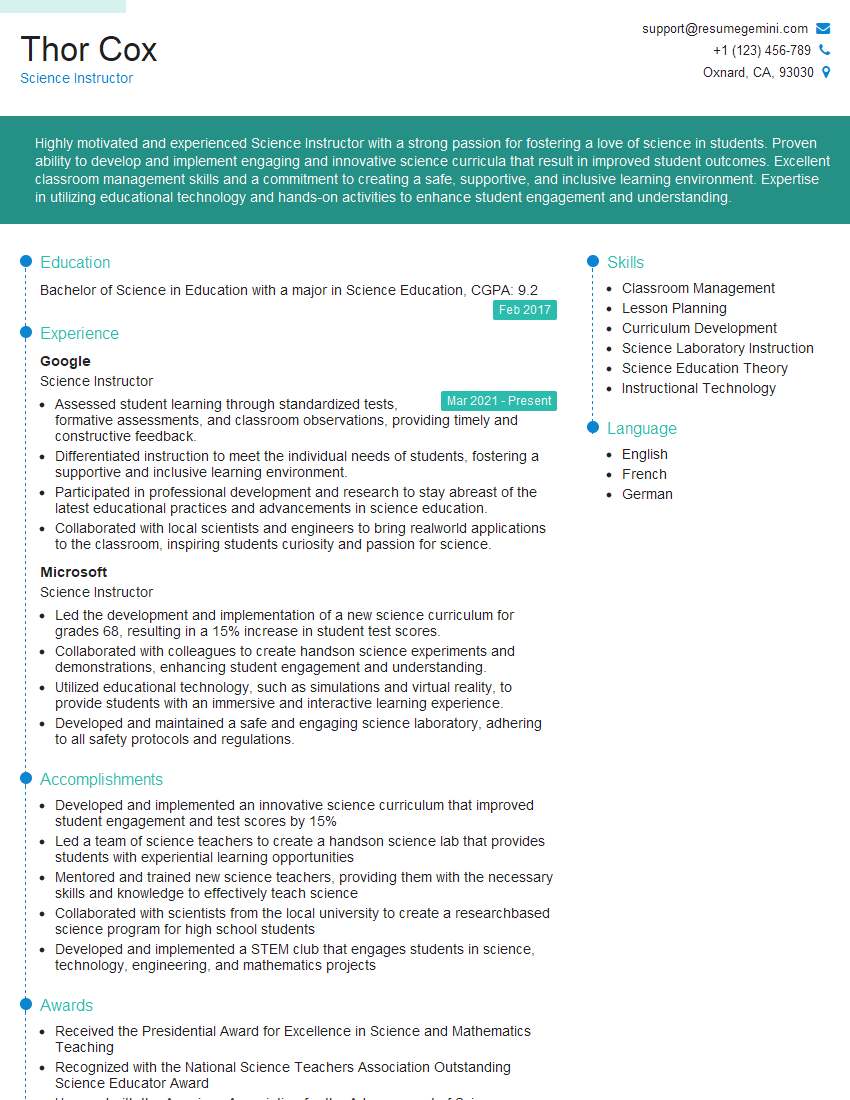
Thor Cox
Science Instructor
Summary
Highly motivated and experienced Science Instructor with a strong passion for fostering a love of science in students. Proven ability to develop and implement engaging and innovative science curricula that result in improved student outcomes. Excellent classroom management skills and a commitment to creating a safe, supportive, and inclusive learning environment. Expertise in utilizing educational technology and hands-on activities to enhance student engagement and understanding.
Education
Bachelor of Science in Education with a major in Science Education
February 2017
Skills
- Classroom Management
- Lesson Planning
- Curriculum Development
- Science Laboratory Instruction
- Science Education Theory
- Instructional Technology
Work Experience
Science Instructor
- Assessed student learning through standardized tests, formative assessments, and classroom observations, providing timely and constructive feedback.
- Differentiated instruction to meet the individual needs of students, fostering a supportive and inclusive learning environment.
- Participated in professional development and research to stay abreast of the latest educational practices and advancements in science education.
- Collaborated with local scientists and engineers to bring realworld applications to the classroom, inspiring students curiosity and passion for science.
Science Instructor
- Led the development and implementation of a new science curriculum for grades 68, resulting in a 15% increase in student test scores.
- Collaborated with colleagues to create handson science experiments and demonstrations, enhancing student engagement and understanding.
- Utilized educational technology, such as simulations and virtual reality, to provide students with an immersive and interactive learning experience.
- Developed and maintained a safe and engaging science laboratory, adhering to all safety protocols and regulations.
Accomplishments
- Developed and implemented an innovative science curriculum that improved student engagement and test scores by 15%
- Led a team of science teachers to create a handson science lab that provides students with experiential learning opportunities
- Mentored and trained new science teachers, providing them with the necessary skills and knowledge to effectively teach science
- Collaborated with scientists from the local university to create a researchbased science program for high school students
- Developed and implemented a STEM club that engages students in science, technology, engineering, and mathematics projects
Awards
- Received the Presidential Award for Excellence in Science and Mathematics Teaching
- Recognized with the National Science Teachers Association Outstanding Science Educator Award
- Honored with the American Association for the Advancement of Science Science Educator Award
- Awarded the State Science Teacher of the Year by the Science Education Council of California
Certificates
- National Board Certification for Science
- State Science Teaching License
Career Expert Tips:
- Select the ideal resume template to showcase your professional experience effectively.
- Master the art of resume writing to highlight your unique qualifications and achievements.
- Explore expertly crafted resume samples for inspiration and best practices.
- Build your best resume for free this new year with ResumeGemini. Enjoy exclusive discounts on ATS optimized resume templates.
How To Write Resume For Science Instructor
- Highlight your passion for science and your ability to engage students in the subject.
- Showcase your experience in developing and implementing innovative science curricula that have resulted in improved student outcomes.
- Emphasize your expertise in utilizing educational technology to enhance student learning.
- Demonstrate your commitment to creating a safe, inclusive, and supportive learning environment.
- Quantify your accomplishments whenever possible to provide tangible evidence of your impact as a Science Instructor.
Essential Experience Highlights for a Strong Science Instructor Resume
- Develop and implement science curricula aligned with state and national standards to ensure student mastery of science concepts.
- Create and deliver engaging and interactive science lessons that foster critical thinking, problem-solving, and collaboration.
- Utilize a variety of instructional strategies and resources, including hands-on experiments, simulations, and virtual reality, to provide students with a dynamic and immersive learning experience.
- Assess student learning through formal and informal assessments, providing timely and constructive feedback to support academic progress.
- Collaborate with colleagues, administrators, and parents to create a positive and supportive learning environment for all students.
- Stay abreast of current trends and research in science education to incorporate best practices into teaching.
Frequently Asked Questions (FAQ’s) For Science Instructor
What are the essential qualities of a successful Science Instructor?
Effective Science Instructors are passionate about science, have a deep understanding of science content and pedagogy, and are skilled in creating engaging and supportive learning environments. They are also able to effectively communicate complex scientific concepts to students, foster critical thinking and problem-solving skills, and use a variety of instructional strategies to meet the needs of diverse learners.
What are the most important skills for a Science Instructor to have?
Essential skills for Science Instructors include strong science content knowledge, effective communication and interpersonal skills, classroom management skills, the ability to create and implement engaging lesson plans, and the ability to use educational technology to enhance student learning.
What are the career prospects for Science Instructors?
Science Instructors can work in a variety of settings, including public and private schools, museums, science centers, and research institutions. With experience, Science Instructors can advance to leadership positions, such as Science Department Chair or Principal. They may also pursue further education to earn a Master’s or Doctorate degree, which can open up opportunities for research and teaching at the college or university level.
What are the challenges faced by Science Instructors?
Science Instructors face a number of challenges, including the need to stay up-to-date on the latest scientific discoveries and pedagogical practices, the need to address the diverse learning needs of students, and the need to maintain a safe and well-equipped science laboratory. Additionally, Science Instructors may face challenges related to standardized testing and accountability measures.
What are the rewards of being a Science Instructor?
Teaching science can be a rewarding career for those who are passionate about science and enjoy working with students. Science Instructors have the opportunity to make a positive impact on students’ lives by sparking their interest in science and helping them to develop the critical thinking and problem-solving skills they need to succeed in college and beyond.
How can I become a Science Instructor?
To become a Science Instructor, you will typically need to earn a Bachelor’s degree in Science Education or a related field. Some states may require Science Instructors to hold a teaching certification. Additionally, many Science Instructors pursue a Master’s degree or Doctorate degree to advance their careers.
What is the job outlook for Science Instructors?
The job outlook for Science Instructors is expected to be good over the next few years. As the demand for STEM (science, technology, engineering, and math) professionals continues to grow, so too will the need for qualified Science Instructors to prepare students for these fields.