Are you a seasoned Serger seeking a new career path? Discover our professionally built Serger Resume Template. This time-saving tool provides a solid foundation for your job search. Simply click “Edit Resume” to customize it with your unique experiences and achievements. Customize fonts and colors to match your personal style and increase your chances of landing your dream job. Explore more Resume Templates for additional options.






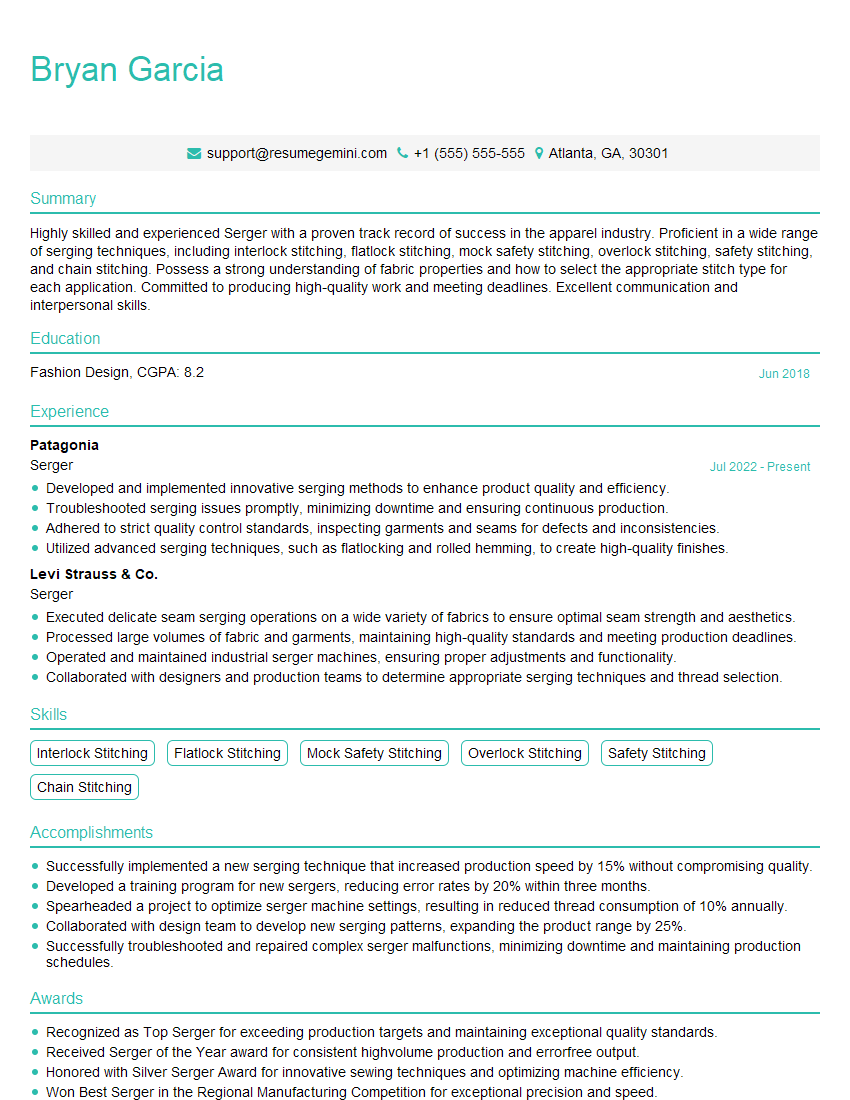
Bryan Garcia
Serger
Summary
Highly skilled and experienced Serger with a proven track record of success in the apparel industry. Proficient in a wide range of serging techniques, including interlock stitching, flatlock stitching, mock safety stitching, overlock stitching, safety stitching, and chain stitching. Possess a strong understanding of fabric properties and how to select the appropriate stitch type for each application. Committed to producing high-quality work and meeting deadlines. Excellent communication and interpersonal skills.
Education
Fashion Design
June 2018
Skills
- Interlock Stitching
- Flatlock Stitching
- Mock Safety Stitching
- Overlock Stitching
- Safety Stitching
- Chain Stitching
Work Experience
Serger
- Developed and implemented innovative serging methods to enhance product quality and efficiency.
- Troubleshooted serging issues promptly, minimizing downtime and ensuring continuous production.
- Adhered to strict quality control standards, inspecting garments and seams for defects and inconsistencies.
- Utilized advanced serging techniques, such as flatlocking and rolled hemming, to create high-quality finishes.
Serger
- Executed delicate seam serging operations on a wide variety of fabrics to ensure optimal seam strength and aesthetics.
- Processed large volumes of fabric and garments, maintaining high-quality standards and meeting production deadlines.
- Operated and maintained industrial serger machines, ensuring proper adjustments and functionality.
- Collaborated with designers and production teams to determine appropriate serging techniques and thread selection.
Accomplishments
- Successfully implemented a new serging technique that increased production speed by 15% without compromising quality.
- Developed a training program for new sergers, reducing error rates by 20% within three months.
- Spearheaded a project to optimize serger machine settings, resulting in reduced thread consumption of 10% annually.
- Collaborated with design team to develop new serging patterns, expanding the product range by 25%.
- Successfully troubleshooted and repaired complex serger malfunctions, minimizing downtime and maintaining production schedules.
Awards
- Recognized as Top Serger for exceeding production targets and maintaining exceptional quality standards.
- Received Serger of the Year award for consistent highvolume production and errorfree output.
- Honored with Silver Serger Award for innovative sewing techniques and optimizing machine efficiency.
- Won Best Serger in the Regional Manufacturing Competition for exceptional precision and speed.
Certificates
- Certified Serger Operator
- Industrial Sewing Certification
- OSHA Safety Certification
Career Expert Tips:
- Select the ideal resume template to showcase your professional experience effectively.
- Master the art of resume writing to highlight your unique qualifications and achievements.
- Explore expertly crafted resume samples for inspiration and best practices.
- Build your best resume for free this new year with ResumeGemini. Enjoy exclusive discounts on ATS optimized resume templates.
How To Write Resume For Serger
- Highlight your experience and skills in using a variety of serging techniques.
- Showcase your knowledge of fabric properties and how to select the appropriate stitch type.
- Quantify your accomplishments whenever possible to demonstrate the impact of your work.
- Include keywords such as “serger”, “interlock stitching”, “flatlock stitching”, and “overlock stitching” to optimize your resume for searchability.
- Proofread your resume carefully for any errors before submitting it.
Essential Experience Highlights for a Strong Serger Resume
- Operate serging machines to sew and finish seams, edges, and hems of garments and other fabric products.
- Select and use appropriate threads, needles, and stitch settings based on fabric type and product specifications.
- Inspect finished products to ensure they meet quality standards.
- Maintain and clean serging machines and work area.
- Troubleshoot and resolve machine issues to minimize downtime.
- Follow safety protocols and wear appropriate personal protective equipment.
- Collaborate with other team members to ensure efficient production.
Frequently Asked Questions (FAQ’s) For Serger
What is the difference between a serger and a sewing machine?
A serger is a specialized sewing machine that is used to create a variety of stitches, including overlock stitches, safety stitches, and flatlock stitches. Sergers are often used to finish seams, edges, and hems of garments and other fabric products. Sewing machines, on the other hand, are used to create a wider range of stitches, including straight stitches, zigzag stitches, and buttonholes. Sewing machines are also used to sew seams, but they are not as well-suited for finishing seams as sergers.
What are the different types of serger stitches?
There are a variety of serger stitches, including overlock stitches, safety stitches, and flatlock stitches. Overlock stitches are used to finish seams and edges of garments and other fabric products. Safety stitches are used to create a more durable seam that is less likely to unravel. Flatlock stitches are used to create a flat, decorative seam that is often used on sportswear and activewear.
How do I choose the right thread for my serger?
The type of thread you choose for your serger will depend on the fabric you are using and the desired stitch type. For most fabrics, a polyester thread is a good choice. However, if you are using a delicate fabric, you may want to use a silk thread. If you are using a heavy fabric, you may want to use a cotton thread.
How do I troubleshoot my serger?
If your serger is not working properly, there are a few things you can do to troubleshoot the problem. First, check to make sure that the machine is properly threaded. Next, check the tension settings. If the tension is too tight, the thread may break. If the tension is too loose, the stitches may not be secure. Finally, check the needle. If the needle is bent or damaged, it will need to be replaced.
How can I improve my serging skills?
There are a few things you can do to improve your serging skills. First, practice regularly. The more you practice, the better you will become at controlling the machine and creating even stitches. Second, experiment with different fabrics and thread types. This will help you to learn how to adjust the machine settings to achieve the desired results. Finally, take a class or workshop on serging. This can be a great way to learn new techniques and get feedback from an experienced instructor.