Are you a seasoned Title Officer seeking a new career path? Discover our professionally built Title Officer Resume Template. This time-saving tool provides a solid foundation for your job search. Simply click “Edit Resume” to customize it with your unique experiences and achievements. Customize fonts and colors to match your personal style and increase your chances of landing your dream job. Explore more Resume Templates for additional options.






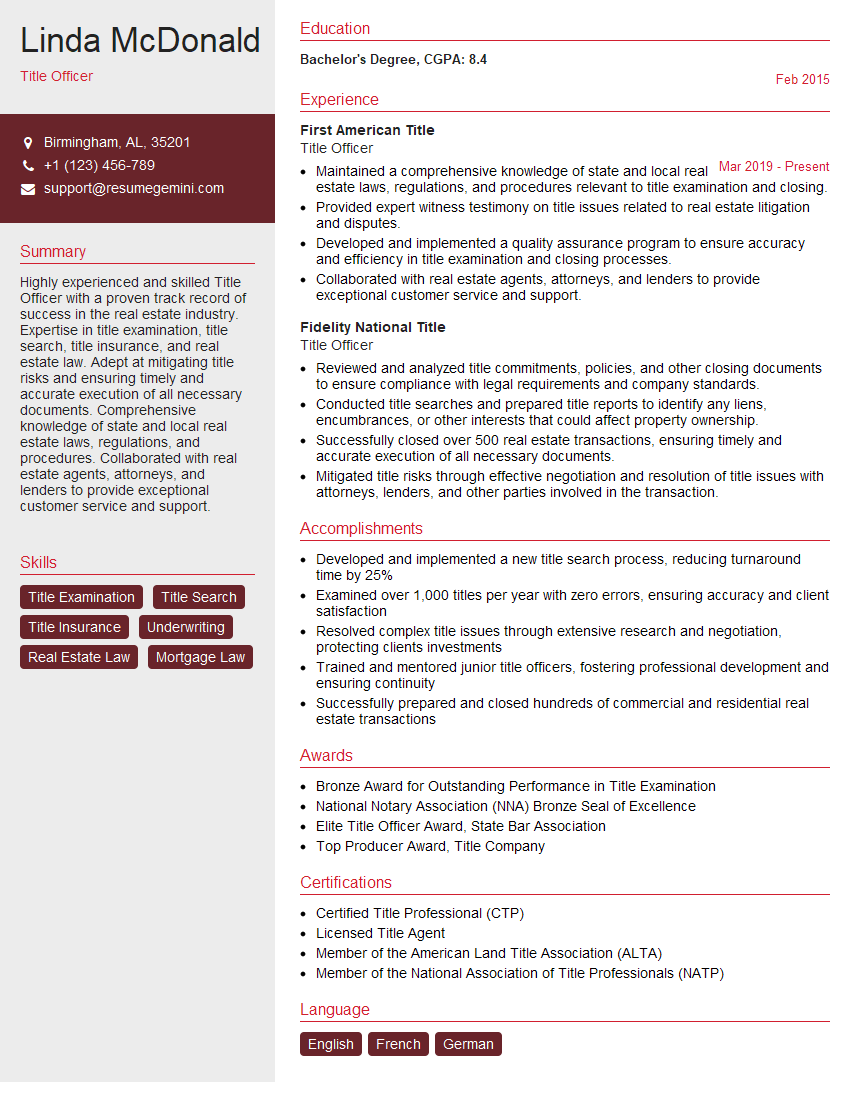
Linda McDonald
Title Officer
Summary
Highly experienced and skilled Title Officer with a proven track record of success in the real estate industry. Expertise in title examination, title search, title insurance, and real estate law. Adept at mitigating title risks and ensuring timely and accurate execution of all necessary documents. Comprehensive knowledge of state and local real estate laws, regulations, and procedures. Collaborated with real estate agents, attorneys, and lenders to provide exceptional customer service and support.
Education
Bachelor’s Degree
February 2015
Skills
- Title Examination
- Title Search
- Title Insurance
- Underwriting
- Real Estate Law
- Mortgage Law
Work Experience
Title Officer
- Maintained a comprehensive knowledge of state and local real estate laws, regulations, and procedures relevant to title examination and closing.
- Provided expert witness testimony on title issues related to real estate litigation and disputes.
- Developed and implemented a quality assurance program to ensure accuracy and efficiency in title examination and closing processes.
- Collaborated with real estate agents, attorneys, and lenders to provide exceptional customer service and support.
Title Officer
- Reviewed and analyzed title commitments, policies, and other closing documents to ensure compliance with legal requirements and company standards.
- Conducted title searches and prepared title reports to identify any liens, encumbrances, or other interests that could affect property ownership.
- Successfully closed over 500 real estate transactions, ensuring timely and accurate execution of all necessary documents.
- Mitigated title risks through effective negotiation and resolution of title issues with attorneys, lenders, and other parties involved in the transaction.
Accomplishments
- Developed and implemented a new title search process, reducing turnaround time by 25%
- Examined over 1,000 titles per year with zero errors, ensuring accuracy and client satisfaction
- Resolved complex title issues through extensive research and negotiation, protecting clients investments
- Trained and mentored junior title officers, fostering professional development and ensuring continuity
- Successfully prepared and closed hundreds of commercial and residential real estate transactions
Awards
- Bronze Award for Outstanding Performance in Title Examination
- National Notary Association (NNA) Bronze Seal of Excellence
- Elite Title Officer Award, State Bar Association
- Top Producer Award, Title Company
Certificates
- Certified Title Professional (CTP)
- Licensed Title Agent
- Member of the American Land Title Association (ALTA)
- Member of the National Association of Title Professionals (NATP)
Career Expert Tips:
- Select the ideal resume template to showcase your professional experience effectively.
- Master the art of resume writing to highlight your unique qualifications and achievements.
- Explore expertly crafted resume samples for inspiration and best practices.
- Build your best resume for free this new year with ResumeGemini. Enjoy exclusive discounts on ATS optimized resume templates.
How To Write Resume For Title Officer
- Quantify your accomplishments with specific numbers and metrics.
- Highlight your knowledge of real estate law and regulations.
- Showcase your ability to work independently and as part of a team.
- Emphasize your customer service and communication skills.
Essential Experience Highlights for a Strong Title Officer Resume
- Reviewed and analyzed title commitments, policies, and other closing documents to ensure compliance with legal requirements and company standards.
- Conducted title searches and prepared title reports to identify any liens, encumbrances, or other interests that could affect property ownership.
- Successfully closed over 500 real estate transactions, ensuring timely and accurate execution of all necessary documents.
- Mitigated title risks through effective negotiation and resolution of title issues with attorneys, lenders, and other parties involved in the transaction.
- Maintained a comprehensive knowledge of state and local real estate laws, regulations, and procedures relevant to title examination and closing.
- Provided expert witness testimony on title issues related to real estate litigation and disputes.
- Developed and implemented a quality assurance program to ensure accuracy and efficiency in title examination and closing processes.
Frequently Asked Questions (FAQ’s) For Title Officer
What are the key responsibilities of a Title Officer?
The key responsibilities of a Title Officer include reviewing and analyzing title commitments, policies, and other closing documents; conducting title searches and preparing title reports; mitigating title risks; maintaining a comprehensive knowledge of state and local real estate laws, regulations, and procedures; and providing expert witness testimony on title issues.
What are the educational requirements for becoming a Title Officer?
Most Title Officers have a bachelor’s degree in a related field, such as business, finance, or real estate.
What are the career prospects for Title Officers?
Title Officers with experience and expertise can advance to management positions, such as Title Manager or Vice President of Title Operations.
What are the salary expectations for Title Officers?
The salary expectations for Title Officers vary depending on their experience, expertise, and location. However, according to the U.S. Bureau of Labor Statistics, the median annual salary for Title Examiners, Abstractors, and Searchers was $67,250 in May 2021.
What are the challenges faced by Title Officers?
Title Officers face a number of challenges, including the need to stay up-to-date on changes in real estate laws and regulations, the need to manage risk, and the need to meet the needs of their clients.