Are you a seasoned Tool Designer seeking a new career path? Discover our professionally built Tool Designer Resume Template. This time-saving tool provides a solid foundation for your job search. Simply click “Edit Resume” to customize it with your unique experiences and achievements. Customize fonts and colors to match your personal style and increase your chances of landing your dream job. Explore more Resume Templates for additional options.






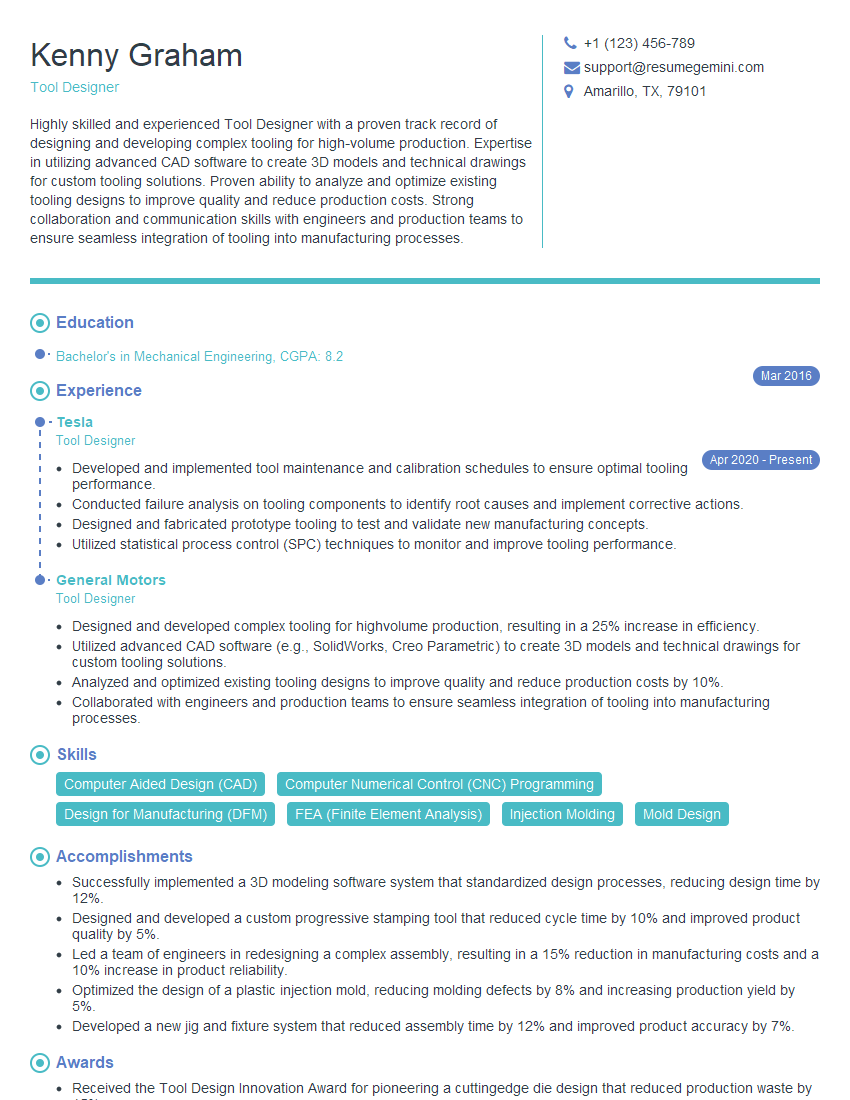
Kenny Graham
Tool Designer
Summary
Highly skilled and experienced Tool Designer with a proven track record of designing and developing complex tooling for high-volume production. Expertise in utilizing advanced CAD software to create 3D models and technical drawings for custom tooling solutions. Proven ability to analyze and optimize existing tooling designs to improve quality and reduce production costs. Strong collaboration and communication skills with engineers and production teams to ensure seamless integration of tooling into manufacturing processes.
Education
Bachelor’s in Mechanical Engineering
March 2016
Skills
- Computer Aided Design (CAD)
- Computer Numerical Control (CNC) Programming
- Design for Manufacturing (DFM)
- FEA (Finite Element Analysis)
- Injection Molding
- Mold Design
Work Experience
Tool Designer
- Developed and implemented tool maintenance and calibration schedules to ensure optimal tooling performance.
- Conducted failure analysis on tooling components to identify root causes and implement corrective actions.
- Designed and fabricated prototype tooling to test and validate new manufacturing concepts.
- Utilized statistical process control (SPC) techniques to monitor and improve tooling performance.
Tool Designer
- Designed and developed complex tooling for highvolume production, resulting in a 25% increase in efficiency.
- Utilized advanced CAD software (e.g., SolidWorks, Creo Parametric) to create 3D models and technical drawings for custom tooling solutions.
- Analyzed and optimized existing tooling designs to improve quality and reduce production costs by 10%.
- Collaborated with engineers and production teams to ensure seamless integration of tooling into manufacturing processes.
Accomplishments
- Successfully implemented a 3D modeling software system that standardized design processes, reducing design time by 12%.
- Designed and developed a custom progressive stamping tool that reduced cycle time by 10% and improved product quality by 5%.
- Led a team of engineers in redesigning a complex assembly, resulting in a 15% reduction in manufacturing costs and a 10% increase in product reliability.
- Optimized the design of a plastic injection mold, reducing molding defects by 8% and increasing production yield by 5%.
- Developed a new jig and fixture system that reduced assembly time by 12% and improved product accuracy by 7%.
Awards
- Received the Tool Design Innovation Award for pioneering a cuttingedge die design that reduced production waste by 15%.
- Recognized with the Excellence in Tool Design award for designing a novel fixture that increased production efficiency by 20%.
- Recognized for outstanding contributions to the field of tool design, receiving the Tool Designer of the Year award.
- Awarded the Tool Design Excellence Award for developing innovative tools that significantly improved manufacturing efficiency.
Certificates
- Certified Tool Designer (CTD)
- Certified Mold Designer (CMD)
- Certified Plastics Engineer (CPE)
- SolidWorks Certified Professional (CSWP)
Career Expert Tips:
- Select the ideal resume template to showcase your professional experience effectively.
- Master the art of resume writing to highlight your unique qualifications and achievements.
- Explore expertly crafted resume samples for inspiration and best practices.
- Build your best resume for free this new year with ResumeGemini. Enjoy exclusive discounts on ATS optimized resume templates.
How To Write Resume For Tool Designer
- Highlight your expertise in advanced CAD software and your ability to create complex 3D models and technical drawings.
- Quantify your accomplishments with specific metrics and results whenever possible.
- Demonstrate your understanding of manufacturing processes and your ability to design tooling that optimizes production efficiency.
- Emphasize your collaborative and communication skills, as well as your ability to work effectively with engineers and production teams.
Essential Experience Highlights for a Strong Tool Designer Resume
- Design and develop complex tooling for high-volume production
- Utilize advanced CAD software (e.g., SolidWorks, Creo Parametric) to create 3D models and technical drawings for custom tooling solutions
- Analyze and optimize existing tooling designs to improve quality and reduce production costs
- Collaborate with engineers and production teams to ensure seamless integration of tooling into manufacturing processes
- Develop and implement tool maintenance and calibration schedules to ensure optimal tooling performance
- Conduct failure analysis on tooling components to identify root causes and implement corrective actions
- Design and fabricate prototype tooling to test and validate new manufacturing concepts
Frequently Asked Questions (FAQ’s) For Tool Designer
What are the key skills required for a successful Tool Designer?
Key skills for Tool Designers include proficiency in advanced CAD software, knowledge of manufacturing processes, and strong analytical and problem-solving abilities.
What are the career prospects for Tool Designers?
Tool Designers are in high demand in various industries, including automotive, aerospace, and manufacturing. With experience, they can advance to roles such as Tooling Manager or Design Engineer.
What is the difference between a Tool Designer and a Toolmaker?
Tool Designers create the designs and specifications for tooling, while Toolmakers are responsible for manufacturing and maintaining the tooling.
What are the educational requirements for becoming a Tool Designer?
Tool Designers typically hold a bachelor’s degree in mechanical engineering or a related field, along with experience in CAD software and manufacturing.
Is certification required for Tool Designers?
Certification is not mandatory but can enhance your credibility and demonstrate your skills. Relevant certifications include the Certified Tooling Designer (CTD) from the Society of Manufacturing Engineers (SME).