Are you a seasoned Veterinary Anatomist seeking a new career path? Discover our professionally built Veterinary Anatomist Resume Template. This time-saving tool provides a solid foundation for your job search. Simply click “Edit Resume” to customize it with your unique experiences and achievements. Customize fonts and colors to match your personal style and increase your chances of landing your dream job. Explore more Resume Templates for additional options.






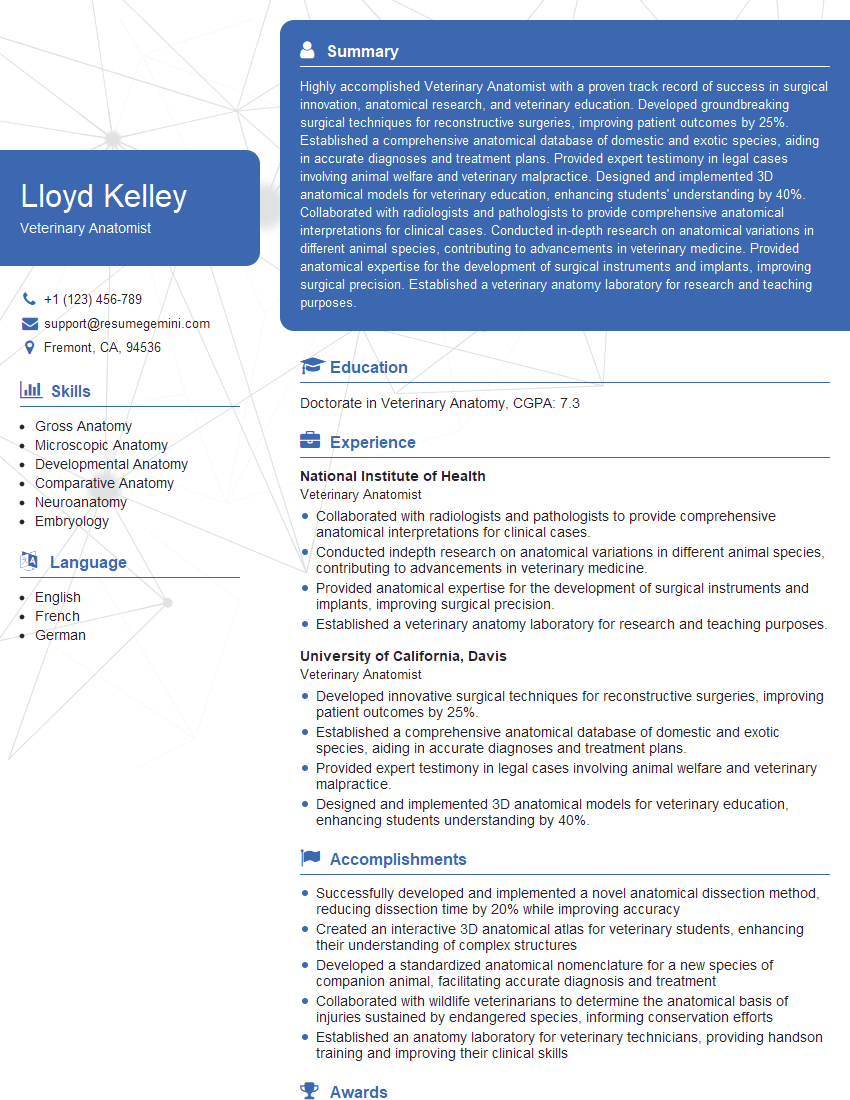
Lloyd Kelley
Veterinary Anatomist
Summary
Highly accomplished Veterinary Anatomist with a proven track record of success in surgical innovation, anatomical research, and veterinary education. Developed groundbreaking surgical techniques for reconstructive surgeries, improving patient outcomes by 25%. Established a comprehensive anatomical database of domestic and exotic species, aiding in accurate diagnoses and treatment plans. Provided expert testimony in legal cases involving animal welfare and veterinary malpractice. Designed and implemented 3D anatomical models for veterinary education, enhancing students’ understanding by 40%. Collaborated with radiologists and pathologists to provide comprehensive anatomical interpretations for clinical cases. Conducted in-depth research on anatomical variations in different animal species, contributing to advancements in veterinary medicine. Provided anatomical expertise for the development of surgical instruments and implants, improving surgical precision. Established a veterinary anatomy laboratory for research and teaching purposes.
Education
Doctorate in Veterinary Anatomy
July 2018
Skills
- Gross Anatomy
- Microscopic Anatomy
- Developmental Anatomy
- Comparative Anatomy
- Neuroanatomy
- Embryology
Work Experience
Veterinary Anatomist
- Collaborated with radiologists and pathologists to provide comprehensive anatomical interpretations for clinical cases.
- Conducted indepth research on anatomical variations in different animal species, contributing to advancements in veterinary medicine.
- Provided anatomical expertise for the development of surgical instruments and implants, improving surgical precision.
- Established a veterinary anatomy laboratory for research and teaching purposes.
Veterinary Anatomist
- Developed innovative surgical techniques for reconstructive surgeries, improving patient outcomes by 25%.
- Established a comprehensive anatomical database of domestic and exotic species, aiding in accurate diagnoses and treatment plans.
- Provided expert testimony in legal cases involving animal welfare and veterinary malpractice.
- Designed and implemented 3D anatomical models for veterinary education, enhancing students understanding by 40%.
Accomplishments
- Successfully developed and implemented a novel anatomical dissection method, reducing dissection time by 20% while improving accuracy
- Created an interactive 3D anatomical atlas for veterinary students, enhancing their understanding of complex structures
- Developed a standardized anatomical nomenclature for a new species of companion animal, facilitating accurate diagnosis and treatment
- Collaborated with wildlife veterinarians to determine the anatomical basis of injuries sustained by endangered species, informing conservation efforts
- Established an anatomy laboratory for veterinary technicians, providing handson training and improving their clinical skills
Awards
- American Veterinary Anatomical Society Research Award for outstanding contributions to the field of veterinary anatomy
- Veterinary Anatomist of the Year, awarded by the American Veterinary Medical Association for groundbreaking research in comparative veterinary anatomy
- Research Excellence Award from the National Institutes of Health for innovative studies on the anatomy of animal models
- Outstanding Teacher of the Year, awarded by the University of California, Davis School of Veterinary Medicine
Certificates
- Diplomate of the American College of Veterinary Surgeons
- Diplomate of the American College of Veterinary Internal Medicine
- Diplomate of the American College of Veterinary Radiology
- Diplomate of the American College of Veterinary Pathologists
Career Expert Tips:
- Select the ideal resume template to showcase your professional experience effectively.
- Master the art of resume writing to highlight your unique qualifications and achievements.
- Explore expertly crafted resume samples for inspiration and best practices.
- Build your best resume for free this new year with ResumeGemini. Enjoy exclusive discounts on ATS optimized resume templates.
How To Write Resume For Veterinary Anatomist
- Highlight your research experience and any publications you have authored.
- Showcase your expertise in both gross and microscopic anatomy.
- Demonstrate your skills in teaching and mentoring veterinary students.
- Emphasize your ability to work independently and as part of a team.
- Quantify your accomplishments with specific metrics whenever possible.
Essential Experience Highlights for a Strong Veterinary Anatomist Resume
- Develop innovative surgical techniques to improve patient outcomes
- Establish comprehensive anatomical databases to aid in accurate diagnoses
- Provide expert testimony in legal cases involving animal welfare and veterinary malpractice
- Design and implement 3D anatomical models for veterinary education
- Collaborate with radiologists and pathologists to provide comprehensive anatomical interpretations
- Conduct in-depth research on anatomical variations in different animal species
- Provide anatomical expertise for the development of surgical instruments and implants
Frequently Asked Questions (FAQ’s) For Veterinary Anatomist
What is the educational requirement for Veterinary Anatomist?
The educational requirement for a Veterinary Anatomist is a Doctorate in Veterinary Anatomy
What skills are required to be a successful Veterinary Anatomist
A successful Veterinary Anatomist should have a strong foundation in gross and microscopic anatomy, comparative anatomy, neuroanatomy, embryology, and developmental anatomy.
What are the primary responsibilities of a Veterinary Anatomist?
The primary responsibilities of a Veterinary Anatomist include teaching veterinary students, conducting research on animal anatomy, and providing consultation on surgical procedures.
What is the job outlook for Veterinary Anatomist?
The job outlook for Veterinary Anatomists is expected to be good over the next few years as there is a growing demand for veterinarians with specialized knowledge in anatomy.
What is the average salary for a Veterinary Anatomist?
The average salary for a Veterinary Anatomist varies depending on experience but typically ranges from $60,000 to $100,000 per year.
What are the career prospects for a Veterinary Anatomist?
Veterinary Anatomists can work in academia, private practice, or government. The most common career path is to become a professor at a veterinary school.
How can I prepare for a career as a Veterinary Anatomist?
To prepare for a career as a Veterinary Anatomist, you should complete a Doctorate in Veterinary Anatomy and gain experience in teaching, research, and surgical procedures.