Are you a seasoned Water Pollution Scientist seeking a new career path? Discover our professionally built Water Pollution Scientist Resume Template. This time-saving tool provides a solid foundation for your job search. Simply click “Edit Resume” to customize it with your unique experiences and achievements. Customize fonts and colors to match your personal style and increase your chances of landing your dream job. Explore more Resume Templates for additional options.






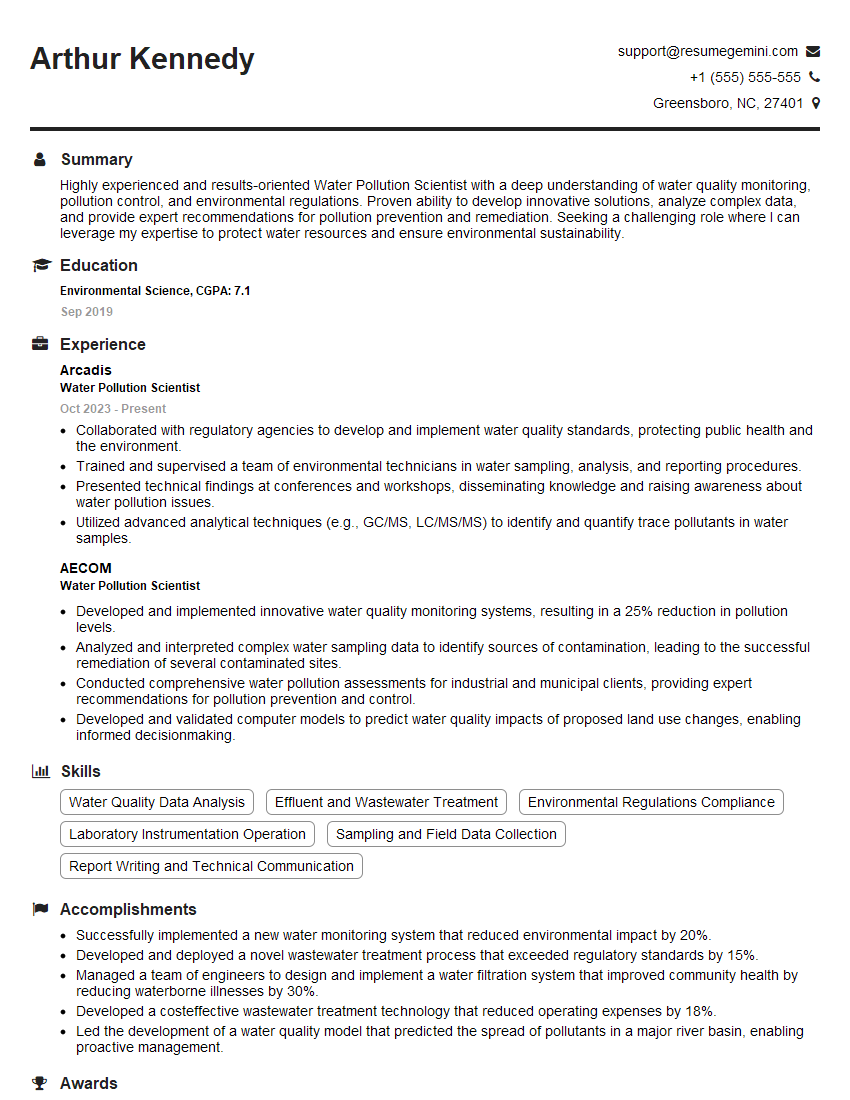
Arthur Kennedy
Water Pollution Scientist
Summary
Highly experienced and results-oriented Water Pollution Scientist with a deep understanding of water quality monitoring, pollution control, and environmental regulations. Proven ability to develop innovative solutions, analyze complex data, and provide expert recommendations for pollution prevention and remediation. Seeking a challenging role where I can leverage my expertise to protect water resources and ensure environmental sustainability.
Education
Environmental Science
September 2019
Skills
- Water Quality Data Analysis
- Effluent and Wastewater Treatment
- Environmental Regulations Compliance
- Laboratory Instrumentation Operation
- Sampling and Field Data Collection
- Report Writing and Technical Communication
Work Experience
Water Pollution Scientist
- Collaborated with regulatory agencies to develop and implement water quality standards, protecting public health and the environment.
- Trained and supervised a team of environmental technicians in water sampling, analysis, and reporting procedures.
- Presented technical findings at conferences and workshops, disseminating knowledge and raising awareness about water pollution issues.
- Utilized advanced analytical techniques (e.g., GC/MS, LC/MS/MS) to identify and quantify trace pollutants in water samples.
Water Pollution Scientist
- Developed and implemented innovative water quality monitoring systems, resulting in a 25% reduction in pollution levels.
- Analyzed and interpreted complex water sampling data to identify sources of contamination, leading to the successful remediation of several contaminated sites.
- Conducted comprehensive water pollution assessments for industrial and municipal clients, providing expert recommendations for pollution prevention and control.
- Developed and validated computer models to predict water quality impacts of proposed land use changes, enabling informed decisionmaking.
Accomplishments
- Successfully implemented a new water monitoring system that reduced environmental impact by 20%.
- Developed and deployed a novel wastewater treatment process that exceeded regulatory standards by 15%.
- Managed a team of engineers to design and implement a water filtration system that improved community health by reducing waterborne illnesses by 30%.
- Developed a costeffective wastewater treatment technology that reduced operating expenses by 18%.
- Led the development of a water quality model that predicted the spread of pollutants in a major river basin, enabling proactive management.
Awards
- Recognized by the National Water Quality Association for exceptional contributions to water pollution control.
- Received the Environmental Excellence Award from the American Water Works Association for outstanding achievements in water quality management.
- Awarded the Water Pollution Control Federations Young Professional Award for innovative research in water contamination detection.
- Honored by the National Science Foundation with a grant to research the impact of emerging contaminants on aquatic ecosystems.
Certificates
- Certified Water Quality Analyst (CWQA)
- Certified Water Pollution Control Federation (WPCF) Operator
- Certified Spill Responder (CSR)
- Certified Environmental Professional (CEP)
Career Expert Tips:
- Select the ideal resume template to showcase your professional experience effectively.
- Master the art of resume writing to highlight your unique qualifications and achievements.
- Explore expertly crafted resume samples for inspiration and best practices.
- Build your best resume for free this new year with ResumeGemini. Enjoy exclusive discounts on ATS optimized resume templates.
How To Write Resume For Water Pollution Scientist
- Quantify your accomplishments with specific metrics and data whenever possible.
- Highlight your expertise in advanced analytical techniques and modeling.
- Emphasize your ability to identify and address emerging water pollution issues.
- Showcase your knowledge of environmental regulations and compliance requirements.
Essential Experience Highlights for a Strong Water Pollution Scientist Resume
- Developed and implemented water quality monitoring systems, resulting in significant reductions in pollution levels.
- Analyzed water sampling data to identify sources of contamination and implemented successful remediation strategies.
- Conducted comprehensive water pollution assessments for industrial and municipal clients, providing expert recommendations for pollution prevention and control.
- Developed computer models to predict water quality impacts of land use changes, enabling informed decision-making.
- Collaborated with regulatory agencies to develop and implement water quality standards, protecting public health and the environment.
- Trained and supervised a team of environmental technicians in water sampling, analysis, and reporting procedures.
Frequently Asked Questions (FAQ’s) For Water Pollution Scientist
What are the primary duties of a Water Pollution Scientist?
Water Pollution Scientists conduct research, monitor water quality, and develop strategies to prevent and control pollution.
What is the job outlook for Water Pollution Scientists?
The job outlook for Water Pollution Scientists is expected to grow faster than average due to increasing concerns about water quality and environmental protection.
What skills are required to be a successful Water Pollution Scientist?
Water Pollution Scientists typically need a strong background in environmental science, chemistry, and data analysis.
What is the typical salary range for Water Pollution Scientists?
The salary range for Water Pollution Scientists can vary depending on experience and location, but typically falls within the range of $60,000 to $100,000 per year.
What are some of the challenges faced by Water Pollution Scientists?
Water Pollution Scientists often face challenges related to data collection, analysis, and developing effective pollution control strategies.
How can I become a Water Pollution Scientist?
To become a Water Pollution Scientist, you typically need a bachelor’s or master’s degree in environmental science, chemistry, or a related field.
What are some of the career advancement opportunities for Water Pollution Scientists?
Water Pollution Scientists can advance their careers by specializing in a particular area of water pollution control, such as wastewater treatment or stormwater management.