Are you gearing up for a career shift or aiming to ace your next interview? Look no further! We’ve curated a comprehensive guide to help you crack the interview for the coveted Avionics Engineer position. From understanding the key responsibilities to mastering the most commonly asked questions, this blog has you covered. So, buckle up and let’s embark on this journey together
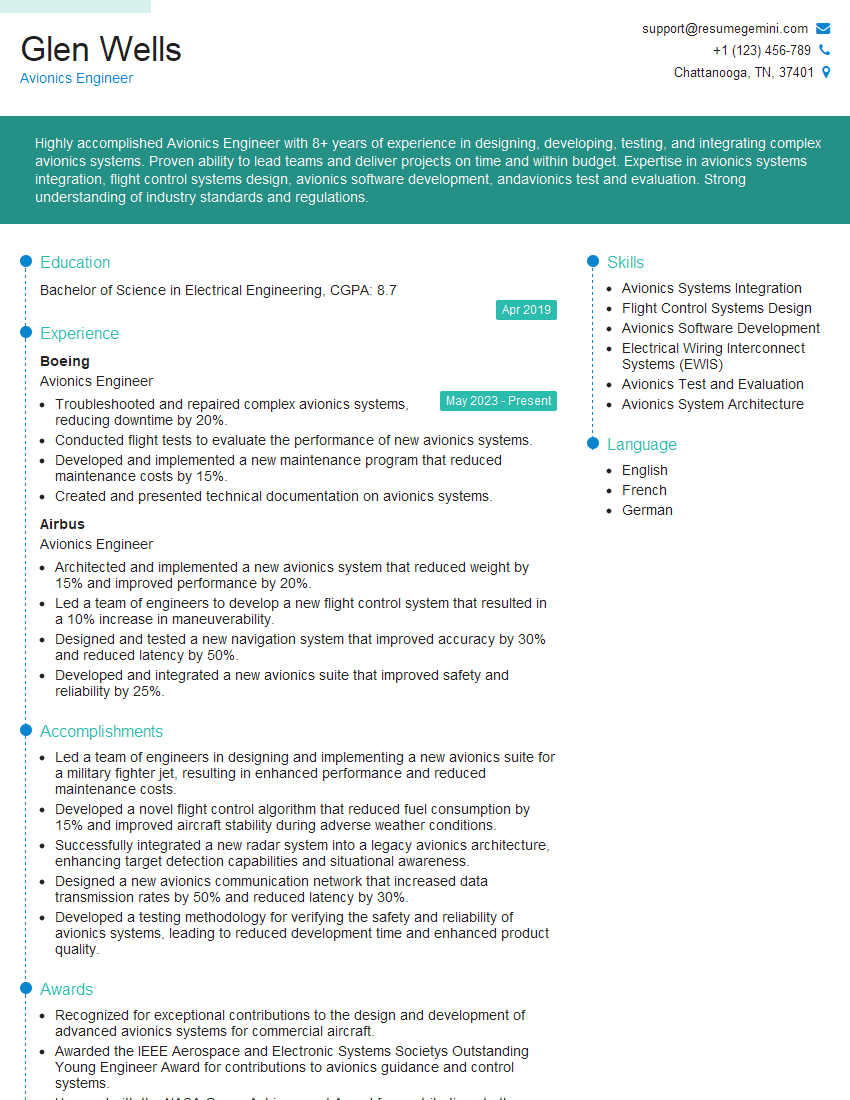
Acing the interview is crucial, but landing one requires a compelling resume that gets you noticed. Crafting a professional document that highlights your skills and experience is the first step toward interview success. ResumeGemini can help you build a standout resume that gets you called in for that dream job.






Essential Interview Questions For Avionics Engineer
1. Explain the design and implementation of an airborne navigation system.
The design and implementation of an airborne navigation system involves several key components and considerations:
- Sensor Integration: Integrating various sensors such as inertial navigation systems (INS), global positioning systems (GPS), air data sensors, and attitude and heading reference systems (AHRS) to provide accurate navigation data.
- Navigation Algorithms: Developing algorithms for dead reckoning, GPS navigation, inertial navigation, and Kalman filtering to estimate aircraft position, velocity, and attitude.
- Interface with Flight Management System: Establishing a communication interface with the flight management system (FMS) to provide navigation data for route planning, guidance, and situational awareness.
- Fault Tolerance and Redundancy: Implementing fault tolerance mechanisms to ensure uninterrupted navigation in the event of sensor failures or outages.
- Certification and Validation: Adhering to industry standards and regulations for certification and validation to ensure the safety and reliability of the navigation system.
2. Describe the principles of operation and maintenance of an aircraft’s electrical power system.
Electrical Power Generation:
- Discuss the methods of electrical power generation in aircraft, including generators driven by aircraft engines or auxiliary power units (APUs).
- Explain the regulation and distribution of electrical power to various aircraft systems.
Electrical Power Maintenance:
- Describe the preventive and corrective maintenance procedures for aircraft electrical systems, including troubleshooting, repair, and replacement.
- Explain the safety precautions and procedures for working on aircraft electrical systems.
3. Discuss the role of avionics in modern aircraft and how it has evolved over time.
The role of avionics in modern aircraft has evolved significantly, becoming increasingly critical for safety, efficiency, and situational awareness:
- Enhanced Safety: Avionics systems provide real-time monitoring, warning, and guidance systems to enhance aircraft safety and reduce the risk of accidents.
- Improved Efficiency: Avionics systems optimize flight planning, reduce fuel consumption, and enhance traffic management, leading to increased operational efficiency.
- Increased Situation Awareness: Avionics systems provide pilots with comprehensive information about their aircraft’s status, surrounding environment, and potential hazards, improving situational awareness.
- Technological Advancements: Avionics systems have evolved from analog to digital technologies, incorporating advanced sensors, processors, and displays for enhanced capabilities.
4. Explain the principles of operation and maintenance of an aircraft’s hydraulic system.
Hydraulic System Operation:
- Describe the components and functions of an aircraft hydraulic system, including pumps, reservoirs, actuators, and control valves.
- Explain how hydraulic pressure is generated, distributed, and utilized to power various aircraft systems.
Hydraulic System Maintenance:
- Outline the preventive and corrective maintenance procedures for aircraft hydraulic systems, including inspections, leak detection, and component replacement.
- Explain the safety precautions and procedures for working on aircraft hydraulic systems.
5. Describe the use of simulation and modeling in the design and development of avionics systems.
Simulation and modeling play a crucial role in the design and development of avionics systems:
- Virtual Prototyping: Creating virtual models of avionics systems allows engineers to test and validate designs before building physical prototypes, reducing development time and costs.
- System Integration: Simulation enables the integration and testing of different avionics subsystems to ensure compatibility and proper functionality.
- Performance Analysis: Simulation allows engineers to evaluate the performance of avionics systems under various flight conditions and scenarios.
- Certification Support: Simulation results can be used to demonstrate compliance with industry standards and regulations, supporting the certification process.
6. Discuss the challenges and future trends in avionics systems development.
Challenges:
- Complexity: Avionics systems are becoming increasingly complex, requiring advanced engineering and design techniques.
- Cybersecurity: Protecting avionics systems from cyber threats is a growing concern.
- Integration: Seamlessly integrating avionics systems with other aircraft systems and ground infrastructure is essential for enhancing overall performance.
Future Trends:
- Artificial Intelligence: AI algorithms are being incorporated into avionics systems to enhance safety and efficiency.
- Electric Propulsion: The transition to electric propulsion systems poses new challenges for avionics design.
- Autonomous Flight: Avionics systems are becoming more autonomous, enabling aircraft to perform maneuvers and operations with minimal pilot input.
7. Explain the design and implementation of a flight control system for an unmanned aerial vehicle (UAV).
The design and implementation of a flight control system for a UAV involve several key considerations:
- Control Architecture: Designing a control architecture that ensures stability, maneuverability, and performance.
- Sensor Integration: Integrating sensors for attitude, position, and velocity to provide feedback to the control system.
- Guidance and Navigation Algorithms: Developing algorithms for autonomous flight, path planning, and obstacle avoidance.
- Redundancy and Fault Tolerance: Ensuring system reliability through redundancy and fault-tolerant mechanisms.
- Simulation and Testing: Simulating and testing the flight control system to verify its performance and safety.
8. Describe the principles of operation and maintenance of an aircraft’s air data system.
Air Data System Operation:
- Explain the components and functions of an aircraft air data system, including pitot tubes, static ports, and air data computers.
- Describe how air data is collected, processed, and provided to various aircraft systems.
Air Data System Maintenance:
- Outline the preventive and corrective maintenance procedures for aircraft air data systems, including inspections, calibrations, and component replacement.
- Explain the safety precautions and procedures for working on aircraft air data systems.
9. Discuss the use of system safety analysis techniques in the development of avionics systems.
System safety analysis techniques are essential for ensuring the safety and reliability of avionics systems:
- Hazard Identification: Identifying potential hazards and risks associated with avionics systems.
- Risk Assessment: Evaluating the likelihood and severity of identified hazards.
- Mitigation Strategies: Developing and implementing strategies to mitigate or eliminate identified risks.
- Certification Support: System safety analysis results support compliance with industry standards and regulations.
10. Explain the importance of human factors engineering in the design of avionics systems.
Human factors engineering plays a critical role in the design of avionics systems to ensure safety, usability, and efficiency:
- User Interface Design: Designing intuitive and easy-to-use interfaces that minimize pilot workload and errors.
- Workload Management: Optimizing the distribution of tasks between pilots and avionics systems to reduce stress and fatigue.
- Training and Documentation: Providing clear and comprehensive training materials and documentation to ensure proper operation and maintenance of avionics systems.
- Maintainability: Considering human factors in the design of avionics systems to facilitate maintenance and troubleshooting.
Interviewers often ask about specific skills and experiences. With ResumeGemini‘s customizable templates, you can tailor your resume to showcase the skills most relevant to the position, making a powerful first impression. Also check out Resume Template specially tailored for Avionics Engineer.
Career Expert Tips:
- Ace those interviews! Prepare effectively by reviewing the Top 50 Most Common Interview Questions on ResumeGemini.
- Navigate your job search with confidence! Explore a wide range of Career Tips on ResumeGemini. Learn about common challenges and recommendations to overcome them.
- Craft the perfect resume! Master the Art of Resume Writing with ResumeGemini’s guide. Showcase your unique qualifications and achievements effectively.
- Great Savings With New Year Deals and Discounts! In 2025, boost your job search and build your dream resume with ResumeGemini’s ATS optimized templates.
Researching the company and tailoring your answers is essential. Once you have a clear understanding of the Avionics Engineer‘s requirements, you can use ResumeGemini to adjust your resume to perfectly match the job description.
Key Job Responsibilities
Avionics Engineers play a crucial role in the design, development, and maintenance of aircraft electronic systems. Their key job responsibilities include:
1. Design and Development
Designing and developing avionics systems, including navigation, communication, and flight control systems. Collaborating with engineers from other disciplines to ensure system compatibility and integration.
- Develop and implement software and hardware components for avionics systems.
- Perform testing and validation of avionics systems to ensure compliance with industry standards and safety regulations.
2. System Integration
Working with other engineers to integrate avionics systems with aircraft platforms. Ensuring that systems are interoperable and meet performance and safety requirements.
- Integrate avionics systems with other aircraft systems, such as the flight control system, engine control system, and electrical system.
- Conduct system-level testing and evaluation to ensure compatibility and performance.
3. Maintenance and Troubleshooting
Maintaining and troubleshooting avionics systems throughout the lifecycle of the aircraft. Identifying and resolving technical issues to ensure safe and reliable operation.
- Troubleshoot and repair avionics systems in the field or at maintenance facilities.
- Perform scheduled and unscheduled maintenance and inspection of avionics systems.
4. Certification and Regulatory Compliance
Ensuring compliance with industry standards and regulations for avionics systems. Working with regulatory agencies to obtain certifications and approvals.
- Obtain and maintain certifications and approvals for avionics systems from regulatory agencies, such as the Federal Aviation Administration.
- Ensure that avionics systems comply with industry standards and safety regulations.
Interview Tips
To ace the interview for an Avionics Engineer position, it is crucial to be well-prepared and confident. Here are some tips:
1. Research the Company and Position
Thoroughly research the company and the specific position you are applying for. Learn about their products, services, and industry standing. Understanding the organization’s culture and mission will help you tailor your responses to the interviewer’s questions.
- Visit the company’s website and LinkedIn page to learn about their products, services, and recent developments.
- Read industry news and articles to stay updated on the latest trends and technologies in avionics.
2. Practice Common Interview Questions
Prepare for common interview questions by researching online resources, practicing with a mentor or friend, or utilizing mock interview websites. Anticipating potential questions will boost your confidence and enable you to provide well-structured answers.
- Prepare for questions about your technical skills, such as your experience with avionics systems, software development, and testing.
- Practice answering questions about your problem-solving abilities and experience in troubleshooting avionics systems.
3. Highlight Your Skills and Experience
Emphasize your relevant skills and experience that align with the job requirements. Quantify your accomplishments using specific metrics and examples to demonstrate your impact on previous projects.
- Highlight your experience in designing, developing, and testing avionics systems.
- Provide examples of projects where you successfully integrated avionics systems with aircraft platforms.
4. Ask Thoughtful Questions
Asking thoughtful questions during the interview indicates your engagement and interest in the position. Prepare questions that demonstrate your understanding of the industry and the company’s goals.
- Ask about the company’s current projects and future plans in avionics development.
- Inquire about the opportunities for professional growth and advancement within the organization.
Next Step:
Armed with this knowledge, you’re now well-equipped to tackle the Avionics Engineer interview with confidence. Remember, preparation is key. So, start crafting your resume, highlighting your relevant skills and experiences. Don’t be afraid to tailor your application to each specific job posting. With the right approach and a bit of practice, you’ll be well on your way to landing your dream job. Build your resume now from scratch or optimize your existing resume with ResumeGemini. Wish you luck in your career journey!