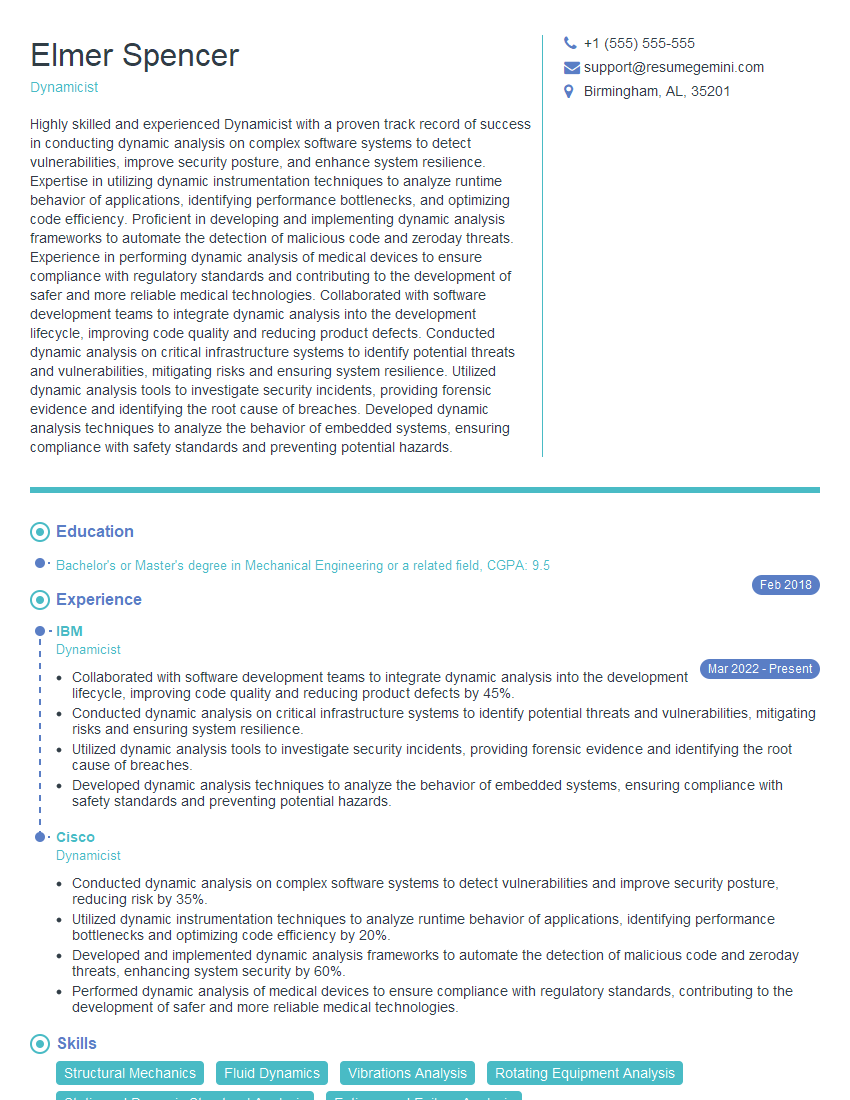
Are you gearing up for a career shift or aiming to ace your next interview? Look no further! We’ve curated a comprehensive guide to help you crack the interview for the coveted Dynamicist position. From understanding the key responsibilities to mastering the most commonly asked questions, this blog has you covered. So, buckle up and let’s embark on this journey together
Acing the interview is crucial, but landing one requires a compelling resume that gets you noticed. Crafting a professional document that highlights your skills and experience is the first step toward interview success. ResumeGemini can help you build a standout resume that gets you called in for that dream job.






Essential Interview Questions For Dynamicist
1. Discuss the relationship between total energy, potential energy, and kinetic energy?
- Total energy is the sum of potential energy and kinetic energy.
- Potential energy is the energy stored in an object due to its position or condition.
- Kinetic energy is the energy of motion.
- In a closed system, total energy is constant.
2. Explain the concept of conservation of angular momentum?
Newton’s Second Law in rotational form
- The rate of change of angular momentum of a system is equal to the net external torque acting on the system.
- Angular momentum is a conserved quantity, meaning that it cannot be created or destroyed.
Applications
- Figure skaters spinning faster when they pull in their arms.
- Planets orbiting the sun in a nearly circular path.
3. What is the difference between a rigid body and a deformable body?
- A rigid body is a body that does not deform under the action of an external force.
- A deformable body is a body that does deform under the action of an external force.
- Rigid bodies can be treated as point masses, while deformable bodies cannot.
4. Explain the concept of moment of inertia?
- Moment of inertia is a measure of an object’s resistance to angular acceleration.
- It is defined as the sum of the products of the masses of the particles in the object and the squares of their distances from the axis of rotation.
- Moment of inertia depends on the mass distribution of the object.
5. What is the relationship between torque, moment of inertia, and angular acceleration?
- Torque is a measure of the force that is applied to rotate an object.
- Moment of inertia is a measure of an object’s resistance to angular acceleration.
- Angular acceleration is the rate at which an object’s angular velocity changes.
- The relationship between torque, moment of inertia, and angular acceleration is given by the equation: torque = moment of inertia * angular acceleration.
6. What is the difference between static equilibrium and dynamic equilibrium?
- Static equilibrium is a state in which the net force and net torque acting on an object are both zero.
- Dynamic equilibrium is a state in which the net force acting on an object is zero, but the net torque is not zero.
- In static equilibrium, the object is not moving.
- In dynamic equilibrium, the object is moving with constant velocity.
7. What is the principle of virtual work?
- The principle of virtual work states that the total work done by the forces acting on a system in equilibrium is zero for any virtual displacement of the system.
- Virtual displacement is a small displacement that is consistent with the constraints on the system.
- The principle of virtual work can be used to solve problems involving equilibrium.
8. What is the Lagrangian formulation of mechanics?
- The Lagrangian formulation of mechanics is a mathematical framework for describing the motion of a system.
- It is based on the principle of least action, which states that the action of a system is minimized when the system is in motion.
- The Lagrangian is a function of the generalized coordinates of the system and their time derivatives.
- The equations of motion of the system can be derived from the Lagrangian using the Euler-Lagrange equations.
9. What is the Hamiltonian formulation of mechanics?
- The Hamiltonian formulation of mechanics is a mathematical framework for describing the motion of a system.
- It is based on the principle of least action, which states that the action of a system is minimized when the system is in motion.
- The Hamiltonian is a function of the generalized coordinates of the system and their conjugate momenta.
- The equations of motion of the system can be derived from the Hamiltonian using Hamilton’s equations.
10. What are the applications of dynamics in engineering?
- Dynamics is used in engineering to design and analyze structures, machines, and vehicles.
- It is also used to control the motion of robots and other automated systems.
- Dynamics is essential for understanding the behavior of fluids and gases.
- It is also used in the design of aircraft, spacecraft, and other vehicles that move through fluids.
Interviewers often ask about specific skills and experiences. With ResumeGemini‘s customizable templates, you can tailor your resume to showcase the skills most relevant to the position, making a powerful first impression. Also check out Resume Template specially tailored for Dynamicist.
Career Expert Tips:
- Ace those interviews! Prepare effectively by reviewing the Top 50 Most Common Interview Questions on ResumeGemini.
- Navigate your job search with confidence! Explore a wide range of Career Tips on ResumeGemini. Learn about common challenges and recommendations to overcome them.
- Craft the perfect resume! Master the Art of Resume Writing with ResumeGemini’s guide. Showcase your unique qualifications and achievements effectively.
- Great Savings With New Year Deals and Discounts! In 2025, boost your job search and build your dream resume with ResumeGemini’s ATS optimized templates.
Researching the company and tailoring your answers is essential. Once you have a clear understanding of the Dynamicist‘s requirements, you can use ResumeGemini to adjust your resume to perfectly match the job description.
Key Job Responsibilities
Dynamicists are highly skilled professionals responsible for ensuring the safe and reliable operation of dynamic systems. They apply their in-depth knowledge of mechanics, physics, and mathematics to analyze and solve complex problems involving moving objects, forces, and energy.
1. System Analysis and Design
Conduct detailed analyses of dynamic systems to identify potential risks, inefficiencies, and areas for improvement. Design and implement modifications to enhance system performance, stability, and safety.
- Develop mathematical models and simulations to predict system behavior under various operating conditions.
- Analyze vibration, noise, and stress patterns to optimize system design and reduce fatigue.
2. Structural Dynamics
Assess the structural integrity of components and systems subjected to dynamic loads and vibrations. Conduct modal analyses to determine resonance frequencies and mode shapes, ensuring structural stability and preventing catastrophic failures.
- Perform finite element analysis (FEA) to simulate structural behavior and predict stress distribution.
- Develop and implement vibration control measures to mitigate excessive vibrations and protect sensitive components.
3. Fluid Dynamics
Analyze and optimize fluid flow systems, including pumps, valves, and pipelines. Investigate flow patterns, pressure drops, and energy losses to enhance efficiency and reduce operating costs.
- Use computational fluid dynamics (CFD) software to simulate and visualize fluid flow phenomena.
- Design and optimize fluid systems to minimize turbulence, cavitation, and erosion.
4. Mechatronics
Integrate mechanical, electrical, and control systems to create complex dynamic systems. Develop and implement control algorithms to ensure precise motion, positioning, and synchronization.
- Design and build mechatronic systems for applications such as robotics, automation, and medical devices.
- Program and tune control systems to achieve optimal performance and stability.
Interview Tips
Preparing thoroughly for a Dynamicist interview is crucial to showcasing your skills and knowledge. Here are some tips to help you succeed:
1. Research the Company and Role
Learn about the company’s industry, products, and culture. Study the job description carefully to identify the specific skills and qualifications required. Tailor your resume and cover letter to highlight your relevant experience and demonstrate how you meet the employer’s needs.
2. Practice Your Technical Skills
Review fundamental concepts in mechanics, physics, and mathematics, especially in areas related to dynamics. Practice solving problems involving vibration, fluid flow, and structural analysis. Consider using online resources or textbooks to refresh your knowledge.
- Be prepared to discuss your familiarity with software tools commonly used in dynamic analysis, such as FEA and CFD.
- Have examples ready to demonstrate your analytical and problem-solving abilities.
3. Highlight Your Projects and Experience
Describe your previous projects in detail, emphasizing your role in analyzing, designing, and optimizing dynamic systems. Quantify your accomplishments whenever possible, using specific metrics to demonstrate the impact of your work.
- Discuss any research or publications you have contributed to, showcasing your expertise in the field.
- If applicable, highlight your experience in developing or implementing control systems for dynamic applications.
4. Prepare for Behavioral Questions
Interviewers often ask behavioral questions to assess your personality, work style, and fit within the team. Practice answering questions about teamwork, problem-solving, and handling pressure.
- Use the STAR method (Situation, Task, Action, Result) to structure your responses and provide clear examples.
- Demonstrate your passion for dynamics and your commitment to continuous learning.
Next Step:
Armed with this knowledge, you’re now well-equipped to tackle the Dynamicist interview with confidence. Remember, preparation is key. So, start crafting your resume, highlighting your relevant skills and experiences. Don’t be afraid to tailor your application to each specific job posting. With the right approach and a bit of practice, you’ll be well on your way to landing your dream job. Build your resume now from scratch or optimize your existing resume with ResumeGemini. Wish you luck in your career journey!