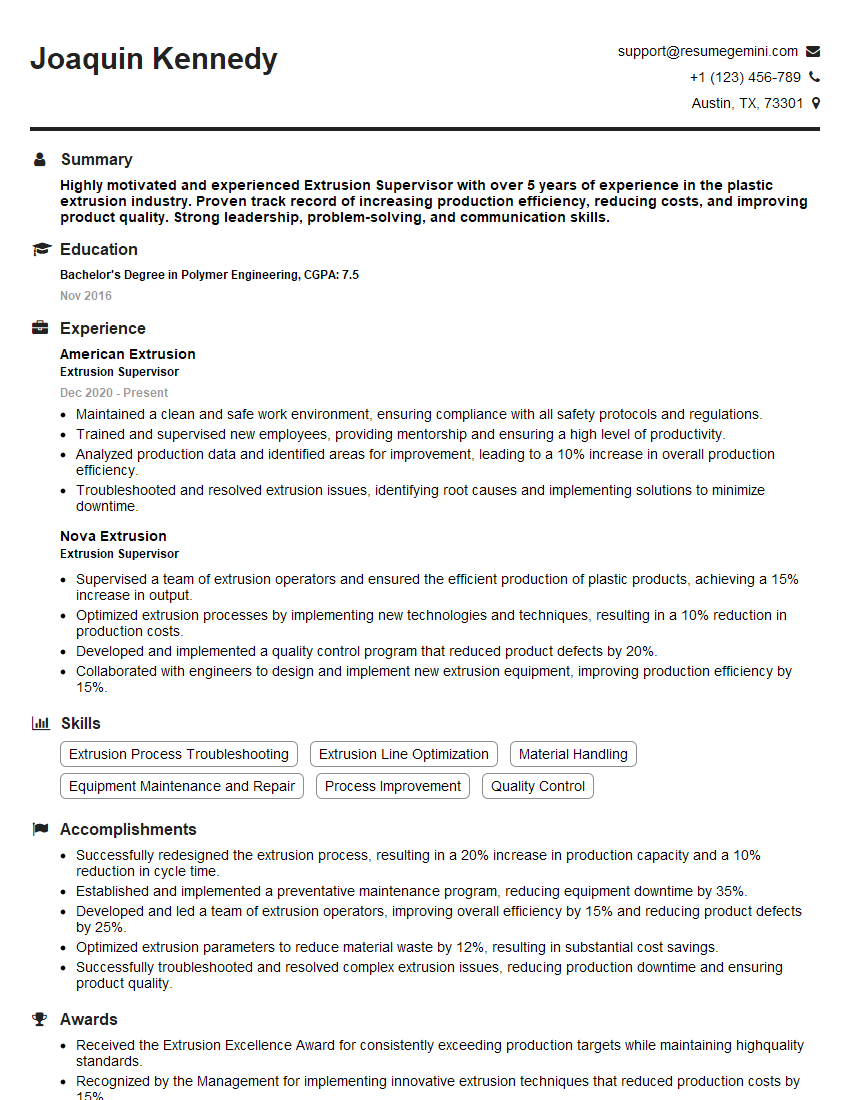
Ever felt underprepared for that crucial job interview? Or perhaps you’ve landed the interview but struggled to articulate your skills and experiences effectively? Fear not! We’ve got you covered. In this blog post, we’re diving deep into the Extrusion Supervisor interview questions that you’re most likely to encounter. But that’s not all. We’ll also provide expert insights into the key responsibilities of a Extrusion Supervisor so you can tailor your answers to impress potential employers.
Acing the interview is crucial, but landing one requires a compelling resume that gets you noticed. Crafting a professional document that highlights your skills and experience is the first step toward interview success. ResumeGemini can help you build a standout resume that gets you called in for that dream job.






Essential Interview Questions For Extrusion Supervisor
1. Describe the process of extrusion in detail.
Extrusion is a manufacturing process used to create objects of a fixed cross-sectional profile by forcing material through a die. The material is typically a thermoplastic or thermosetting polymer, and the process can be used to create a wide variety of products, including pipes, tubes, sheets, and films.
- The extrusion process begins with the material being fed into a hopper, which then drops the material into a heated barrel.
- Inside the barrel, the material is heated until it becomes molten and is then forced through a die by a screw or ram.
- The shape of the die determines the cross-sectional profile of the extruded product.
- As the extruded product exits the die, it is cooled and solidified by a cooling bath or air.
- The extruded product can then be cut to length and finished as needed.
2. What are the different types of extrusion processes?
Screw extrusion
- Screw extrusion is the most common type of extrusion process, and it uses a screw to force the material through the die.
- Screw extruders are typically used for thermoplastics, which are polymers that become molten when heated.
Ram extrusion
- Ram extrusion uses a ram to force the material through the die.
- Ram extruders are typically used for thermosetting polymers, which are polymers that harden when heated.
Hydrostatic extrusion
- Hydrostatic extrusion uses a fluid to force the material through the die.
- Hydrostatic extrusion is typically used for metals and ceramics.
3. What are the key parameters that need to be controlled in an extrusion process?
- Temperature
- Pressure
- Screw speed
- Die temperature
- Cooling rate
These parameters must be carefully controlled in order to produce a product with the desired properties.
4. What are the common problems that can occur in an extrusion process, and how can they be solved?
- Material flow problems: These can be caused by a variety of factors, including incorrect temperature or pressure settings, worn or damaged dies, or improper material handling.
- Product quality problems: These can be caused by a variety of factors, including incorrect temperature or pressure settings, worn or damaged dies, or improper material handling.
- Safety problems: These can be caused by a variety of factors, including improper machine operation, inadequate safety guards, or lack of proper training.
It is important to be aware of these common problems and to have procedures in place to prevent or solve them.
5. What are the key quality control measures that need to be implemented in an extrusion process?
- Raw material inspection: The raw material should be inspected to ensure that it meets the required specifications.
- Process monitoring: The extrusion process should be monitored to ensure that the key parameters are within the desired ranges.
- Product testing: The finished product should be tested to ensure that it meets the required specifications.
Implementing these quality control measures will help to ensure that the extruded product is of the desired quality.
6. What are the latest trends in extrusion technology?
- Increased use of automation: Automation is being used to increase the efficiency and productivity of extrusion processes.
- Development of new materials: New materials are being developed that are better suited for extrusion processing.
- Increased use of sustainable practices: Extrusion processes are becoming more sustainable, with the use of recycled materials and reduced energy consumption.
These trends are helping to drive the advancement of extrusion technology and are making it more versatile and efficient.
7. How can extrusion technology be used to improve product design and development?
- Extrusion can be used to create complex shapes that would be difficult or impossible to manufacture using other methods. This allows for greater design freedom and can lead to more innovative products.
- Extrusion can be used to produce products with a wide range of properties. This allows for the development of products that are tailored to specific applications.
- Extrusion can be used to produce products that are cost-effective and meet high quality standards. This makes extrusion an attractive option for a wide range of product design and development projects.
8. What are the key challenges facing the extrusion industry?
- Increasing competition from other manufacturing processes: Other manufacturing processes, such as injection molding and blow molding, are becoming more competitive with extrusion.
- Rising costs of raw materials: The cost of raw materials is a major factor in the cost of extruded products.
- Environmental regulations: Extrusion processes can generate waste and emissions, which can be subject to environmental regulations.
The extrusion industry is facing a number of challenges, but it is also a dynamic industry with a lot of potential for growth.
9. What are the career opportunities for extrusion supervisors?
- Extrusion supervisors can work in a variety of industries, including plastics, metals, and food.
- Extrusion supervisors can advance to management positions, such as plant manager or operations manager.
- Extrusion supervisors can also start their own businesses.
10. What are the key skills and qualifications that extrusion supervisors need?
- Technical knowledge of extrusion processes: Extrusion supervisors need to have a thorough understanding of extrusion processes, including the different types of extrusion machines, the materials that can be extruded, and the process parameters that need to be controlled.
- Supervisory skills: Extrusion supervisors need to be able to supervise and motivate a team of employees. This includes setting goals, providing feedback, and resolving conflicts.
- Problem-solving skills: Extrusion supervisors need to be able to identify and solve problems that arise during the extrusion process. This includes identifying the root cause of the problem and developing a solution that will prevent it from recurring.
- Communication skills: Extrusion supervisors need to be able to communicate effectively with employees, customers, and suppliers. This includes being able to give clear instructions, explain technical concepts, and resolve conflicts.
Interviewers often ask about specific skills and experiences. With ResumeGemini‘s customizable templates, you can tailor your resume to showcase the skills most relevant to the position, making a powerful first impression. Also check out Resume Template specially tailored for Extrusion Supervisor.
Career Expert Tips:
- Ace those interviews! Prepare effectively by reviewing the Top 50 Most Common Interview Questions on ResumeGemini.
- Navigate your job search with confidence! Explore a wide range of Career Tips on ResumeGemini. Learn about common challenges and recommendations to overcome them.
- Craft the perfect resume! Master the Art of Resume Writing with ResumeGemini’s guide. Showcase your unique qualifications and achievements effectively.
- Great Savings With New Year Deals and Discounts! In 2025, boost your job search and build your dream resume with ResumeGemini’s ATS optimized templates.
Researching the company and tailoring your answers is essential. Once you have a clear understanding of the Extrusion Supervisor‘s requirements, you can use ResumeGemini to adjust your resume to perfectly match the job description.
Key Job Responsibilities
As an Extrusion Supervisor, you will play a vital role in overseeing all aspects of the extrusion process. Your primary responsibilities will include:
1. Production Management
Supervising the operation of extrusion lines to ensure optimal production levels and product quality.
- Establishing production schedules and targets.
- Monitoring line performance and identifying areas for improvement.
2. Quality Control
Maintaining high standards of product quality by adhering to specifications and procedures.
- Conducting regular product inspections.
- Identifying and resolving quality issues promptly.
3. Maintenance and Repair
Ensuring the proper maintenance and repair of extrusion equipment to minimize downtime and prevent breakdowns.
- Performing routine maintenance tasks.
- Coordinating repairs with maintenance personnel.
4. Safety and Compliance
Prioritizing safety and compliance with industry regulations and company policies.
- Ensuring employees follow safety protocols.
- Maintaining a clean and organized work environment.
Interview Tips
To ace your interview for the Extrusion Supervisor position, follow these tips:
1. Research the Company and Industry
Demonstrate your interest and knowledge of the company you’re applying to and the extrusion industry. Familiarize yourself with their products, processes, and market position.
2. Highlight Your Technical Expertise
Emphasize your strong understanding of extrusion technology, production processes, and quality control principles. Provide specific examples of how you’ve used your knowledge to solve problems.
3. Showcase Your Leadership and Management Skills
Highlight your ability to lead and motivate a team, manage multiple priorities, and make sound decisions under pressure. Describe situations where you’ve successfully supervised a team and improved productivity.
4. Prepare for Technical Questions
Expect technical questions related to extrusion processes, equipment troubleshooting, and quality control measures. Practice answering these questions confidently and provide specific details.
5. Ask Thoughtful Questions
At the end of the interview, prepare a few insightful questions that demonstrate your genuine interest in the role and the company. This shows initiative and engagement.
Next Step:
Now that you’re armed with interview-winning answers and a deeper understanding of the Extrusion Supervisor role, it’s time to take action! Does your resume accurately reflect your skills and experience for this position? If not, head over to ResumeGemini. Here, you’ll find all the tools and tips to craft a resume that gets noticed. Don’t let a weak resume hold you back from landing your dream job. Polish your resume, hit the “Build Your Resume” button, and watch your career take off! Remember, preparation is key, and ResumeGemini is your partner in interview success.