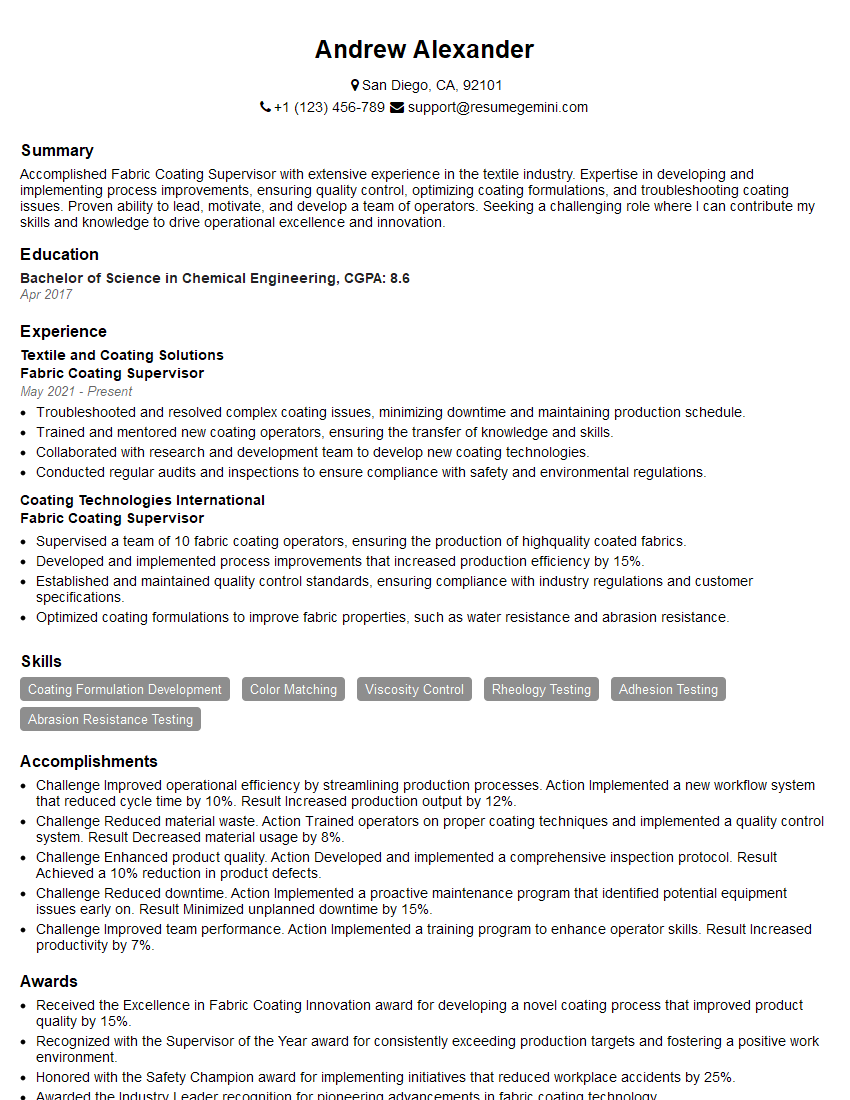
Are you gearing up for an interview for a Fabric Coating Supervisor position? Whether you’re a seasoned professional or just stepping into the role, understanding what’s expected can make all the difference. In this blog, we dive deep into the essential interview questions for Fabric Coating Supervisor and break down the key responsibilities of the role. By exploring these insights, you’ll gain a clearer picture of what employers are looking for and how you can stand out. Read on to equip yourself with the knowledge and confidence needed to ace your next interview and land your dream job!
Acing the interview is crucial, but landing one requires a compelling resume that gets you noticed. Crafting a professional document that highlights your skills and experience is the first step toward interview success. ResumeGemini can help you build a standout resume that gets you called in for that dream job.






Essential Interview Questions For Fabric Coating Supervisor
1. What are the different types of fabric coatings available and what are their applications?
- Water-repellent coatings: These coatings are applied to fabrics to make them resistant to water and stains. They are often used on outdoor fabrics, such as awnings and tarps.
- Fire-retardant coatings: These coatings are applied to fabrics to make them resistant to fire. They are often used on fabrics used in public spaces, such as curtains and upholstery.
- Antimicrobial coatings: These coatings are applied to fabrics to kill bacteria and other microorganisms. They are often used on fabrics used in healthcare settings, such as hospital gowns and curtains.
2. What are the key factors to consider when selecting a fabric coating?
Factors to consider:
- The desired properties of the coated fabric
- The intended use of the coated fabric
- The cost of the coating
Properties of the fabric:
- The type of fabric
- The weight of the fabric
- The texture of the fabric
3. What are the different methods of applying fabric coatings?
- Dip coating: This method involves dipping the fabric into a bath of coating material.
- Spray coating: This method involves spraying the coating material onto the fabric.
- Roll coating: This method involves passing the fabric through a series of rollers that apply the coating material.
4. What are the quality control measures that should be in place during fabric coating?
- Visual inspection of the coated fabric
- Testing of the coated fabric’s properties
- Monitoring of the coating process
5. What are the common problems that can occur during fabric coating and how can they be solved?
- Blistering: This problem can be caused by the presence of air bubbles in the coating. It can be solved by using a vacuum to remove the air bubbles.
- Cracking: This problem can be caused by the coating being too thick or by the fabric being too flexible. It can be solved by using a thinner coating or by using a more rigid fabric.
- Peeling: This problem can be caused by the coating not adhering properly to the fabric. It can be solved by using a primer to improve the adhesion.
6. What are the latest trends in fabric coating technology?
- The use of nanotechnology to create coatings with improved properties
- The development of sustainable coatings that are environmentally friendly
- The use of digital printing to create custom-designed coatings
7. What are the challenges facing the fabric coating industry?
- The rising cost of raw materials
- The increasing demand for sustainable coatings
- The development of new technologies that are disrupting the industry
8. What are your strengths and weaknesses as a fabric coating supervisor?
Strengths:
- I have over 10 years of experience in the fabric coating industry.
- I have a strong understanding of the different types of fabric coatings and their applications.
- I am familiar with the different methods of applying fabric coatings and the quality control measures that should be in place.
Weaknesses:
- I am not yet familiar with the latest trends in fabric coating technology.
- I am not yet experienced in supervising a team of fabric coating operators.
9. What are your salary expectations?
- I am expecting a salary of $60,000 to $70,000 per year.
- I am willing to negotiate my salary based on the specific duties and responsibilities of the position.
10. Do you have any questions for me?
- I am interested in learning more about the company’s history and its commitment to sustainability.
- I am curious about the company’s plans for future growth and expansion.
- I would like to know more about the company’s culture and values.
Interviewers often ask about specific skills and experiences. With ResumeGemini‘s customizable templates, you can tailor your resume to showcase the skills most relevant to the position, making a powerful first impression. Also check out Resume Template specially tailored for Fabric Coating Supervisor.
Career Expert Tips:
- Ace those interviews! Prepare effectively by reviewing the Top 50 Most Common Interview Questions on ResumeGemini.
- Navigate your job search with confidence! Explore a wide range of Career Tips on ResumeGemini. Learn about common challenges and recommendations to overcome them.
- Craft the perfect resume! Master the Art of Resume Writing with ResumeGemini’s guide. Showcase your unique qualifications and achievements effectively.
- Great Savings With New Year Deals and Discounts! In 2025, boost your job search and build your dream resume with ResumeGemini’s ATS optimized templates.
Researching the company and tailoring your answers is essential. Once you have a clear understanding of the Fabric Coating Supervisor‘s requirements, you can use ResumeGemini to adjust your resume to perfectly match the job description.
Key Job Responsibilities
Fabric Coating Supervisors are responsible for overseeing the production process of coating fabrics and ensuring that the end products meet quality standards.
1. Planning and Scheduling
Plan and schedule production activities, including raw material procurement, equipment maintenance, and staffing.
- Establish production goals and timelines.
- Coordinate with other departments to ensure smooth production flow.
2. Quality Control
Monitor and ensure the quality of coated fabrics according to specifications.
- Conduct regular inspections and testing.
- Identify and resolve quality issues promptly.
3. Process Improvement
Analyze production processes and identify areas for improvement.
- Implement process changes to increase efficiency and reduce costs.
- Train and develop staff to enhance productivity.
4. Team Management
Lead and motivate a team of fabric coating operators.
- Assign tasks and provide clear instructions.
- Monitor and evaluate team performance.
Interview Tips
To prepare for an interview for a Fabric Coating Supervisor position, it is essential to:
1. Research the Company and Position
Familiarize yourself with the company’s products, values, and culture. Research the specific responsibilities and qualifications required for the position.
- Visit the company website and social media pages.
- Read industry publications and news articles.
2. Practice Answering Common Interview Questions
Prepare answers to common interview questions, such as:
- Tell me about your experience in fabric coating.
- Describe a time when you improved a production process.
- How do you motivate and manage a team?
3. Emphasize Relevant Skills and Experience
Highlight your skills and experience that are most relevant to the position. Use specific examples to demonstrate your abilities.
- Quantify your accomplishments whenever possible.
- Use keywords from the job description in your answers.
4. Ask Thoughtful Questions
Prepare thoughtful questions to ask the interviewer. This shows your interest in the position and the company and gives you an opportunity to clarify any information.
- Ask about the company’s growth plans.
- Inquire about the team you will be leading.
Next Step:
Armed with this knowledge, you’re now well-equipped to tackle the Fabric Coating Supervisor interview with confidence. Remember, preparation is key. So, start crafting your resume, highlighting your relevant skills and experiences. Don’t be afraid to tailor your application to each specific job posting. With the right approach and a bit of practice, you’ll be well on your way to landing your dream job. Build your resume now from scratch or optimize your existing resume with ResumeGemini. Wish you luck in your career journey!