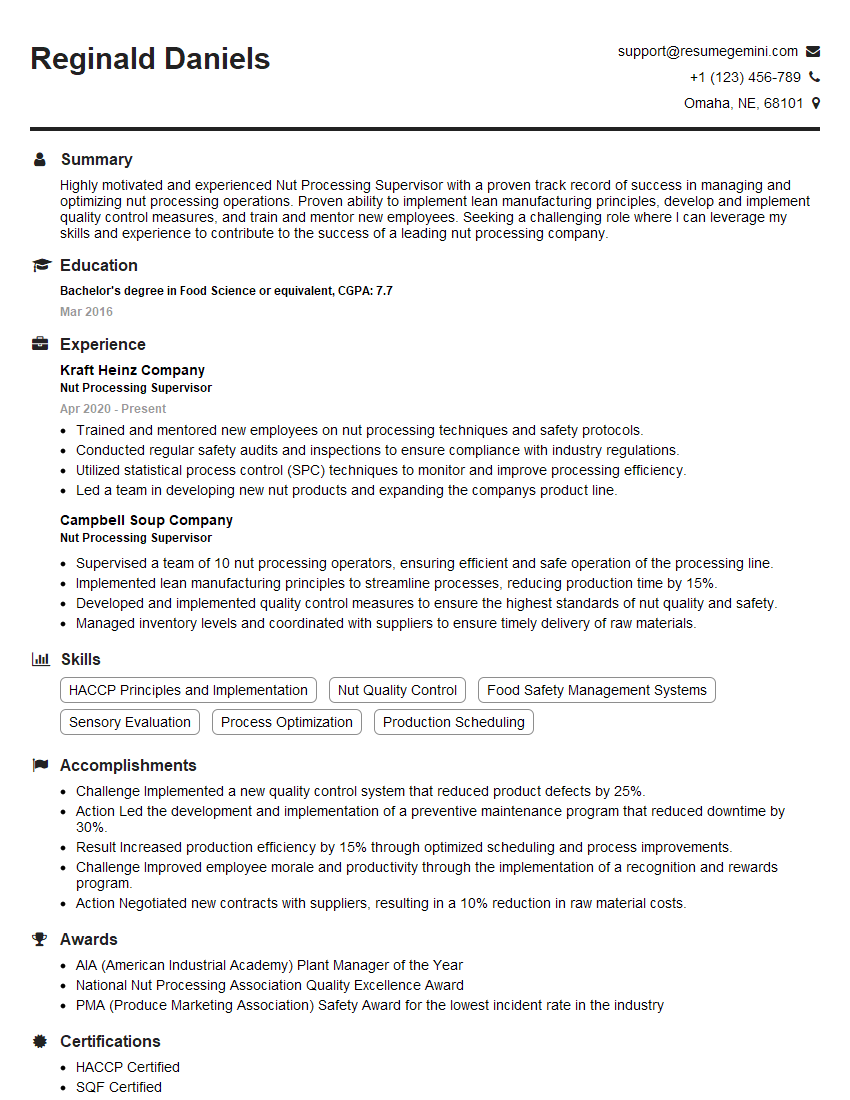
Feeling lost in a sea of interview questions? Landed that dream interview for Nut Processing Supervisor but worried you might not have the answers? You’re not alone! This blog is your guide for interview success. We’ll break down the most common Nut Processing Supervisor interview questions, providing insightful answers and tips to leave a lasting impression. Plus, we’ll delve into the key responsibilities of this exciting role, so you can walk into your interview feeling confident and prepared.
Acing the interview is crucial, but landing one requires a compelling resume that gets you noticed. Crafting a professional document that highlights your skills and experience is the first step toward interview success. ResumeGemini can help you build a standout resume that gets you called in for that dream job.






Essential Interview Questions For Nut Processing Supervisor
1. Describe the key stages involved in nut processing and how each stage impacts the final product.
The key stages involved in nut processing are:
- Harvesting: Nuts are harvested from trees or shrubs, which can be done manually or mechanically.
- Cleaning: Nuts are cleaned to remove debris, dirt, and foreign materials.
- Sorting: Nuts are sorted by size, shape, and quality.
- Drying: Nuts are dried to remove moisture and prevent spoilage.
- Shelling: Nuts are shelled to remove the outer shell.
- Roasting: Nuts are roasted to enhance their flavor and aroma.
- Packaging: Nuts are packaged in various forms, such as bags, jars, or vacuum-sealed containers, to maintain their freshness and quality.
- Storage: Nuts are stored in controlled conditions to preserve their quality and prevent spoilage.
Each stage of nut processing impacts the final product in the following ways:
- Harvesting: The timing and method of harvesting can affect the maturity, quality, and yield of nuts.
- Cleaning: Adequate cleaning removes impurities that can affect the taste, texture, and safety of the final product.
- Sorting: Sorting ensures that only high-quality nuts are processed, which improves the overall quality and value of the final product.
- Drying: Proper drying removes excess moisture, preventing spoilage and preserving the flavor and nutritional value of nuts.
- Shelling: Efficient shelling methods minimize damage to nuts and maximize yield.
- Roasting: Roasting enhances the flavor and aroma of nuts while also reducing moisture content and increasing shelf life.
- Packaging: Proper packaging protects nuts from moisture, oxygen, and other environmental factors that can affect their quality and safety.
- Storage: Controlled storage conditions maintain the quality, flavor, and nutritional value of nuts throughout their shelf life.
2. How do you ensure the quality and safety of nuts throughout the processing line?
Quality Control
- Establish quality standards and specifications for incoming raw materials.
- Implement quality checks at each stage of processing to identify and remove defective or substandard nuts.
- Use statistical process control techniques to monitor and maintain consistent quality.
- Calibrate and maintain processing equipment regularly to ensure accurate measurements and minimize variation.
- Train staff on quality control procedures and best practices.
Safety
- Follow Good Manufacturing Practices (GMPs) and Hazard Analysis and Critical Control Points (HACCP) principles.
- Implement sanitation and hygiene protocols to prevent contamination and ensure the safety of products.
- Regularly inspect and clean processing equipment and facilities.
- Monitor and control critical processing parameters, such as temperature and moisture, to ensure product safety.
- Train staff on food safety regulations and best practices.
3. How do you optimize the yield and efficiency of nut processing operations?
- Analyze and improve harvesting methods to minimize losses and maximize yield.
- Optimize cleaning and sorting processes to remove impurities and substandard nuts efficiently.
- Calibrate and maintain processing equipment to ensure accurate measurements and minimize waste.
- Implement lean manufacturing principles to reduce downtime, waste, and inefficiencies.
- Train staff on best practices for efficient processing and equipment operation.
- Monitor and track key performance indicators (KPIs) to identify areas for improvement.
4. How do you manage and train a team of nut processing operators?
- Provide clear instructions and training on processing procedures and safety protocols.
- Supervise and monitor operators’ performance to ensure adherence to standards.
- Provide regular feedback and coaching to improve skills and knowledge.
- Foster a positive and collaborative work environment.
- Implement a performance management system to track progress and identify training needs.
5. What are the latest trends and innovations in nut processing technology?
- Automated sorting and grading systems using advanced imaging technologies.
- Energy-efficient drying and roasting methods to reduce environmental impact.
- Modified atmosphere packaging (MAP) to extend shelf life and preserve freshness.
- Blockchain technology for traceability and transparency throughout the supply chain.
- Artificial intelligence (AI) and machine learning algorithms to optimize processing parameters and predict maintenance needs.
6. How do you stay up-to-date on the latest industry regulations and best practices?
- Attend industry conferences, workshops, and training programs.
- Read industry publications and research papers.
- Network with other professionals in the field.
- Participate in industry associations and working groups.
7. How do you handle unexpected challenges or equipment breakdowns during nut processing operations?
- Assess the situation and identify the cause of the problem.
- Develop and implement a contingency plan to minimize downtime and maintain product quality.
- Communicate with relevant stakeholders, including production, maintenance, and quality control teams.
- Coordinate repairs and maintenance efficiently.
- Document the incident and implement preventive measures to prevent similar issues in the future.
8. How do you ensure that nuts meet specific customer requirements and specifications?
- Establish clear communication channels with customers to understand their requirements.
- Develop and implement customized processing plans to meet specific specifications.
- Conduct regular quality checks and analysis to verify compliance with customer requirements.
- Provide documentation and traceability to demonstrate that nuts meet specifications.
9. How do you maintain a safe and hazard-free work environment in the nut processing facility?
- Implement and enforce safety protocols and procedures.
- Provide regular safety training and refresher courses to employees.
- Conduct regular safety inspections and audits to identify potential hazards.
- Maintain a clean and organized work environment.
- Empower employees to report any safety concerns or incidents.
10. How do you ensure the traceability of nuts throughout the supply chain?
- Implement a traceability system to track nuts from the source to the end consumer.
- Use barcodes, RFID tags, or other identification methods to track product movement.
- Maintain accurate records and documentation of production, processing, and distribution activities.
- Cooperate with suppliers and customers to ensure traceability across the entire supply chain.
Interviewers often ask about specific skills and experiences. With ResumeGemini‘s customizable templates, you can tailor your resume to showcase the skills most relevant to the position, making a powerful first impression. Also check out Resume Template specially tailored for Nut Processing Supervisor.
Career Expert Tips:
- Ace those interviews! Prepare effectively by reviewing the Top 50 Most Common Interview Questions on ResumeGemini.
- Navigate your job search with confidence! Explore a wide range of Career Tips on ResumeGemini. Learn about common challenges and recommendations to overcome them.
- Craft the perfect resume! Master the Art of Resume Writing with ResumeGemini’s guide. Showcase your unique qualifications and achievements effectively.
- Great Savings With New Year Deals and Discounts! In 2025, boost your job search and build your dream resume with ResumeGemini’s ATS optimized templates.
Researching the company and tailoring your answers is essential. Once you have a clear understanding of the Nut Processing Supervisor‘s requirements, you can use ResumeGemini to adjust your resume to perfectly match the job description.
Key Job Responsibilities
The Nut Processing Supervisor is responsible for overseeing the safe and efficient operation of a nut processing facility, ensuring that products meet quality standards and production targets are achieved. Key responsibilities include:
1. Production Management
Managing all production shift operations and ensuring adherence to quality standards and production schedules
- Scheduling and assigning tasks to team members
- Monitoring production lines and equipment performance
2. Quality Control
Implementing and enforcing quality control procedures
- Inspecting raw materials and finished products
- Maintaining records and reports on quality control
3. Safety Management
Enforcing safety regulations and ensuring compliance with safety protocols
- Conducting safety training and drills
- Maintaining a safe and clean work environment
4. Team Management
Supervising and developing a team of nut processors
- Providing guidance and training to enhance performance
- Evaluating employee performance and providing feedback
Interview Tips
Preparing thoroughly for a Nut Processing Supervisor interview can significantly increase your chances of success. Here are some tips to help you ace the interview:
1. Research the Company
Before the interview, take the time to learn about the company, its values, and its nut processing operations. Understanding the company’s goals and challenges will help you tailor your answers and demonstrate your interest in the role.
- Visit the company website
- Read industry publications
2. Prepare for Common Interview Questions
Practice answering common interview questions related to your experience, skills, and qualifications. Examples of potential interview questions include:
- Tell me about your experience in nut processing.
- How do you ensure quality control in a nut processing facility?
- What safety procedures have you implemented in your previous roles?
3. Highlight Your Skills and Experience
Emphasize your technical skills, such as knowledge of nut processing equipment and quality control techniques. Also, highlight your leadership and management abilities, such as your ability to motivate and train a team.
- Provide specific examples of your accomplishments.
- Quantify your results whenever possible.
4. Ask Informed Questions
Asking thoughtful questions during the interview shows that you are engaged and interested in the role. Prepare questions about the company’s nut processing operations, the team you would be leading, and the opportunities for advancement.
- Don’t ask questions that can be easily answered by researching the company.
- Focus on questions that demonstrate your knowledge of the industry and the role.
Next Step:
Armed with this knowledge, you’re now well-equipped to tackle the Nut Processing Supervisor interview with confidence. Remember, a well-crafted resume is your first impression. Take the time to tailor your resume to highlight your relevant skills and experiences. And don’t forget to practice your answers to common interview questions. With a little preparation, you’ll be on your way to landing your dream job. So what are you waiting for? Start building your resume and start applying! Build an amazing resume with ResumeGemini.